Key Takeaways
- OpenAI says ChatGPT search sends rewritten queries to third-party search providers, and its help pages name Bing as one of them. For Enterprise and Edu workspaces, Bing is the search engine it uses.
- Seer Interactive found that 87%+ of SearchGPT citations matched Bing’s top results for the same query. Ranking in Bing puts your pages in the pool ChatGPT is most likely to cite.
- Bing is not the only input. ChatGPT also runs its own crawler, OAI-SearchBot, and studies suggest it sometimes uses other sources. Treat Bing as the foundation, not the whole strategy.
- The Bing SEO basics that matter most for ChatGPT: get indexed in Bing, use IndexNow, allow OAI-SearchBot, answer questions clearly, keep pages fresh, and earn links and brand mentions.
- Bing Webmaster Tools now has an AI Performance report that shows citations in Microsoft Copilot, Bing AI summaries and select partners, which makes Bing the easiest place to measure AI visibility today.
Short answer: Bing SEO matters for ChatGPT because ChatGPT search uses third-party search providers, including Bing, to find pages before it writes an answer. If your page is not in the Bing index, or ranks poorly in Bing for the question, ChatGPT is less likely to find and cite it. Start with Bing Webmaster Tools, IndexNow and OAI-SearchBot access, then build the content, links and brand mentions that help any page rank.
How Does ChatGPT Search Use Bing?
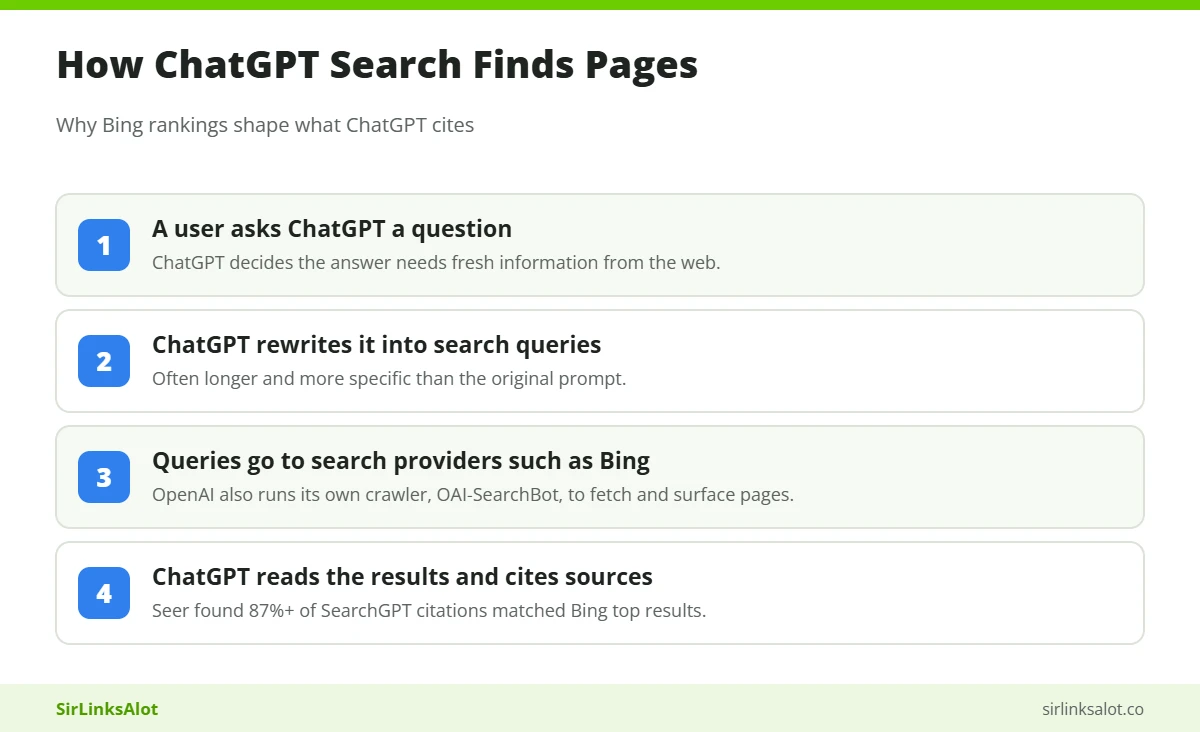
When ChatGPT decides to search the web, it does not read the whole internet in real time. It rewrites your prompt into one or more search queries, sends them to search providers, and reads the pages that come back. OpenAI’s ChatGPT search help page explains that ChatGPT search “sometimes partners with other search providers” and typically rewrites the query into more targeted queries for those providers.
OpenAI is more specific in its Enterprise and Edu documentation, which says ChatGPT search may share disassociated search queries with the Bing search engine to return web results. Microsoft and OpenAI have a long partnership, and earlier versions of ChatGPT browsing ran through Bing.
The practical result shows up in the data. Seer Interactive compared SearchGPT citations with Bing results and found that 87%+ of SearchGPT citations matched Bing’s top results for the same query. That is a strong reason to treat Bing SEO as ChatGPT SEO.
Bing is a major input, not the only one
Be careful with the claim that “ChatGPT just uses Bing.” OpenAI also runs its own crawler, OAI-SearchBot, which it uses to surface websites in ChatGPT search. Semrush has published research arguing that ChatGPT also draws on Google results in some cases. And Ahrefs found that only 12% of AI-cited URLs rank in Google’s top 10 for the original prompt, which shows AI tools retrieve far beyond the first page of Google.
The safe conclusion for your SEO strategy: Bing rankings put you in front of ChatGPT more often than any other single fix, but your content still has to be crawlable by OpenAI, useful to the model, and backed by authority signals that work across search engines.
Why Bing SEO Matters More in the AI Era
For years, many SEO teams ignored Bing because its search share is much smaller than Google’s. AI search changes that math. Bing’s index now feeds several AI experiences at once:
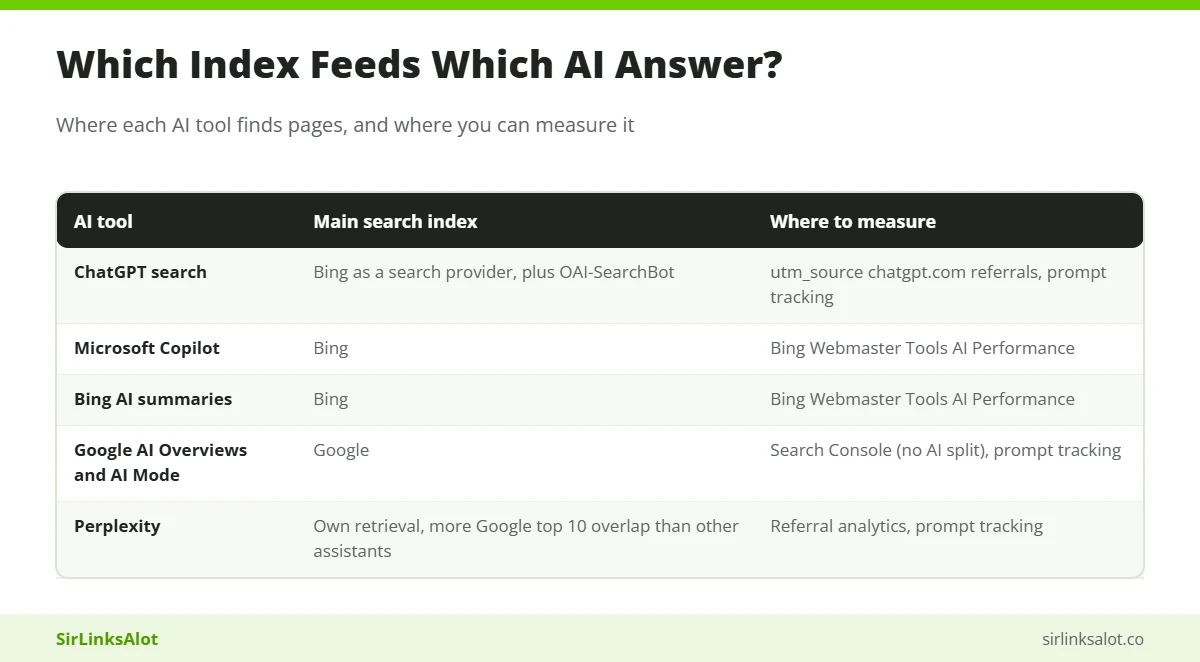
- ChatGPT search, through OpenAI’s use of Bing as a search provider.
- Microsoft Copilot, which grounds answers in Bing results.
- Bing’s own AI-generated summaries in Bing search results.
- Select partner integrations that Microsoft includes in its AI Performance reporting.
So a page that ranks well in Bing can earn visibility in classic Bing search, Microsoft Copilot and ChatGPT at the same time. For digital marketing teams and SEO services providers trying to win AI visibility, Microsoft Bing is the lowest-effort, highest-leverage search engine to fix first. Our guide to SEO for Bing covers the full set of Bing ranking basics.
What People Mean by “SEO Bing GPT”
You will see the phrase “SEO Bing GPT” or “Bing GPT SEO” used for this work. It usually means optimizing for Bing so that GPT-powered tools, mainly ChatGPT and Microsoft Copilot (formerly Bing Chat), can find and cite your pages. There is no separate Bing GPT algorithm to target. SEO Bing GPT work is regular search engine optimization for Bing, plus a few AI-specific steps such as OAI-SearchBot access and AI citation tracking.
How to Optimize for Bing So ChatGPT Can Find You
1. Set up Bing Webmaster Tools
Create a Bing Webmaster Tools account and import your sites from Google Search Console. It takes a few minutes. Submit your XML sitemap, check the Site Explorer report for pages missing from the Bing index, and fix crawl errors. Pages that are not in the Bing index cannot rank in Bing, and are less likely to appear in ChatGPT search.
2. Turn on IndexNow
IndexNow is a protocol that lets you notify Bing and other participating search engines the moment a page is published or updated. Bing’s own announcement of its AI Performance report noted that IndexNow helps AI systems reference the most current version of a page. Many WordPress SEO plugins support it with a single setting, and you can learn more at IndexNow.org.
3. Allow OAI-SearchBot
OpenAI’s publisher FAQ says that for your content to be included in summaries and snippets in ChatGPT, you should not block OAI-SearchBot. Check your robots.txt, firewall and CDN bot settings. Some security tools block AI crawlers by default. OpenAI notes it can take about 24 hours for changes to robots.txt to take effect for search. You can block GPTBot separately if you do not want content used for training.
4. Match the questions people ask
ChatGPT search uses rewritten search queries, which are often longer and more specific than typical keywords. Do keyword research for question-style queries, then answer them directly near the top of the page. Short definitions, clear H2 and H3 questions, and concise answers make your content easy for Bing to rank and for ChatGPT to quote.
5. Keep pages fresh
AI tools lean toward recently updated content. Update key pages with current facts, dates and examples, then ping IndexNow so Bing sees the change quickly. This is especially important for latest news, pricing, product comparisons and anything with a year in the title.
6. Fix on-page basics Bing still rewards
Bing pays close attention to clear titles, descriptive meta descriptions, keyword use in headings, clean HTML and fast pages. Use structured data where it fits, such as Article, FAQPage, Product and Organization schema. These help Bing understand your page and help AI tools extract the answer.
7. Earn backlinks and brand mentions
Links still matter in Bing, and authority helps your pages rank in the results ChatGPT reads. Relevant backlinks, mentions on pages that already rank in Bing, and placements on “best of” lists all help. See do backlinks matter for AI search for the data, and how to get your brand on best of lists for one of the most cited formats.
8. Strengthen social media and entity signals
Bing has historically paid attention to social media signals and entity information. Keep your brand name, description and links consistent across your website, social media profiles, Bing Places and business directories. Consistent entity data helps Bing and the AI tools built on it describe your business correctly.
Bing SEO vs Google SEO for AI Search
Most good SEO works in both search engines. The differences are about emphasis:
- Indexing: Bing supports IndexNow. Google does not. Fast Bing indexing can get updated pages into ChatGPT answers faster.
- On-page signals: Bing tends to reward clear, literal keyword use in titles and headings more than Google does.
- AI surfaces: Google SEO feeds AI Overviews and AI Mode. Bing SEO feeds Microsoft Copilot and much of ChatGPT search.
- Measurement: Bing Webmaster Tools reports AI citations. Google Search Console does not separate AI Overview citations.
The best SEO strategy is to rank Google and Bing together, then use Bing’s AI reporting to see which pages AI tools actually cite.
How Microsoft Bing Fits With Perplexity and Other AI Search Engines
Microsoft Bing is not the only search index behind artificial intelligence answers. Perplexity runs its own retrieval and tends to cite pages that already rank well in Google. Ahrefs found that 28.6% of Perplexity’s cited URLs landed in Google’s top 10, the highest overlap of the assistants it studied. Google AI Overviews and AI Mode pull from Google’s own index. Microsoft Copilot and much of ChatGPT search lean on Bing.
That is why the best approach to SEO and GEO (generative engine optimization) treats each search index as its own channel:
- Does Bing rank you? That shapes ChatGPT search and Microsoft Copilot.
- Does Google rank you? That shapes AI Overviews, AI Mode and much of Perplexity.
- Do third-party pages mention you? That shapes the answer in every tool, because AI models summarize what many sources say about your brand.
For most sites, SEO Google and Bing work overlaps heavily. The extra Bing GPT work is small: Bing Webmaster Tools, IndexNow, Bing index checks and a review of how your content performs in Bing search results.
Using ChatGPT for SEO Research on Bing
ChatGPT is also a useful SEO research tool for this work. Common ChatGPT use cases for Bing SEO include:
- Query mining: ask ChatGPT what follow-up questions people ask about your topic, then check which ones you rank for in Bing. This kind of light data mining surfaces long-tail queries that keyword tools miss.
- Answer checks: ask ChatGPT search your target questions and compare the answer with your page. If the answer leaves out your brand, check which pages it cited and whether they rank in Bing.
- Blog SEO drafts: use ChatGPT to outline FAQ sections and summaries, then edit them with your own expertise and data.
- Data mining exports: paste Bing Webmaster Tools query and AI Performance exports into ChatGPT to group grounding queries by topic and intent.
Treat ChatGPT output as a starting point for SEO ChatGPT research, not as a source of facts. Verify every number and claim before it goes on a page.
How to Measure Bing and ChatGPT Visibility
Bing Webmaster Tools AI Performance
In February 2026, Microsoft launched AI Performance in Bing Webmaster Tools as a public preview. It shows how your content appears across Microsoft Copilot, AI-generated summaries in Bing and select partner integrations, including total citations, cited pages and the grounding queries that triggered them. Microsoft added more views in mid-2026, including intents, topics and citation share. It does not show clicks, and it does not break out ChatGPT separately, but it is the best first-party AI citation data any search engine offers today.
ChatGPT referral traffic
OpenAI says ChatGPT adds utm_source=chatgpt.com to referral URLs, so you can track ChatGPT search traffic in Google Analytics or any analytics content report. Watch which pages get ChatGPT referrals and compare them with your Bing rankings.
Prompt tracking
Run a fixed set of search queries in ChatGPT each month, record which pages it cites, and check whether those pages rank in Bing. Tools that automate this are covered in our guide to tools to track brand mentions in AI.
Common Bing SEO Mistakes That Hurt ChatGPT Visibility
- Never setting up Bing Webmaster Tools. You cannot fix Bing index problems you cannot see.
- Blocking OAI-SearchBot by accident. Security plugins and CDN bot rules often do this without anyone noticing.
- Ignoring Bing rankings. A page can rank well in Google and poorly in Bing. Check both.
- Letting pages go stale. Out-of-date pages lose ground in both Bing and AI answers.
- Relying only on your own site. ChatGPT often cites third-party pages. Brand mentions and backlinks on pages that rank in Bing matter too. Our niche edits for AI visibility guide explains how to get mentioned on pages that already rank.
A Simple Bing SEO for ChatGPT Checklist
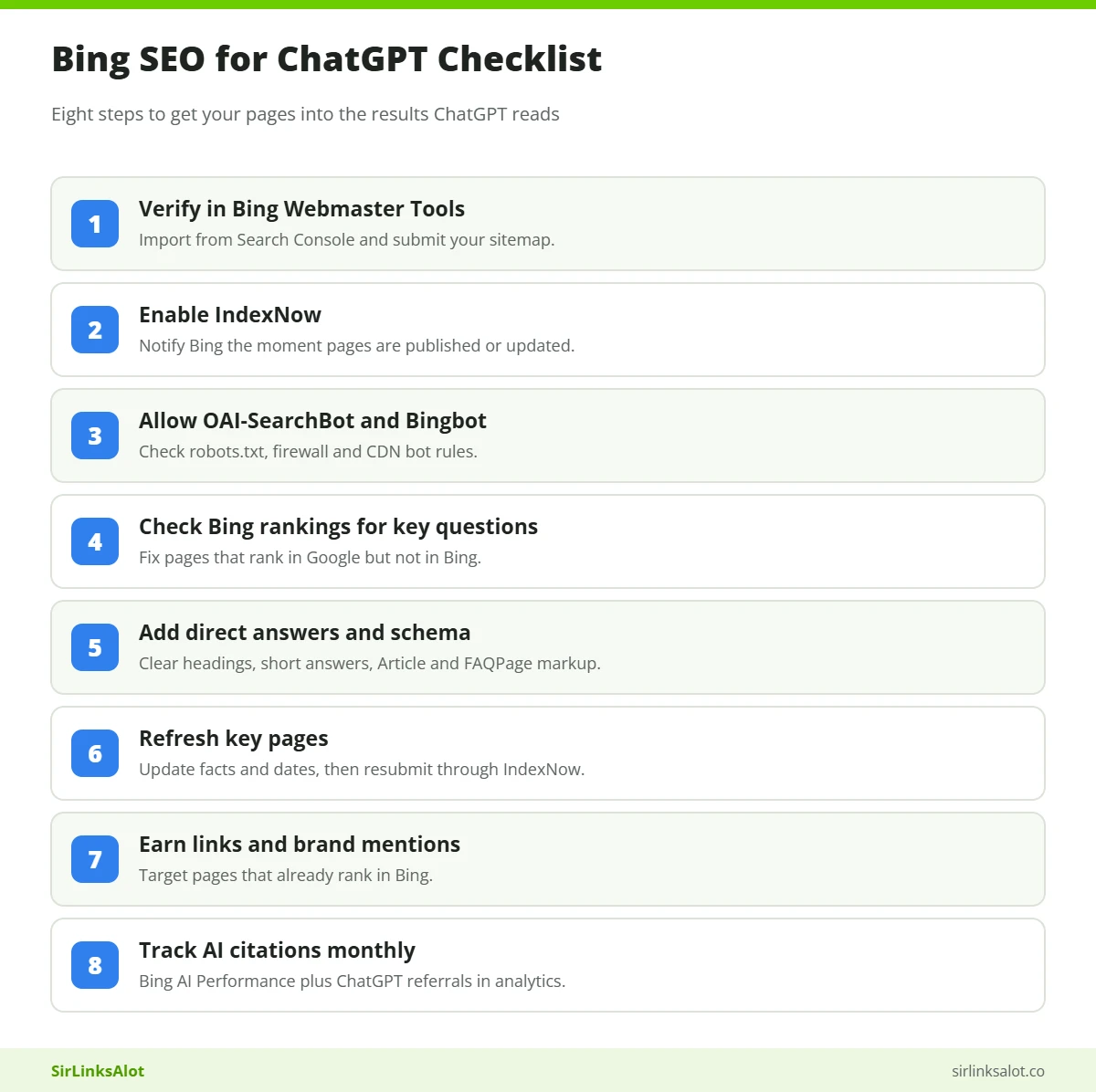
- Verify your site in Bing Webmaster Tools and submit your sitemap.
- Enable IndexNow on your CMS.
- Confirm OAI-SearchBot and Bingbot can crawl your key pages.
- Check Bing rankings for your top 20 questions and fix pages that do not rank.
- Add direct answers, clear headings and schema to those pages.
- Refresh key pages quarterly and resubmit through IndexNow.
- Build backlinks and brand mentions on pages that rank in Bing.
- Track AI Performance in Bing Webmaster Tools and ChatGPT referrals in analytics every month.
Frequently Asked Questions
Does ChatGPT use Bing?
Yes. OpenAI says ChatGPT search uses third-party search providers and names Bing for Enterprise and Edu workspaces. Independent research also shows a strong overlap between ChatGPT citations and Bing’s top results. ChatGPT also uses its own crawler, so Bing is a major input rather than the only one.
Does ranking on Bing help with ChatGPT?
Yes. Pages that rank in Bing’s top results are much more likely to be retrieved and cited by ChatGPT search. Bing rankings are one of the most practical levers for ChatGPT visibility.
Is Bing SEO different from Google SEO?
The fundamentals are the same, but Bing places more weight on clear on-page keywords and supports IndexNow for fast indexing. Optimizing for both search engines is the best approach.
What is SEO Bing GPT?
SEO Bing GPT is a shorthand for optimizing your site for Bing so GPT-powered tools such as ChatGPT and Microsoft Copilot can find and cite it. It is part of a broader digital marketing strategy that covers Google, Bing and AI answers together.
Does Bing still have Bing Chat?
Bing Chat was renamed Microsoft Copilot. Copilot answers are grounded in Bing search, and Bing Webmaster Tools now reports Copilot citations in its AI Performance report.
Should I block GPTBot or OAI-SearchBot?
They are separate. Blocking GPTBot tells OpenAI not to use your content for training. Blocking OAI-SearchBot can keep your pages out of ChatGPT search answers. Most businesses that want ChatGPT visibility should allow OAI-SearchBot.
How long does it take for Bing changes to show in ChatGPT?
With IndexNow, Bing can pick up changes quickly. ChatGPT search reads live results, so improvements in Bing rankings can show up in answers within days or weeks, depending on the query.
Sources and further reading
- ChatGPT search, OpenAI Help Center
- ChatGPT search for Enterprise and Edu, OpenAI Help Center
- Publishers and Developers FAQ, OpenAI Help Center
- Overview of OpenAI Crawlers, OpenAI
- 87% of SearchGPT Citations Match Bing’s Top Results, Seer Interactive
- Introducing AI Performance in Bing Webmaster Tools Public Preview, Bing Webmaster Blog, February 2026
- New AI Visibility Insights in Bing Webmaster Tools, Bing Search Blog, June 2026
- Only 12% of AI Cited URLs Rank in Google’s Top 10 for the Original Prompt, Ahrefs
- ChatGPT Definitely Uses Google, Semrush