Most of our Managed Link Building (MLB) campaigns start with either a brand-new domain or a site that’s been actively building links for years.
This one was neither. The client runs a UK-based e-commerce store in the home furnishings niche – a site that had been live since 2015 and had built up modest organic visibility on its own, but had never invested in structured link building.
We worked with this client across two separate phases: a four-month initial engagement from November 2023 through February 2024, then a fifteen-month pause while the client focused their budget elsewhere, followed by a second phase from May 2025 through December 2025. In January 2026, they redirected their MLB budget to a second website.
What makes this campaign worth documenting is the pattern of growth across that stop-start timeline – and the gap between the metrics that went up and the ones that didn’t.
Starting Point & Initial Audit
We completed the first audit in November 2023.
The site had been around for roughly eight years at that point, with its earliest backlinks dating to 2015. It had a modest organic presence but had never invested in deliberate link building.
Starting Metrics (November 2023)
| Metric | Value |
| Organic Traffic | 713 |
| Organic Keywords | 478 |
| Top-3 Rankings | 16 |
| Domain Rating (DR) | 11 |
| Referring Domains | 17 |
| Indexed Pages | 79 |
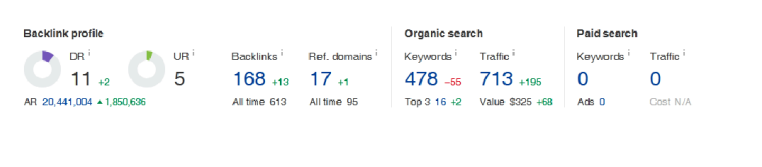
The backlink profile was sparse but clean – no spam, no PBN footprint, nothing that needed disavowing. We found only two higher-quality contextual links among the existing referring domains.
The anchor text profile looked natural, and the homepage carried most of the existing link equity with no inner pages being over-linked relative to the total count.
In short, this was a site with real age and clean history, but almost no off-page foundation to work from.
Our initial assessment was to treat it as near the beginning of its link-building journey: heavy homepage focus, natural anchors, mid-authority links to build volume and trust before pushing harder.
Strategy
As a Managed Link Building client, the strategy was reviewed and adjusted monthly based on how the site’s metrics responded – not locked into a rigid plan set at the start.
The overall approach evolved across the two phases:
- In Phase 1 (November 2023 – February 2024) we focused on building a foundational layer. The site had age and a clean history on its side, but almost no meaningful backlink profile. Our priority was homepage authority using mid-range placements and conservative, natural anchors. We also included pillow links and social signals early on to diversify the profile before any real authority had been established.
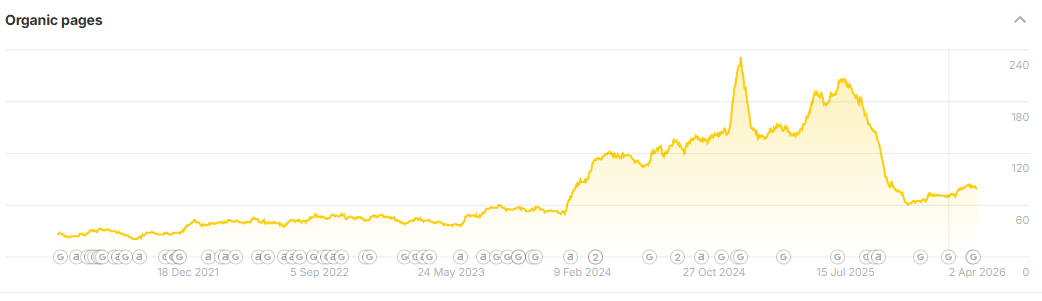
- Phase 2 (May 2025 – December 2025) started from a much stronger position. During the fifteen-month gap, the client had expanded the site’s content significantly – from roughly 79 indexed pages to over 800 – and organic traffic had grown from around 1,000 to 3,200 visits. A combination of the Phase 1 links maturing and the client’s own content investment had shifted the site into a different bracket. Our updated audit at re-entry showed DR had inched up to 13 and referring domains had grown to 52, some of which came organically as the site gained visibility.

With that stronger base, we could afford to be more aggressive in Phase 2: higher-authority placements were introduced earlier, inner-page targeting was expanded to support specific product categories.
We also broadened the anchor mix to include more descriptive and product-level terms alongside the branded foundation.
Throughout both phases, a few principles stayed constant: real contextual links only (guest posts and niche edits), no bursts or aggressive pacing, and a gradual escalation in placement authority rather than leading with the highest-DR links available.
Month-by-Month Breakdown
The tables below cover every month where we built links across both phases. The gap period (March 2024 through April 2025) is excluded since no link building activity occurred.
Phase 1
| Month | Link Types | DR Range | Focus | Notes |
| Nov 2023 | Guest posts, niche edits, social signals | DR 10-50 | Homepage | Initial foundation; natural anchors and early diversity |
| Dec 2023 | Guest posts, niche edits, pillow links | DR 21-50 | Homepage | Continued foundation with pillow links for profile insulation |
| Jan 2024 | Guest posts, niche edits | DR 10-51+ | Homepage | First higher-authority placement introduced |
| Feb 2024 | Guest posts, niche edits, social signals | DR 36-51+ | Homepage + inner page | Authority escalation; first inner-page target |
After February 2024, the client paused the campaign for financial reasons.
No links were built between March 2024 and April 2025. During that time, the client focused on expanding the site’s content – roughly quadrupling the number of indexed pages – while the Phase 1 links continued aging in the background.
When we resumed in May 2025, the site was in a noticeably different position than where we had left it.
Phase 2
| Month | Link Types | DR Range | Focus | Notes |
| May 2025 | Guest posts, niche edits | DR 20-50 | Homepage + inner page | Campaign resumed; mid-authority for re-entry |
| Jun 2025 | Guest posts, niche edits, social signals | DR 36-51+ | Homepage + inner page | Higher-authority push reintroduced |
| Jul 2025 | Guest posts, social signals | DR 20-51+ | Homepage + inner page | Emphasis on high-DR guest posts |
| Aug 2025 | Niche edits | DR 10-51+ | Homepage + inner page | Niche edit-only month; high authority emphasis |
| Sep 2025 | Guest posts, niche edits | DR 20-51+ | Homepage + inner page | Continued authority layering |
| Oct 2025 | Guest posts, niche edits | DR 36-51+ | Homepage + inner page | Steady mid-to-high authority mix |
| Nov 2025 | Guest posts, niche edits, social signals | DR 20-51+ | Homepage + inner page | Diversified link types and targets |
| Dec 2025 | Guest posts, niche edits, social signals | DR 36-51+ | Homepage + inner pages | Final month; strongest authority concentration |
Results
The headline numbers tell a clear growth story, especially given that the campaign included a 15-month break.
Performance Summary
| Metric | Nov 2023 | Jan 2026 | Change |
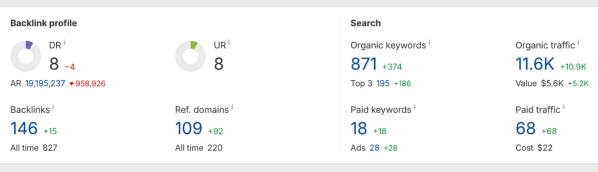
| Organic Traffic | 713 | 11,600 | +10,887 |
| Top-3 Rankings | 16 | 195 | +179 |
| Referring Domains | 17 | 109 | +92 |
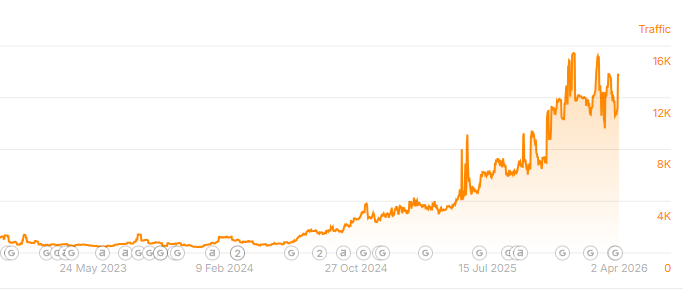
Traffic grew over 15x from the start of the campaign to its conclusion.
The most dramatic acceleration came during Phase 2 – between May 2025 (3,200 traffic at re-entry) and January 2026 (11,600), traffic roughly tripled in eight months of active link building.
Top-3 rankings grew from 16 to 195, indicating that the site wasn’t just picking up fringe positions – it was competing for and winning high-visibility spots in its niche.
Nearly all of this traffic originated from the UK market (99%+ by the final reporting period), which aligns with the site’s target audience.
It’s worth noting that the gap period wasn’t wasted time.
The client’s content expansion – growing from 79 to over 800 indexed pages – gave the Phase 1 links far more content to support when they matured. By the time Phase 2 began, the combination of aged links and expanded content had already moved the site from 713 to 3,200 monthly visits without any active link building during that period.
Metrics Requiring Context
| Metric | Nov 2023 | Jan 2026 | Change | Context |
| Domain Rating (DR) | 11 | 8 | -3 | Ahrefs periodically recalibrates DR scores. The decline likely reflects legacy referring domains (pre-campaign) being deindexed or losing their own authority over time, not a loss of campaign-built links. Meanwhile, traffic and rankings – the metrics that reflect actual search engine trust – continued climbing. |
| Organic Keywords (Ahrefs) | 478 | 871 | +393 | This number peaked at 2,300 in mid-2025 before a Google change to SERP reporting limited Ahrefs’ ability to track rankings beyond position 10. The apparent decline is a reporting artifact, not a real loss of visibility. Traffic gains during the same period confirm this. |
Challenges
No campaign runs without friction. Several factors introduced noise into this campaign’s metrics at various points.
- SERP composition changes. Around August-September 2025, the site lost several first-position rankings – not to competitors, but to Google’s own ads and shopping results being promoted above organic listings. We flagged this in our September 2025 report. Organic authority doesn’t protect against Google reallocating SERP real estate, and traffic dipped briefly as a result before recovering by late 2025.
- Ahrefs reporting disruption. In late 2025, Google changed a parameter that limited search engine results reporting to the top 10 results per keyword. This meant Ahrefs could no longer consistently track rankings or estimate traffic for keywords ranking below position 10. The result was a sharp apparent drop in tracked keywords (from 2,300 to around 870) that didn’t correspond to any real loss of rankings or traffic. We see this kind of tool-level disruption from time to time – it affects all sites tracked in Ahrefs, not just this one.
- The fifteen-month gap. Any pause in active link acquisition means the site isn’t adding new authority signals to stay ahead of competitors who are. In this case, the client’s parallel investment in content helped offset that risk, but the gap did mean that in Phase 2 we were partially re-establishing momentum rather than building continuously from where Phase 1 left off.
Anchor Text & Target Page Approach
The anchor strategy we used prioritized brand safety and naturalness, appropriate for a site with real commercial intent and an existing brand identity.
The largest share of anchors used brand name variations, direct URL formats, and branded-product combinations – the kind of links a real business accumulates naturally through mentions, directories, and editorial references. A smaller but meaningful portion used product-level and descriptive terms, which we introduced primarily during Phase 2 once the branded foundation was solid. The remainder consisted of generic, non-descriptive references that added diversity without signaling any particular intent.
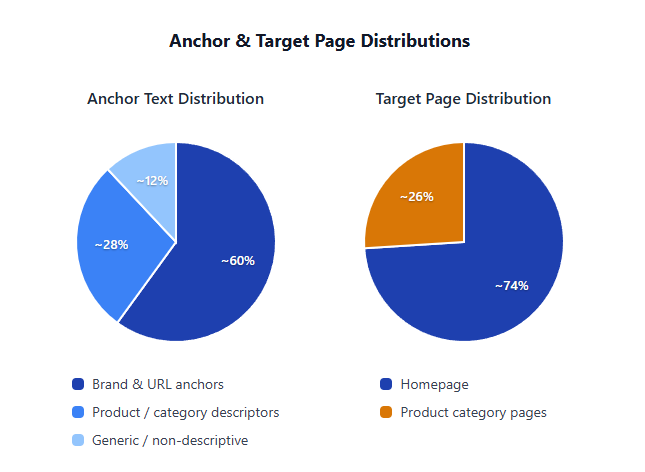
We weighted target page selection heavily toward the homepage throughout Phase 1 and the early months of Phase 2. As the site’s domain-level authority grew, we added inner-page links to support specific product category pages – never individual product listings, but the category hubs that serve as the main ranking targets for commercial keywords.
This distribution kept the domain’s overall authority concentrated at the top level while selectively feeding authority to the pages most likely to drive revenue through organic search.
Analysis & Takeaways
This campaign produced strong results, but the more interesting story lies in the pattern by which those results emerged.
The Phase 1 links, built on a modest budget over just four months, didn’t produce dramatic visible gains at the time. Traffic moved from roughly 700 to 1,000 visits – respectable, but not headline-worthy. What those links actually did was establish a foundation that continued maturing over the following year. When the client paired that with a significant content expansion during the gap, the two investments compounded. By the time Phase 2 began, the site had already grown to 3,200 visits, with no new links built.
Phase 2 then added fresh authority on top of that established base, and traffic accelerated sharply – from 3,200 to 11,600 in eight months. The velocity of growth in Phase 2 was significantly higher than Phase 1, which is consistent with what we typically see: early links build trust slowly, and later links benefit from the credibility those earlier ones established.
The DR decline is worth addressing directly because it contradicts the narrative that every other metric supports. In our experience, Ahrefs’ DR calculation is sensitive to changes in the broader link graph – when referring domains in a site’s historical profile lose their own authority or get deindexed, DR can drop even as the site’s actual search performance improves. We’ve seen this pattern across multiple campaigns. The traffic and ranking data tell a more accurate story of this site’s authority trajectory.
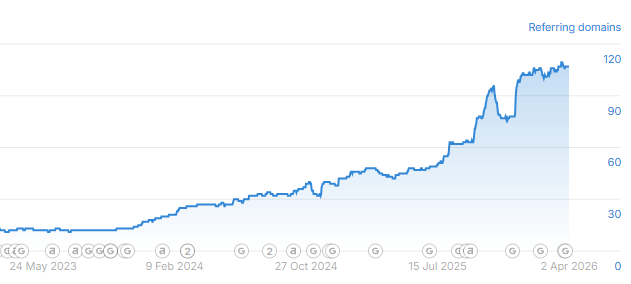
A few observations from this campaign that we think are worth highlighting:
Content and links are multipliers, not substitutes. The client’s content expansion during the gap gave Phase 1 links more pages to benefit. Neither investment would have produced the same result alone – 800 pages without backlinks would have ranked poorly, and 17 backlinks without content depth would have had limited ranking surface.
Pausing doesn’t erase past work. The fifteen-month break didn’t undo what we built. Links age and mature in the background, and when active building resumed, the site responded faster than it had during Phase 1. That said, the gap did mean competitors had time to build their own authority, so in Phase 2 we were partly catching up as well as pushing forward.
Surface metrics and real performance can diverge. DR dropped, Ahrefs keyword counts fell due to reporting changes, and Google’s SERP changes briefly displaced some top rankings. At the same time, actual traffic grew over 15x. In our view, campaign evaluation needs to weight outcome metrics (traffic, conversions, revenue) over tool-reported scores that are subject to third-party methodology changes.
Conclusion
Over roughly twelve active months of Managed Link Building spread across two phases, this site went from 713 monthly organic visits to over 11,600 – with the strongest growth coming during the second phase when we layered fresh authority onto an aged foundation.
For an e-commerce retailer, that kind of traffic growth translates directly to revenue opportunity. Every additional visitor landing on a product category page through organic search is someone actively looking to buy – not a cold audience that needs convincing. Moving from 16 to 195 top-3 rankings means the site now occupies prime real estate for dozens of commercial search terms it was previously invisible for.
The client was happy enough with the results that in January 2026 they asked us to apply the same approach to their second website, redirecting their MLB budget accordingly. That site is already showing strong early progress after just a few months of link building, and we may publish a separate case study covering it. The links we built during this engagement remain in place and will continue to contribute to the site’s authority profile going forward.