Key Takeaways
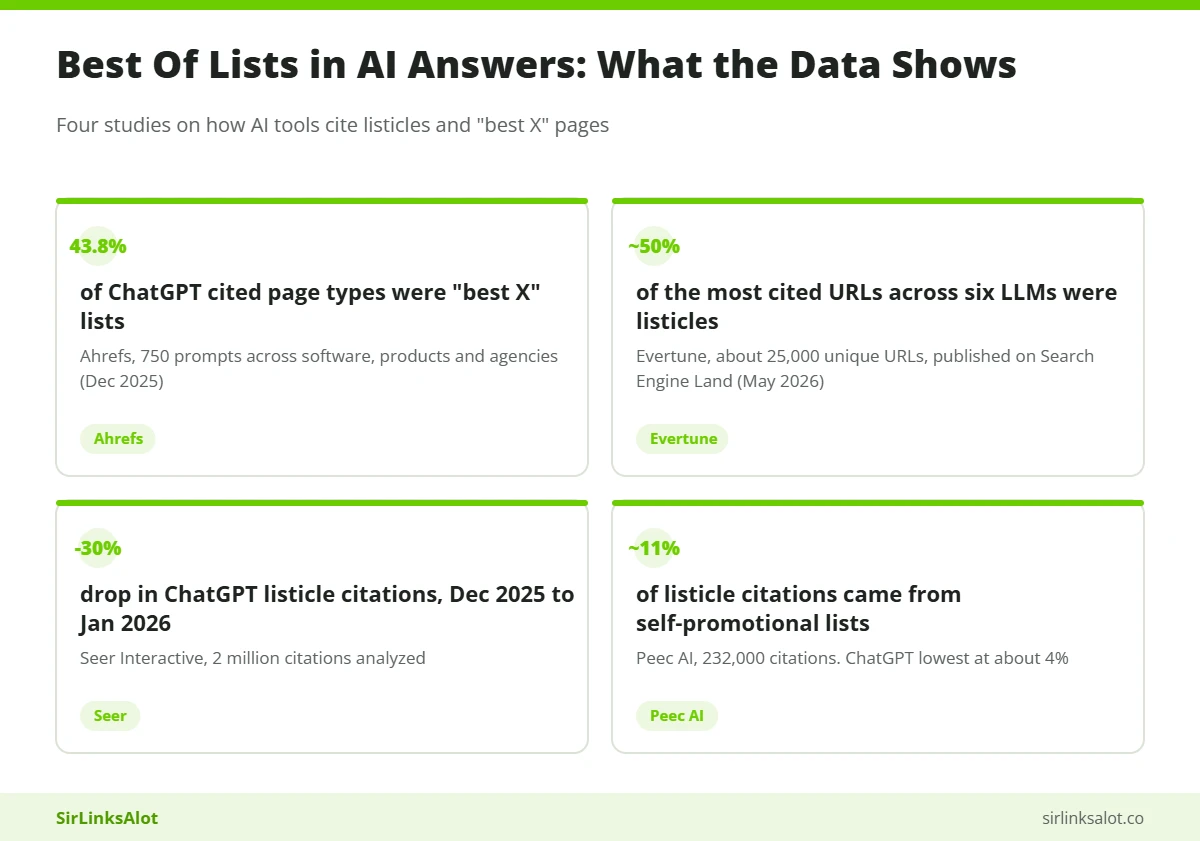
- “Best of” lists are one of the most cited page types in AI answers. In an Ahrefs study of 750 ChatGPT prompts, “best X” blog lists made up 43.8% of all cited page types.
- The lists that keep getting cited are fresh, comprehensive, show a methodology, and come from third parties. Self-published lists that rank the author first are losing citations.
- To get your brand on best of lists, find the lists AI tools already cite for your category, then earn inclusion through outreach, reviews, data, product access, PR and paid placements where the publisher discloses them.
- Give list editors an entry they can paste: a one-line positioning statement, who you are best for, pricing, proof and a current screenshot.
- Track results by prompt: which lists you are on, which lists AI cites, and how often your brand is named in the answer.
Short answer: to get your brand on best of lists, start with the lists that already shape your category. Ask ChatGPT, Perplexity and Google the same questions your buyers ask, note every “best of” page they cite, then contact the publishers of those pages with a clear, easy-to-use entry and a reason to include you. Third-party inclusion beats publishing your own list, because AI tools increasingly discount pages where a brand ranks itself first.
Why Best Of Lists Matter for AI Search
When someone asks an AI tool “what is the best CRM for a small business” or “best SEO agencies in New York,” the model needs a shortlist fast. A best list is that shortlist, already written, already structured and usually already ranked. That makes best lists ideal raw material for generated answers.
The data backs this up. In Ahrefs’ study of 26,283 ChatGPT source URLs, Glen Allsopp found that recently updated “best X” lists were the most prominent page type in ChatGPT sources across software, product and agency prompts, at 43.8% of cited page types. Evertune’s research, published on Search Engine Land, reviewed about 25,000 of the most cited URLs across six LLMs and found that half of them were listicles.
For your brand strategy, this means best lists are no longer just a referral traffic play. They are one of the main places AI tools look when deciding which brands to recommend to potential customers. If your brand is missing from the lists that matter, it is often missing from the answer too.
Lists matter for traditional search too
Best of lists also rank in Google for high-intent “best” keywords, send referral traffic, and usually include a backlink. A single placement on the right list can build brand awareness, referral traffic, link equity and AI visibility at once. That is why list placements have become a core part of modern link building and digital marketing plans.
Which Best Of Lists Does AI Actually Cite?
Not every list is worth chasing. The citation data has shifted over the past year, and the lists that keep earning citations share a few traits.
Seer Interactive tracked 2 million ChatGPT citations and found that listicle citations fell about 30% from December 2025 to January 2026, with 13 of 16 industries declining. Self-serving listicles were hit hardest. But the listicles that grew through that drop followed a consistent pattern: recency, comprehensiveness, external validation and clear structure.
Peec AI’s analysis of 232,000 citations found that roughly 11% of listicle citations came from self-promotional lists where a company ranks its own product, and that ChatGPT showed the lowest self-promotion rate at about 4%.
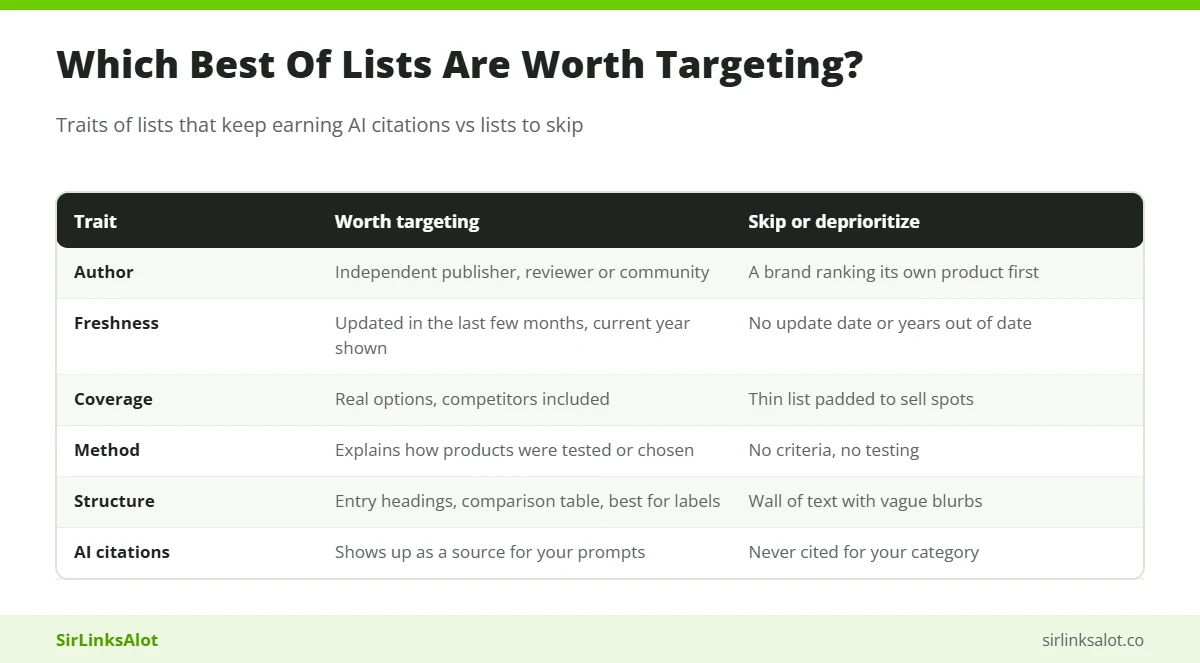
So the best list to target looks like this:
- Third-party: written by a publisher, reviewer or community, not by one of the brands on the list.
- Fresh: updated within the last few months, with the current year on the page.
- Comprehensive: covers the real options in the category, including competitors.
- Transparent: explains how products were tested or chosen.
- Structured: uses headings per entry, comparison tables and short “best for” labels.
- Already cited: shows up as a source when you run your target prompts.
Best Of Lists as Part of Your Brand Strategy
Getting on best lists works best when it sits inside a wider brand strategy rather than running as a one-off campaign. Before you pitch anyone, decide three things for your business: which audience you want to win, which category you want to own, and what you want AI tools to say about your brand in one sentence.
- Pick the category you can win. “Best project management tool” is crowded. “Best project management tool for construction teams” is a list your business can actually top.
- Match lists to your target audience. A list read by enterprise buyers does little for a small business brand selling to freelancers, and the reverse is also true.
- Keep your positioning consistent. Use the same “best for” line on your website, review profiles, social media bios and every list pitch. Consistency helps AI tools describe your business the same way across sources.
- Tie it to business growth goals. Decide whether each list is for AI visibility, referral traffic, backlinks or sales credibility, and measure it against that goal.
A brand strategy built this way turns best lists from random wins into a pattern. Each new list placement reinforces the same message, which is exactly the kind of repeated, consistent brand mention AI tools learn from.
Types of Best Of Lists Worth Targeting
- Editorial roundups: “best X” articles on publisher and industry blogs. These are the most cited format in the Ahrefs data.
- Review platforms: G2, Capterra, Trustpilot and niche review sites, where rankings come from customer reviews.
- Industry awards: annual “best of” awards from trade publications and associations.
- Local best of lists: city guides, local newspaper awards and Google Business profile driven roundups for local businesses.
- Comparison and alternatives pages: “X vs Y” and “best alternatives to X” pages, which often pull in a shortlist of brands.
- Community lists: Reddit threads, forum recommendation posts and curated resource lists on GitHub or Notion.
- Video roundups: YouTube “best X” videos and their descriptions, which AI tools increasingly read.
Marketplace and bestseller lists
If you sell physical products, marketplace rankings act as best lists too. Amazon Best Sellers pages, category rankings and “top rated” badges are driven by sales and reviews rather than editors, so the path in is different: strong product listings, steady reviews and promotions around peak periods such as Black Friday. These rankings are separate by marketplace, so a product can rank in the U.S. store and be invisible in Australia or other regions. Editorial writers often use these marketplace rankings to build their own best lists, so marketplace momentum can lead to editorial inclusion.
How to Find the Best Lists That Shape Your Category
Good list building starts with a target list of the right pages, not a spreadsheet of every listicle on the internet.
- Write your prompt set. List 20 to 50 questions your target audience asks when choosing a product like yours: “best X for small business,” “best X under $50,” “X alternatives,” “best X in [city].”
- Run the prompts in ChatGPT, Perplexity, Gemini and Google AI Mode. Record every cited URL and which brands each answer names.
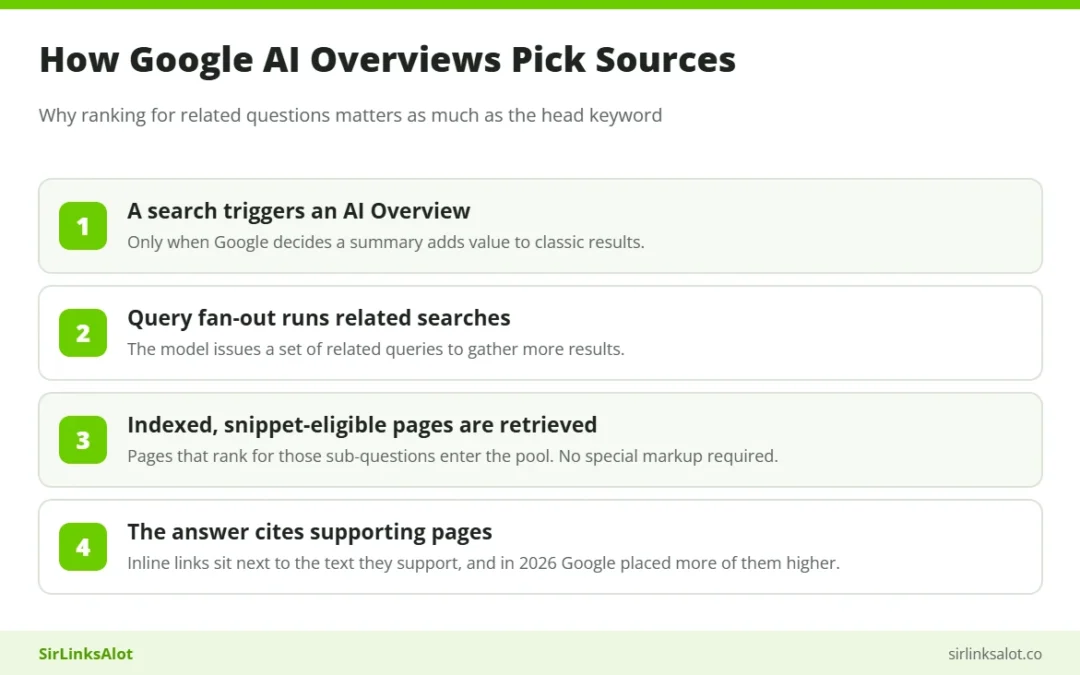
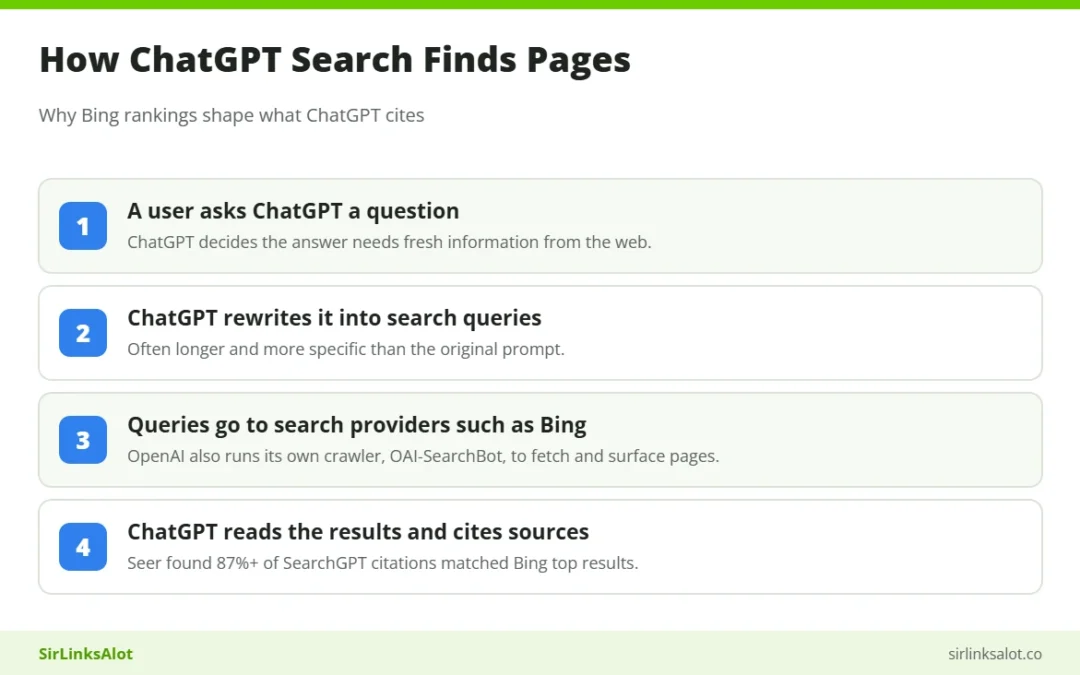
- Search Google and Bing for the same “best” keywords. Note the top 20 list pages. ChatGPT search leans on Bing, so Bing results matter.
- Use an AI visibility tool to pull cited pages at scale. Our roundup of tools to track brand mentions in AI covers the options.
- Check where competitors appear. Run your competitors’ brand names through a backlink tool and look for referring pages with “best” or “top” in the title.
- Score each list. Rate it on AI citations, Google ranking, freshness, traffic, whether competitors are on it, and whether the publisher accepts updates.
The result is a short, prioritized list of pages where inclusion would change what AI tools say about your category. Make sure each page is still live and still updated before you spend time on outreach.
How to Get Your Brand on Best Of Lists
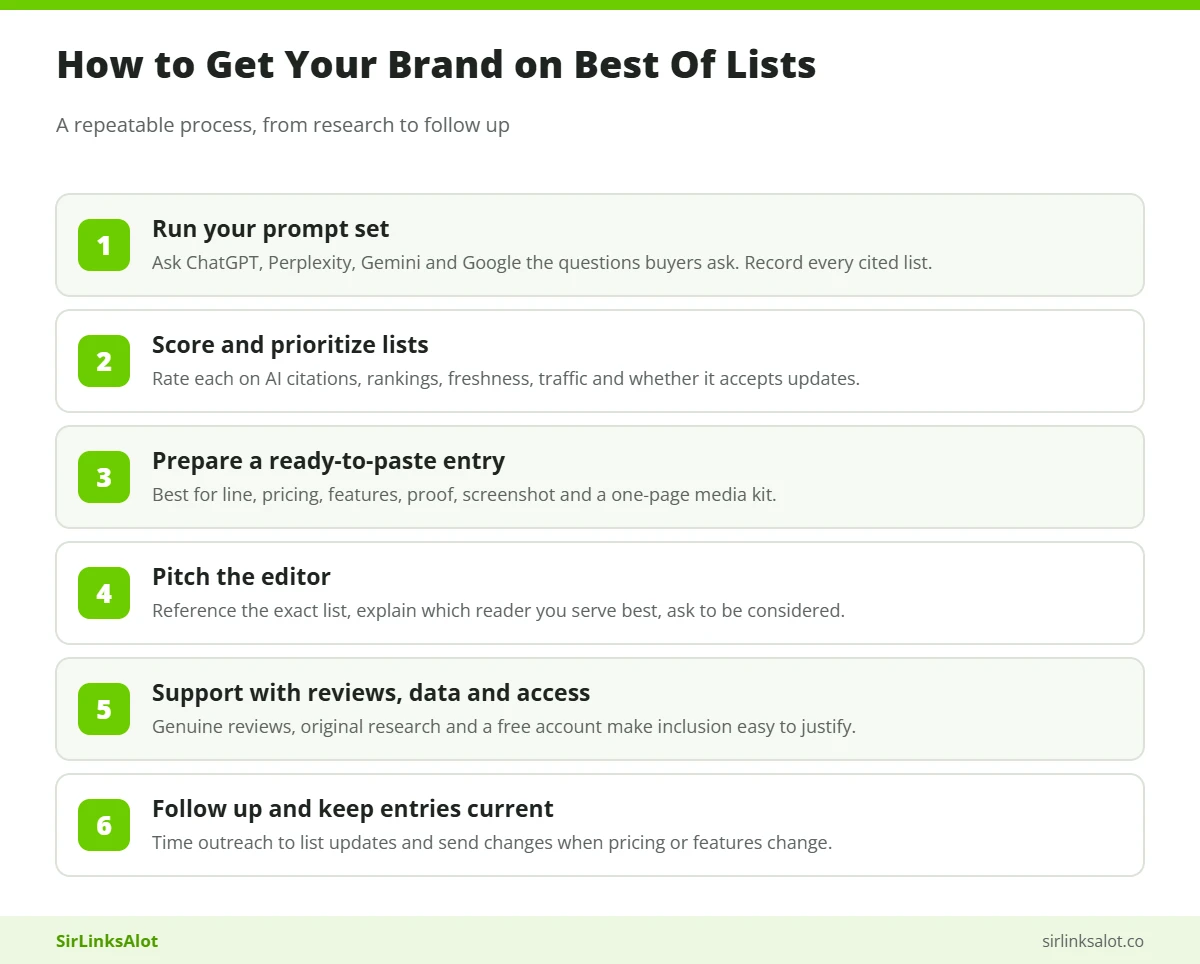
1. Make the editor’s job easy
List editors update dozens of entries at a time. The brands that get added are the ones that hand over a complete, accurate entry. Prepare a short media kit (a one-page PDF works well) with a one-line description, who your product is best for, pricing, three standout features, proof such as customer numbers or case studies, a current screenshot or product photo, and a contact for questions.
2. Send a short, specific pitch
Reference the exact list, explain which reader your brand serves better than the current entries, and include the ready-to-use entry. Do not ask for the number one spot. Ask to be considered at the next update. Personal, specific pitches beat templates every time.
3. Offer product access or a demo
Reviewers who test products need access. Offer a free account, a sample, or a walkthrough call. Lists that show real testing are the ones that keep their AI citations, so helping the reviewer test you helps the list and your brand.
4. Build reviews on the platforms list writers check
Many editors shortlist brands from review platforms. A steady flow of genuine customer reviews on G2, Capterra, Trustpilot or your Google Business profile makes you easier to include and easier to defend. Ask happy customers at natural moments, such as after onboarding or a successful project.
5. Publish original data and case studies
Editors love a stat they can cite. Original research, benchmarks and detailed case studies give writers a reason to mention your brand and something unique to say about it. This is also the core of good digital PR, which earns coverage beyond a single list.
6. Enter awards and nominations
Industry and local awards publish winner lists that get cited and linked. Many are free to enter. Ask your customers to nominate you where the format allows it, and make the nomination link easy to find on your website and social media.
7. Get mentioned in the communities AI reads
Reddit threads, forums and YouTube reviews often feed both AI answers and the writers of best lists. Participate honestly, answer questions and let customers share their experience. Never fake reviews or plant posts.
8. Use disclosed paid and sponsored placements carefully
Some publishers offer paid inclusion or sponsored list placements. These can work when the site is relevant, the placement is disclosed, and the list stays genuinely useful to readers. Avoid lists that exist only to sell spots, because AI tools and Google are both getting better at ignoring them. Our listicle placement service explains how we vet list pages before any placement.
9. Ask for inclusion when an existing list gets updated
Many best lists are updated on a schedule. Note the “last updated” date of each target page and reach out a few weeks before the next likely refresh. Adding your brand to a page that already ranks and gets cited is similar in spirit to a niche edit: you are improving an existing resource rather than creating a new one.
10. Follow up and keep your entry accurate
Once you are on the list, send updates when pricing, features or positioning change. Outdated entries get removed. A quick note every few months keeps your entry current and keeps the relationship warm for the next update.
What Your List Entry Should Include
AI tools often quote or paraphrase the entry text from a list. Write the entry you want a model to repeat.
- A clear “best for” line: “Best for small business teams that need simple pipeline tracking.”
- Your brand name spelled consistently with your website, social media profiles and Google Business profile.
- Specific facts: pricing, plan names, integrations and the year of the information.
- Pros and cons: honest drawbacks make the entry believable and help the right buyers self-select.
- A link to the most relevant page, usually a product page or pricing page rather than your homepage.
Should You Publish Your Own Best Of List?
Many brands publish their own “best X” list and rank themselves first. For a while, it worked. The Ahrefs research found ChatGPT did cite some self-promotional lists, including ones where the author’s brand took first place. But Seer’s data shows those self-serving pages are losing citations fastest, and Seer’s own team wrote about choosing not to rank itself in listicles and later seeing its AI visibility recover once the format lost ground.
Our view: if you publish a list on your own site, make it genuinely useful, include real competitors, explain the methodology and disclose your relationship. But do not treat it as a substitute for third-party lists. A brand that only appears on its own list sends a weak signal. A brand that appears across many independent lists sends a strong one.
How to Make the Most of a Best Of Placement
- Share it. Post the placement on social media, in your email marketing and in sales decks. Social proof helps convert new customers.
- Add it to your site. An “as featured in” section on your homepage or product page builds trust.
- Link to it. A link from your site or press page can help the list page itself rank and stay visible.
- Turn it into a relationship. The editor who included you is a contact for future guest posts, quotes and updates.
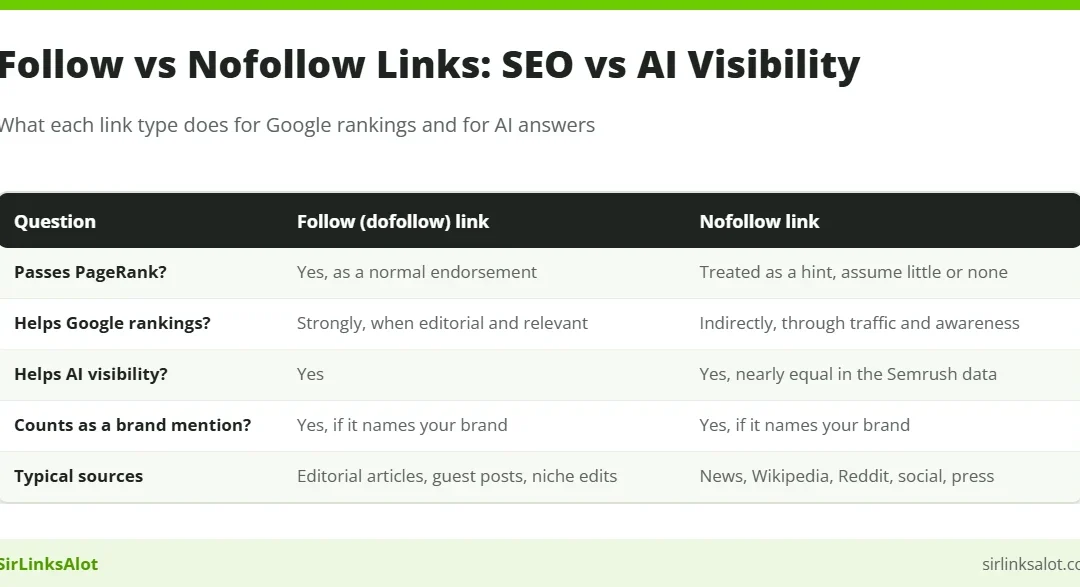
- Check the link. Confirm the backlink is live and points to the right page. Many lists use affiliate or nofollow links, which still build brand mentions even when they pass less link equity. See our breakdown of backlinks vs brand mentions for why both count.
Turn Best List Traffic Into an Email List
A list placement sends visitors who are actively comparing options. Many will not buy on the first visit, so the smartest brands make it easy for them to stay in touch. Turning that traffic into an email list extends the value of every placement long after the list is published.
- Send list traffic to a dedicated page. Ask the editor to link to a product page or landing page built for comparison shoppers, not your homepage.
- Offer something useful for an email address. A buyer’s checklist, a short comparison PDF, a free trial or a short video series gives people a reason to sign up.
- Keep the form simple. People sign up when it takes one field and a few seconds. Make it easy and place it where comparison shoppers will see it.
- Follow up with a short welcome sequence. Your first marketing email should explain who your product is best for, repeat the proof the list mentioned, and answer the questions buyers ask when comparing.
- Segment your mailing list by source. Tag subscribers who came from best lists so your email marketing can speak to people who are still comparing options.
Email list growth from list traffic is easy to overlook, but it turns a one-time referral into a channel your business owns. It also shows which lists send buyers rather than browsers, which helps you prioritize future marketing efforts.
How to Measure Results
Track best of lists like any other marketing strategy, with a few numbers you check monthly:
- Lists won: number of target lists that include your brand, and your position on each.
- AI mentions: how often AI tools name your brand across your prompt set.
- Cited lists: which of your lists are cited as sources in those answers.
- Referral traffic and conversions from list pages in your analytics.
- Branded search volume in Google Search Console, which tends to rise as brand mentions spread.
If you are on many lists but AI tools still skip your brand, check whether those lists are the ones being cited. Inclusion on an uncited list is a nice backlink, but it will not move AI answers on its own. For the bigger picture on how links feed AI answers, see do backlinks matter for AI search.
Mistakes to Avoid
- Pitching every listicle you find. Focus on lists that rank, get cited and fit your target audience.
- Asking for the top spot. Editors protect their credibility. Ask to be considered.
- Sending generic copy. Tailor the entry to the list’s reader.
- Buying placements on spam lists. Pages built only to sell spots can hurt more than they help.
- Letting entries go stale. Old pricing and features get your brand removed at the next update.
- Relying on your own list. Self-ranked lists are losing ground in AI citations.
Frequently Asked Questions
How long does it take to get on a best of list?
It depends on the publisher’s update cycle. Some lists are updated monthly, others once a year. Expect weeks to months from first pitch to inclusion, and plan your outreach around each list’s update schedule.
Do I need to pay to get on best of lists?
Many editorial lists are free and based on merit, reviews and testing. Some publishers charge for sponsored or affiliate placements. If you pay, make sure the placement is disclosed and the list is genuinely useful to readers.
Do best of lists help a small business?
Yes. Local best of lists, review platforms and niche roundups are often easier for a small business to win than national lists, and they influence both local search and AI answers about local options.
Which AI tools rely most on best lists?
The Ahrefs study found best lists were highly prominent across popular AI platforms, with ChatGPT the main focus of the research. Evertune’s data found listicles heavily cited across ChatGPT, Copilot, Gemini, Google AI Mode, AI Overviews and Perplexity.
Is it better to be first on a list?
Position helps, but inclusion matters more. AI tools often pull several brands from the same list. Being on more of the right lists usually beats chasing the top spot on one.
What if I need help getting on best lists?
If your team needs help, start with the research steps above, which you can do in house. Outreach and placements are where many businesses bring in a partner, because relationships with list editors take time to build. Whoever does it, make sure the lists are relevant, the placements are disclosed where required, and results are tracked by prompt.
Can I get my brand on a list that is already published?
Yes. Contact the author or editor, explain why your brand fits the list’s reader, and provide a complete entry. Many publishers welcome accurate updates, especially before a scheduled refresh.
Sources and further reading
- Do Self-Promotional “Best” Lists Boost ChatGPT Visibility? Study of 26,283 Source URLs, Ahrefs, December 4, 2025
- AI search loves listicles: What 25,000 URLs reveal about citations, Evertune on Search Engine Land, May 2026
- The Listicle Window Is Closing in AI Search: 30% Decline MoM, Seer Interactive
- 2025: ChatGPT named 21 competitors and us 0 times. 2026: them 0, us 65%, Seer Interactive
- Self-promotional listicles analysis: Data from 232,000 citations, Peec AI, March 3, 2026