Key Takeaways
- Yes, nofollow links can help AI visibility. In a Semrush and Kevin Indig study of 1,000 domains, nofollow links correlated with AI visibility almost exactly as strongly as follow links.
- The reason is simple: AI tools read text. A nofollow link still puts your brand name and context on a page that ChatGPT, Perplexity or Google AI Overviews may retrieve.
- Platforms differ. ChatGPT and Gemini slightly favored nofollow links in the Semrush data, while Google AI Overviews and Perplexity leaned toward follow links.
- For Google rankings, follow links still pass more value. Google has treated nofollow as a hint since 2019, so nofollow links may be considered, but they are not a substitute for editorial follow links.
- The best approach for AI search is a balanced link profile: editorial follow links for rankings, plus nofollow links and unlinked mentions on the high-trust sites AI tools cite.
Short answer: nofollow links help AI visibility because AI tools care about where your brand is mentioned, not only whether a link passes link equity. A nofollow link on a trusted, relevant page, such as a news article, a Wikipedia reference, a Reddit thread or a review site, gives AI models a brand mention to read. Follow links still matter more for ranking in Google, so the strongest plan uses both.
What Is a Nofollow Link?
A nofollow link is a hyperlink with the rel=”nofollow” attribute in its HTML. It tells search engines that the site does not want to vouch for the linked page or pass ranking credit to it. A follow link, often called a dofollow link, has no such attribute, so search engines can treat it as a normal endorsement.
In HTML, the difference is one attribute:
- Follow link: <a href=”https://example.com/”>Example</a>
- Nofollow link: <a href=”https://example.com/” rel=”nofollow”>Example</a>
The three link attributes in 2026
In 2019, Google introduced two new link attributes alongside nofollow:
- rel=”sponsored” for links that are part of ads, sponsorships or other paid agreements, including affiliate program links.
- rel=”ugc” for links in user generated content, such as comments and forum posts.
- rel=”nofollow” for any other link the site does not want to endorse.
Google also changed how it treats all three. Instead of ignoring nofollow links completely, Google now uses the attributes as hints about which links to consider. That means a nofollow link may still be counted in some cases, though Google does not say when.
A short history of nofollow
Google, Yahoo and Microsoft introduced the nofollow attribute in 2005 to fight comment spam. Blog owners could add it to links in comments so spammers gained nothing from posting them. Over time, nofollow spread to sponsored links, social media profiles, forums and many news sites. In 2019, Google added sponsored and ugc and moved all three to a hint model. In the AI era, the attribute matters less than ever for brand visibility, because AI models read the page rather than the link graph.
Do Nofollow Links Help SEO?
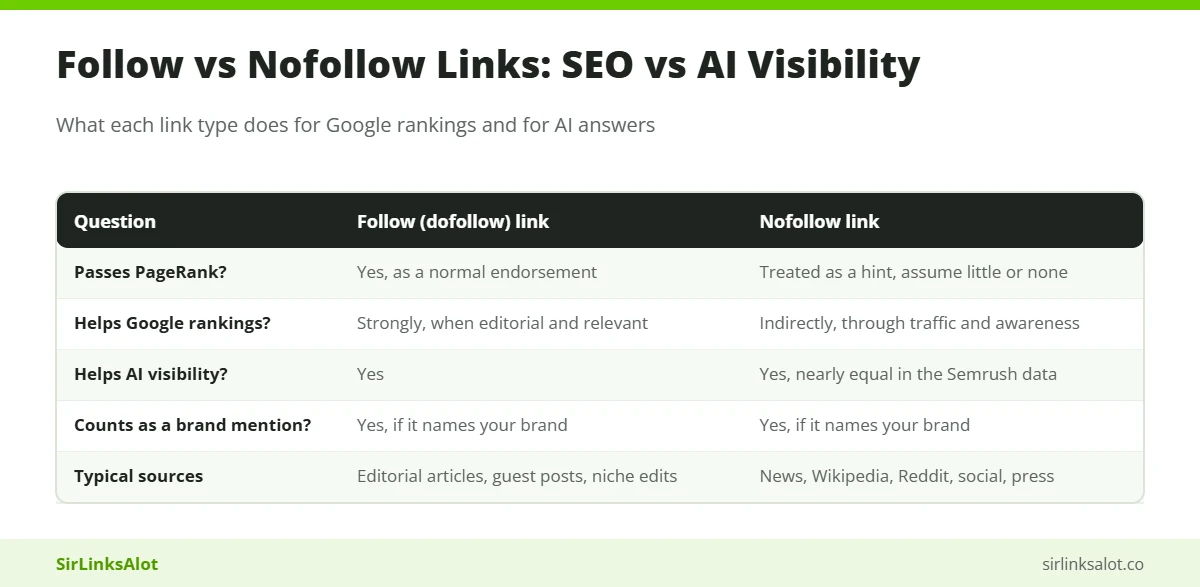
For traditional SEO, follow links are still the main way links pass PageRank and authority. Nofollow links pass less ranking value, and Google does not promise to count them at all. But nofollow links help SEO in indirect ways that matter:
- Referral traffic: a nofollow link on a popular page can send real visitors.
- Discovery: search engines can still find and crawl pages through nofollow links in many cases.
- A natural link profile: real websites earn a mix of follow and nofollow links. A backlink profile with only follow links can look unnatural.
- Brand awareness: mentions on news sites, social media and communities lead to branded searches and future editorial follow links.
Many of the most trusted sites on the web, including Wikipedia, Reddit, Quora and many news publishers, use nofollow or ugc on outbound links by default. Those sites rarely pass link equity, but they are some of the most visible sources in AI answers. For a full overview of link formats, see our guide to types of backlinks.
Do Nofollow Links Help AI Visibility?
This is where the data gets interesting. The Semrush study with Kevin Indig analyzed 1,000 domains and compared backlink metrics with how often each brand appeared in AI answers across ChatGPT, Gemini, Perplexity and Google AI Overviews.
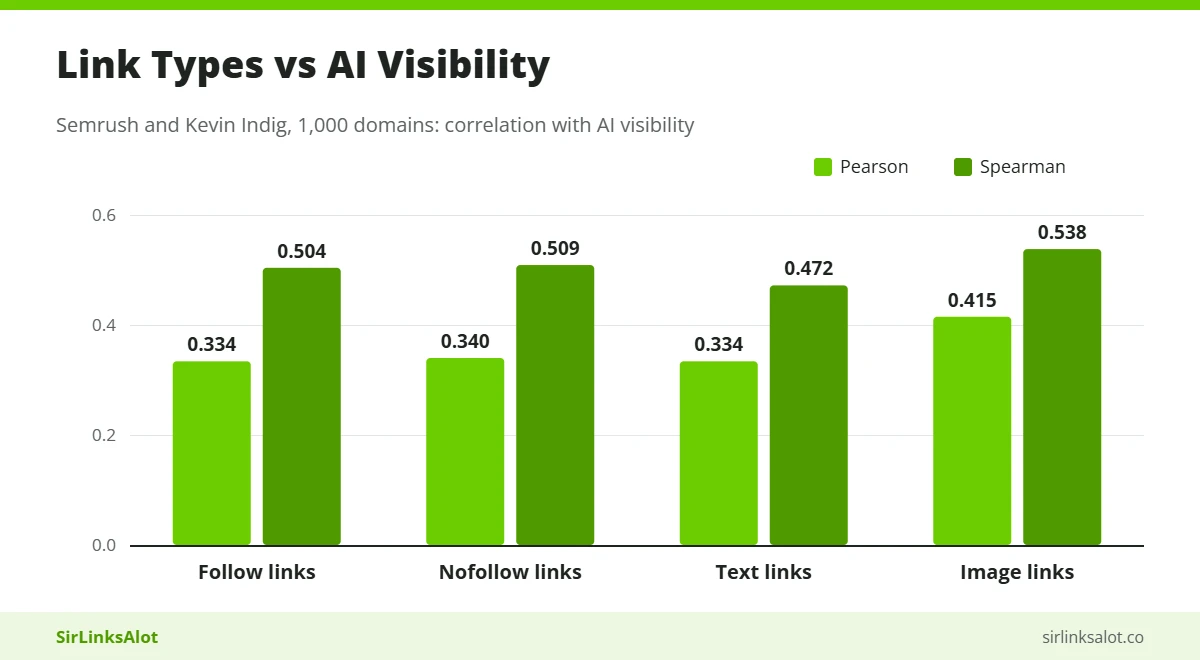
Nofollow links carried almost as much weight as follow links
Follow links correlated with AI visibility at 0.334 (Pearson) and 0.504 (Spearman). Nofollow links came in at 0.340 and 0.509, essentially the same and very slightly higher. For AI visibility, the follow nofollow distinction mattered far less than it does for Google rankings.
Platforms treat link types differently
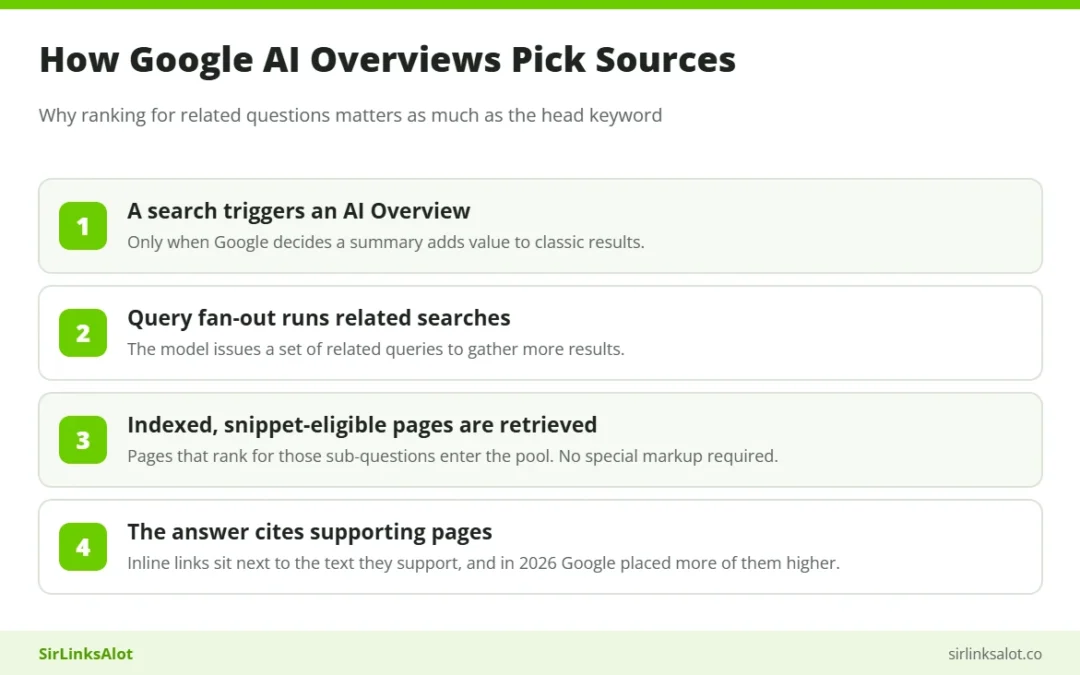
The study found that ChatGPT and Gemini slightly favored nofollow links, while Google AI Overviews and Perplexity leaned toward follow links. ChatGPT search and Perplexity also weighed link quality the least of the platforms studied. That fits how these tools work: Google AI Overviews pull from Google’s ranked index, where follow links matter for ranking, while ChatGPT reads the text of pages it retrieves.
Image links performed well too
Image links correlated with AI visibility at 0.415 (Pearson) and 0.538 (Spearman), compared with 0.334 and 0.472 for text links. That suggests AI visibility follows broad brand presence across many link types, not just classic text links.
Authority still matters
The same study found Semrush Authority Score correlated with AI mentions at 0.65 (Pearson) and 0.57 (Spearman). So the overall strength of a brand’s link profile still matters. Nofollow links help, but they work best as part of a strong, balanced backlink profile.
Why Nofollow Links Help AI Search
The core reason is that large language models read text. When ChatGPT, Gemini or Perplexity builds an answer from a page, they read the words around your link. The rel attribute in the HTML does not stop the model from seeing that your brand was mentioned in a relevant context.
That is why brand signals dominate AI visibility research. Ahrefs’ study of 75,000 brands found branded web mentions correlated with AI Overview visibility at 0.664, well above backlink counts at 0.218. A nofollow link that names your brand is a brand mention first. We explain the difference in backlinks vs brand mentions.
It also explains why so many of the sources AI tools cite are nofollow by default. Similarweb reported that Wikipedia and Reddit each accounted for roughly 12% to 13% of U.S. ChatGPT citations in early 2026. Both sites nofollow outbound links. A mention there will not pass PageRank, but it puts your brand in front of the models directly.
Nofollow Links by AI Platform
Each AI tool finds and uses pages differently, which changes how much a nofollow link can help:
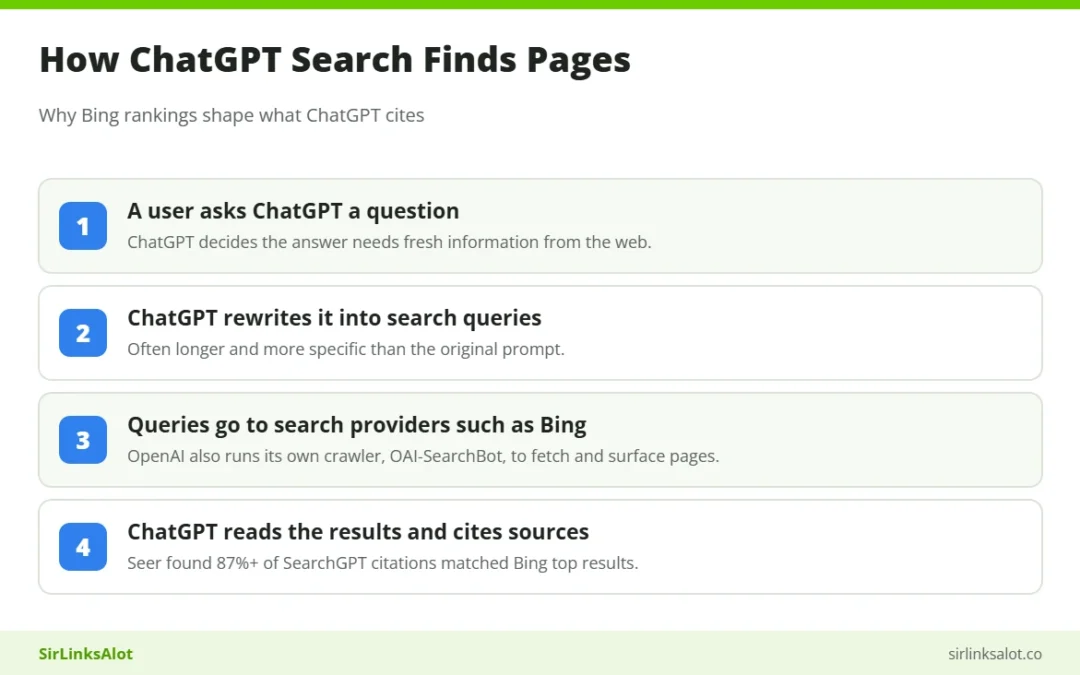
- ChatGPT: reads pages returned by search providers such as Bing and its own crawler. It slightly favored nofollow links in the Semrush data, which fits a system that reads text rather than counting links.
- Gemini: also slightly favored nofollow links in the same study. Mentions on widely read sites appear to matter more than link attributes.
- Google AI Overviews: leaned toward follow links. AI Overviews cite pages from Google’s ranked index, and follow links help those pages rank.
- Perplexity: also leaned toward follow links, and tends to cite pages that rank well in Google.
- Microsoft Copilot: grounds answers in Bing. Bing has its own link signals, so follow links that help you rank in Bing still matter.
So for ChatGPT and Gemini, chasing nofollow brand mentions on trusted sites is worth the effort. For Google AI Overviews and Perplexity, pair those mentions with follow links that help your pages rank.
Common Types of Nofollow Links Worth Getting
Not every nofollow link is equal. These link types often carry nofollow or ugc attributes and can still help AI visibility:
- News and press coverage: many publishers nofollow outbound links, but coverage on a trusted news site is a strong brand signal.
- Press release distribution: wire services usually nofollow links. A press release alone rarely moves rankings, but pickups on relevant sites can add mentions.
- Social media profiles and posts: LinkedIn, YouTube and other social platforms nofollow most links, yet AI tools increasingly cite social and video content.
- Community answers: Reddit and Quora answers that genuinely help readers can be cited directly in AI answers.
- Guest posting and blogger outreach: some publishers nofollow author bio links. If the outreach guest posting placement is relevant, the brand mention still has value.
- Local SEO citations: directory and review listings help local businesses appear in AI answers about local options.
- Affiliate program and sponsored placements: qualified with sponsored or nofollow, but still brand mentions on relevant pages.
When Follow Links Still Matter Most
None of this means you should stop building follow links. Follow links still matter most when:
- You need a page to rank in Google. Google AI Overviews and AI Mode cite pages from Google’s index, so ranking still feeds AI Overview visibility.
- You need to rank in Bing for ChatGPT. ChatGPT search leans on Bing, and links help pages rank in Bing too. See Bing SEO for ChatGPT.
- You compete in a tough niche. Competitive keywords still require editorial follow links from relevant, authoritative sites.
- You are building a new site. Follow links help new sites get crawled, indexed and trusted.
Our guide to link building for AI Overviews covers where follow links fit for Google’s AI features specifically.
Building a Balanced Link Profile for AI Search
A balanced link profile mixes follow and nofollow links, text and image links, and links from many types of sites. Here is a practical way to build one:
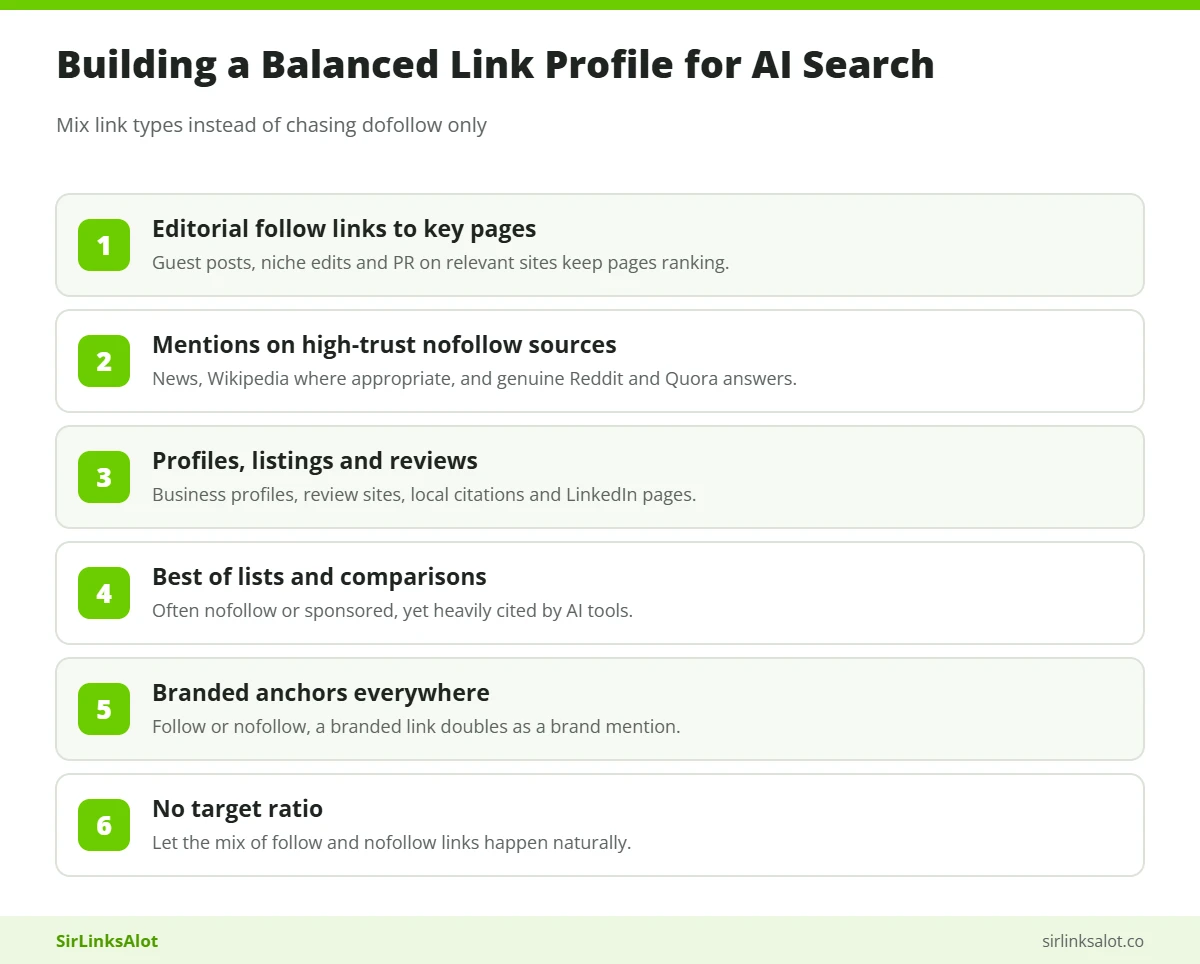
- Earn editorial follow links to key pages. Guest posting, niche edits and digital PR on relevant sites remain the backbone of link building SEO.
- Get mentioned on high-trust nofollow sources. News coverage, Wikipedia citations where genuinely appropriate, and helpful participation on Reddit and Quora.
- Pursue press coverage. Many news sites nofollow outbound links, but a press mention on a trusted publisher is one of the strongest brand signals for AI. Our digital PR service is built around this.
- Build profiles and listings. Business profiles, review sites, local SEO citations and LinkedIn company pages add brand mentions, often with nofollow links.
- Get on best of lists. Many listicles use nofollow or sponsored links, yet they are among the most cited pages in AI answers. See how to get your brand on best of lists.
- Use branded anchor text. Follow or nofollow, a link with your brand name in the anchor text doubles as a brand mention.
- Do not chase a ratio. There is no ideal percentage of nofollow links. Focus on relevance and trust, and let the mix happen naturally.
Nofollow Links and Paid Placements
Google’s spam policies say paid links should be qualified with rel=”sponsored” or rel=”nofollow”. That includes sponsored posts, affiliate program links and many press release distribution links. For years, link builders saw qualified links as worthless. In AI search, they are not. A sponsored placement on a relevant, trusted page still gives AI tools a brand mention to read, even when it passes no PageRank.
This matters for anyone buying links. A legitimate paid placement that is correctly qualified can still support AI visibility without breaking Google’s rules. Just make sure the host page is relevant, real and read by people.
Nofollow Links for Agencies and White Label Link Building
Agencies that resell white label link building often promise only dofollow links, because clients have been trained to see nofollow links as a waste. In AI search, that promise can backfire. If your white label link building partner filters out every nofollow opportunity, you may be skipping the news sites, communities and review platforms AI tools cite most.
Better questions for white label link building services and other link building services:
- Do you report brand mentions and AI visibility, not just dofollow links?
- Do you include high-trust nofollow placements when they fit the client?
- Can you show case studies where links and mentions improved AI visibility?
- How do you keep a natural mix of follow and nofollow links in the backlink profile?
If you resell services to clients, explain the follow nofollow balance up front. A white label link report that shows brand mentions alongside dofollow links tells a more accurate story in 2026.
How to Audit Nofollow Links on Your Own Site
Nofollow also matters for your own technical SEO. Check that:
- Internal links are followed. Nofollow on internal links can stop link equity from reaching important pages. Most internal links should be normal follow links.
- Sponsored and affiliate links are qualified. Use rel=”sponsored” for paid and affiliate links you publish.
- User generated content uses ugc or nofollow. Comments and forum posts should be marked so spam links do not reflect on your site.
- Important outbound citations are not blocked by mistake. Citing sources with normal links is fine and helps readers.
Free tools and browser extensions can highlight nofollow links on any page, and a site crawler can audit them in bulk. To review the links pointing at your site, use a backlink checker and filter by link type.
How to Measure the Impact of Nofollow Links on AI Visibility
- Track a prompt set monthly in ChatGPT, Perplexity, Gemini and Google AI Overviews, and record how often your brand appears.
- Log new mentions by type: follow link, nofollow link, sponsored, ugc and unlinked.
- Check citations: see whether the pages holding your nofollow links appear as sources in AI answers.
- Watch branded search volume in Google Search Console as a proxy for growing awareness.
- Compare with rankings: follow links should move rankings; nofollow links should show up more in mentions and AI answers.
For the broader evidence on links and AI search, see do backlinks matter for AI search.
Conclusion: Rethinking Nofollow in the AI Era
Nofollow links were long treated as second-class links in digital marketing. AI search changes that. When the goal is to appear in generated answers, a nofollow link on a trusted, relevant page can do much of the same work as a follow link, because the model reads the mention, not the attribute. Keep building editorial follow links for rankings, but stop ignoring nofollow opportunities on the sites AI tools trust most.
Frequently Asked Questions
Do nofollow links help with AI Overviews and ChatGPT answers?
Yes. Nofollow links correlated with AI visibility about as strongly as follow links in the Semrush study. ChatGPT slightly favored nofollow links, while Google AI Overviews leaned toward follow links.
Do nofollow links pass link equity?
Google treats nofollow as a hint, so it may choose to consider some nofollow links, but you should assume they pass little or no link equity for rankings.
What is the difference between dofollow and nofollow links for AI visibility?
For AI visibility the difference is small, because AI tools read the text around a link. For Google rankings, dofollow links pass more value.
How many nofollow links should I have in a healthy backlink profile?
There is no ideal ratio. A natural link profile includes a mix of follow and nofollow links from relevant sites. Focus on quality and relevance rather than a target percentage.
Can too many dofollow links hurt my AI search visibility?
Dofollow links themselves do not hurt AI visibility. Problems come from low quality or manipulative links, such as PBNs and paid links that are not qualified, which can hurt rankings and trust.
Are Reddit and Wikipedia links worth getting for AI visibility?
Genuine mentions on Reddit and Wikipedia can help because AI tools cite those sites often. Both nofollow outbound links, and both communities remove promotional spam, so only contribute where you add real value.
Sources and further reading
- Do Backlinks Still Matter in AI Search? Insights from 1,000 Domains, Semrush with Kevin Indig, October 2025
- Evolving “nofollow”: new ways to identify the nature of links, Google Search Central Blog, September 10, 2019
- Spam policies for Google web search, Google Search Central
- An Analysis of AI Overview Brand Visibility Factors (75K Brands Studied), Ahrefs
- The Most Cited Domains by LLMs and the Signals That Get You Cited, Similarweb