A new online gaming site targeting a Southeast Asian market came into the Managed Link Building (MLB) program in late October 2025 with an unusual starting position – over 360 referring domains on paper, but almost none of them were worth anything.
The backlink profile was dominated by auto-generated spam from domain scrapers and low-quality SEO agency promotion spam – inflated numbers with no real authority behind them.
The site also operates in a restricted niche (online gambling), which limits the types of links that can be built and increases the cost of those that can. With a monthly budget of $500–$600, that meant working with fewer placements per cycle than a typical campaign.
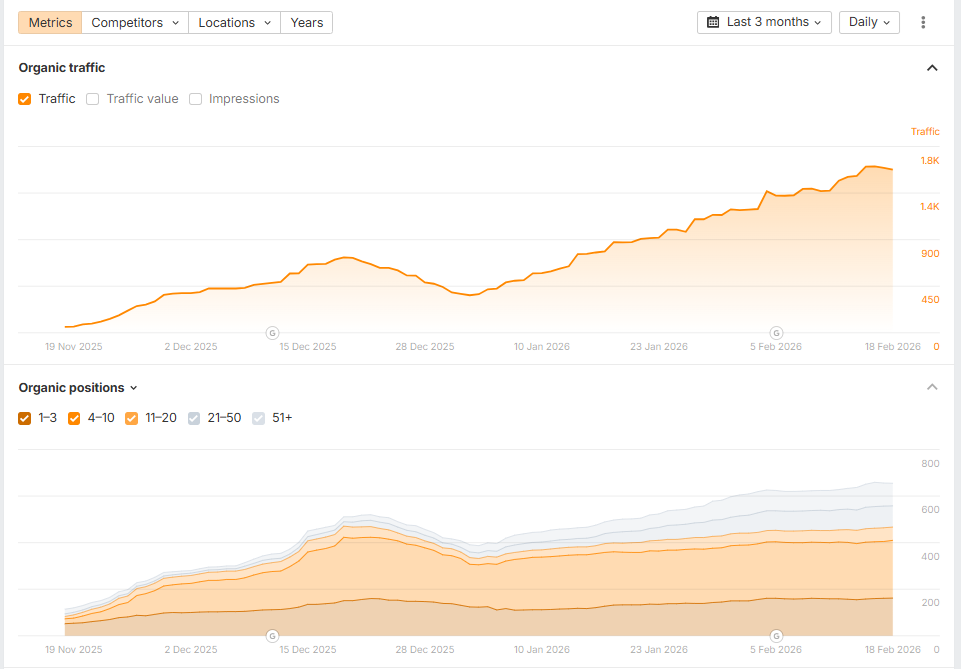
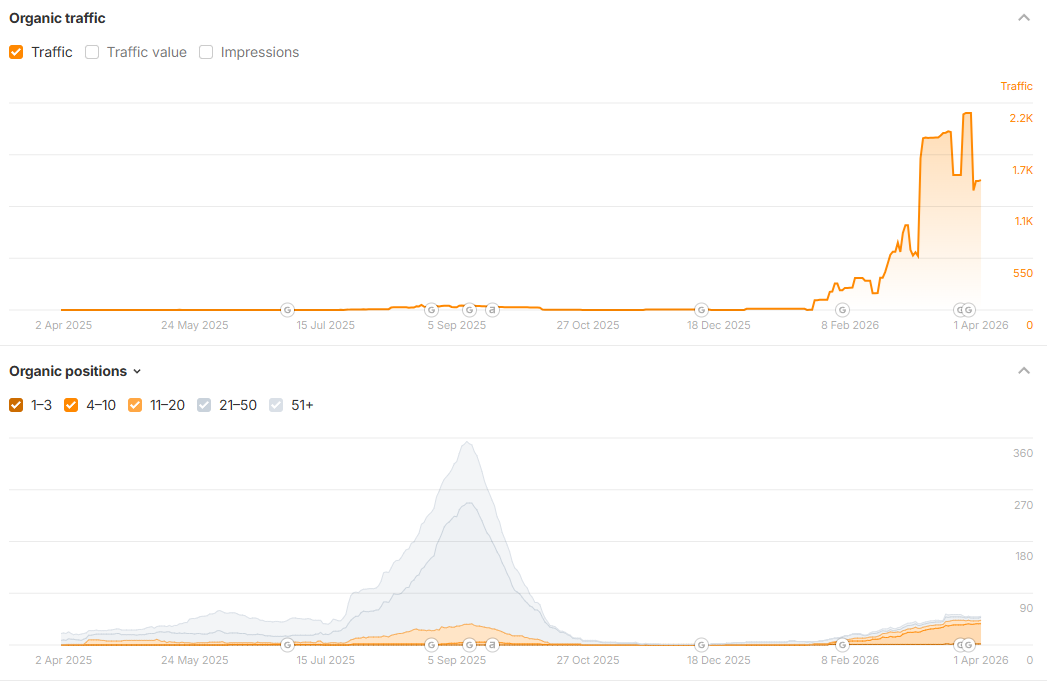
Five months of building later, the site went from zero organic traffic to over 2,100 monthly visits, picked up its first top-3 rankings, and started generating consistent keyword growth – all while the spam backlink profile was being cleaned out underneath it.
Starting Point & Initial Audit
The client first reached out to us about the MLB service in mid-2025 but held off for nearly four months while completing a site rebuild and backend work.
That’s time the campaign could have been running – and given how the site responded once building actually started, the delay likely cost several months of compounding growth.
When the updated audit was completed in late October 2025, the site’s metrics told a deceptive story. A DR of 26 and over 360 referring domains looked like a reasonable baseline on the surface.
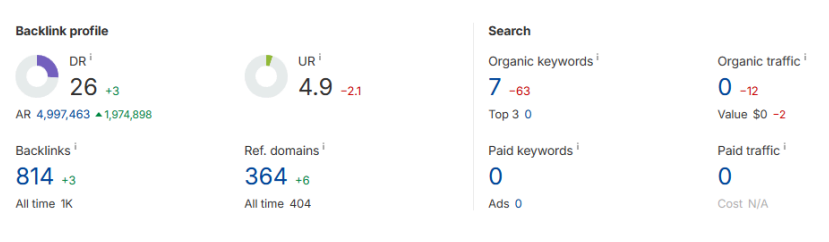
In reality, both audits – the original from July and the updated version from October – flagged the same problem – the backlink profile was almost entirely auto-generated links from domain scrapers, directories, and spammy SEO agency sites.
No higher-quality contextual links from sites with meaningful metrics or traffic could be found. Some removed pages on the site had also been targeted by spam link providers, further cluttering the profile.
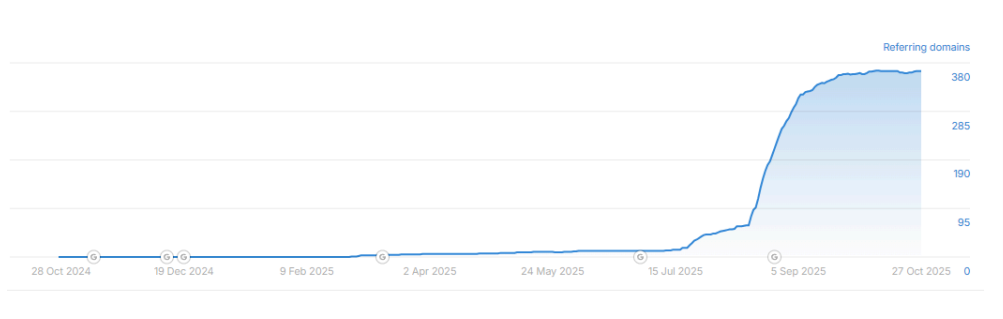
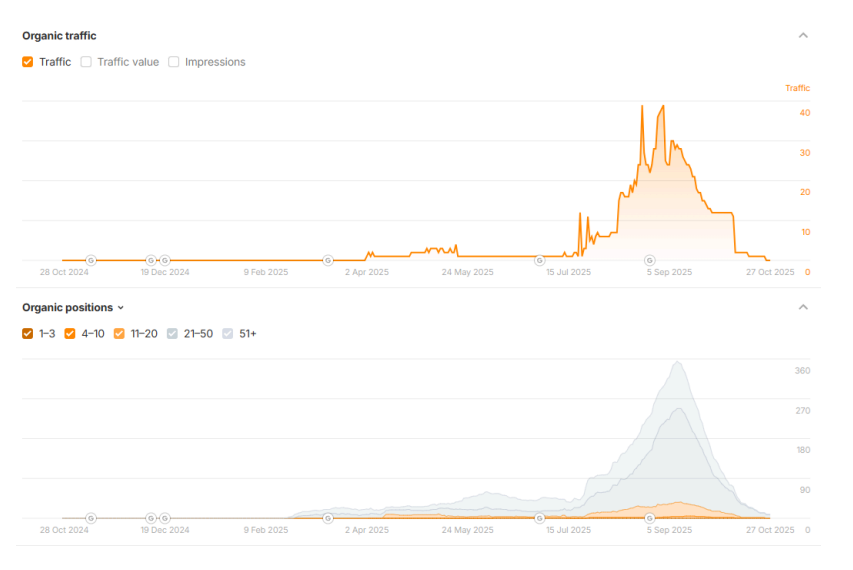
The site had briefly shown a small spike in rankings and traffic in September 2025, but it disappeared as quickly as it appeared – not sustained by any real authority signals.
From an off-page perspective, the effective starting point was close to zero despite the inflated surface metrics
| Metric | October 2025 |
| Domain Rating (DR) | 26 |
| Referring Domains | 364 |
| Indexed Pages | 77 |
| Organic Keywords | 7 |
| Top-3 Rankings | 0 |
| Organic Traffic | 0 |
The audit conclusion – treat it as a fresh build.
The existing backlink profile offered no usable foundation – just noise that would eventually be cleaned out as Ahrefs purged those spam domains from its index. The initial focus would be on homepage authority, foundational link diversity, and conservative anchor usage.
Strategy
The MLB program adjusts its approach each month based on how a site is responding, and this campaign was no exception – but the niche constraints shaped the playbook from the start.
Guest posts were effectively the only high-impact link type available. Niche edits, social profile links, and several other standard options could not be built for a site in this vertical. The guest posts that could be built came at a premium over standard pricing, so a $500–$600 monthly budget typically bought two or three placements per cycle rather than the four or five a non-restricted site might get at the same spend. Every placement had to earn its spot.
Early months focused on mid-authority guest posts (DR 20–35) pointed at the homepage, with branded and URL-based anchors making up the bulk of the profile. The logic was straightforward: build volume and establish a clean authority foundation before doing anything targeted. Pillow links were added in the first month for diversity and to create a natural-looking link velocity.
As the site started picking up keywords and showing its first traffic signals around January 2026, the team shifted toward higher-authority placements (DR 36–51+). The budget increase from $500 to $600, initiated by the client after seeing early positive movement, helped fund this escalation.
Inner page targeting came last. The client had initially asked about spreading links across five inner pages and using more exact-match keyword anchors. The SirLinksalot MLB team pushed back on both – recommending a roughly even homepage-to-inner-page split once the site was ready, and keeping exact-match anchors to a minimum given the niche’s elevated overoptimization risk. The first inner page link went out in month five, once sustained growth justified expanding the targeting.
Challenges
The campaign didn’t face any single dramatic setback – no penalty, no algorithm hit, no technical crisis.
Instead, it operated under a set of persistent constraints that shaped what was possible at each stage.
- The niche restrictions and their impact on link availability and pricing are covered in the Strategy section above. Beyond that, two other factors are worth noting.
- The spam backlink profile created a messy metrics baseline. With 360+ junk referring domains at the start, Ahrefs’ progressive cleanup of those links meant the RD count would drop throughout the campaign – even as real authority was being added. This made month-over-month reporting tricky: the numbers that matter (traffic, keywords, rankings) were going up, while the numbers that are easiest to track at a glance (DR, RD count) were flat or declining. Anyone looking at the backlink profile tab without context would get the wrong impression.
- Traffic was also volatile once growth started. The site went from zero to meaningful visibility fairly quickly, and new sites in competitive niches tend to bounce around as Google tests positions. Daily and weekly traffic numbers swung noticeably, even while the overall trend was clearly upward. The September 2025 spike and collapse – which happened before the campaign started – was an early example of this pattern.
Month-by-Month Breakdown
Four building cycles were completed between October 2025 and March 2026.
The table below shows link types, authority ranges, and targeting focus for each – not volume, which varied month to month based on the team’s assessment of what the site needed.
| Month | Link Types | DR Range | Focus | Notes |
| Nov 2025 | Guest posts, Pillow links | DR 20–35 | Homepage | Foundation month; mid-range placements plus diversity links for a natural baseline |
| Dec 2025 | Guest posts | DR 20–35 | Homepage | Continued mid-authority building; budget increased from $500 to $600 |
| Jan 2026 | Guest posts | DR 36–51+ | Homepage | Authority escalation – first high-DR placements as the site began adding keywords |
| Mar 2026 | Guest posts, Social signals, Pillow links | DR 36–50 | Homepage + inner page | First inner page link; more targeted anchors introduced alongside a natural mix |
There was no building cycle in February 2026. The January order was placed mid-month and reported on February 11, and the next order followed in early March. This is a normal result of the billing and reporting cadence rather than a deliberate pause.
Results
The headline numbers tell the story pretty clearly.
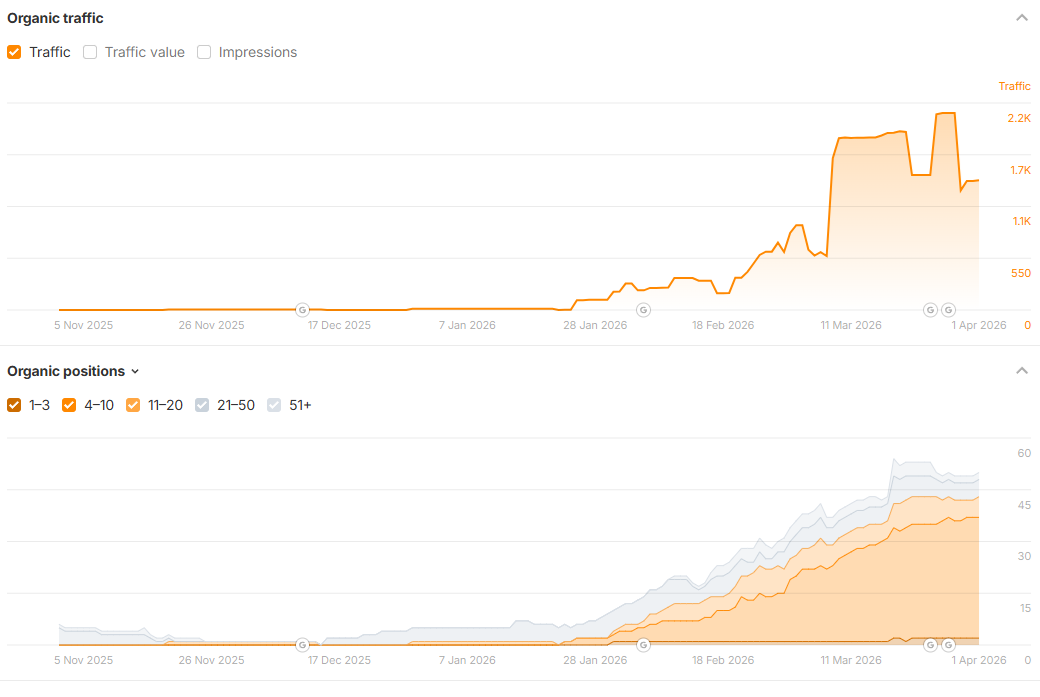
A site that was generating zero organic traffic in October 2025 hit 2,100+ monthly visits by March 2026, with growth accelerating sharply after January as earlier links matured alongside newer higher-authority placements.
| Metric | Oct 2025 | Mar 2026 | Change |
| Organic Traffic | 0 | 2,100+ | +2,100+ |
| Organic Keywords | 7 | 41 | +34 |
| Top-3 Rankings | 0 | 2 | +2 |
Traffic did dip from its peak in late March, which is consistent with the volatility pattern discussed in the Challenges section.
The overall trajectory remains clearly upward.
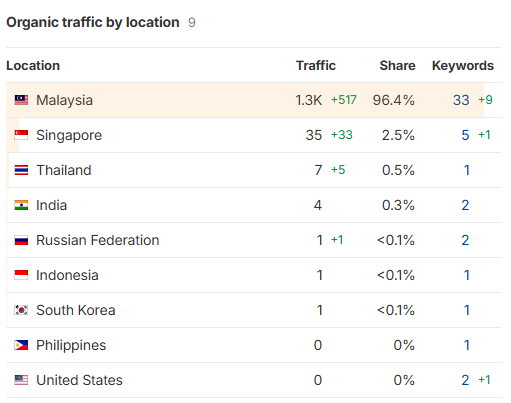
The geographic distribution confirmed the campaign was reaching the right audience – the vast majority of traffic came from the primary target market, with smaller volumes from neighboring Southeast Asian countries.
[THE CHART BELOW MAY BE DELETED FOR CLIENT PRIVACY REASONS]
As covered in Challenges, the backlink profile metrics moved in the opposite direction from the performance metrics during this period.
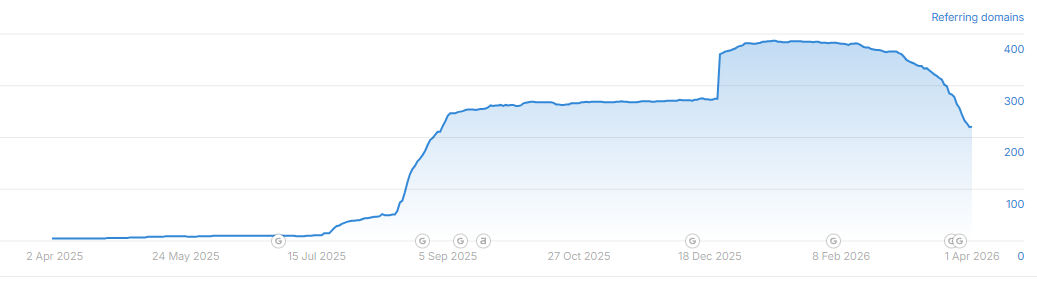
The context table below summarizes what happened and why.
| Metric | Oct 2025 | Mar 2026 | Change | Context |
| Domain Rating (DR) | 26 | 26 | 0 | Spam cleanup offset new acquisitions; DR lags behind traffic/ranking growth when starting RD count was artificially inflated |
| Referring Domains | 364 | 217 | -147 | Ahrefs purged ~150 spam referring domains from its index; remaining profile is smaller but substantially more legitimate |
Anchor Text & Target Page Approach
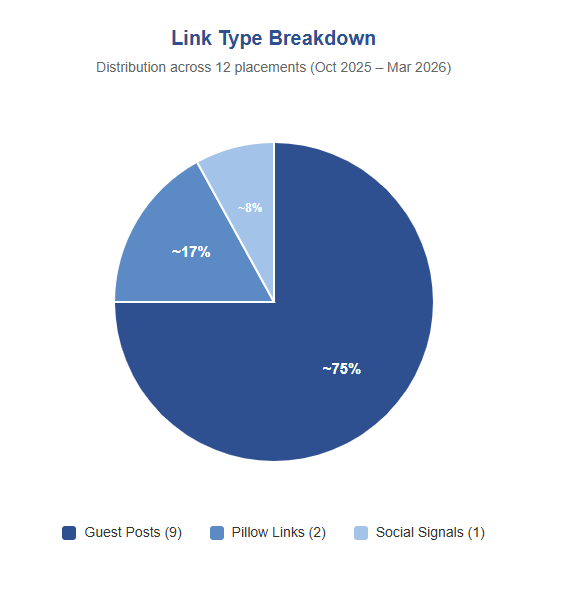
This section breaks down anchor text usage and link targeting across the nine guest posts built during the campaign.
Pillow links and social signals are excluded from the percentages since they serve a different function (diversity and naturalness) and would skew the distribution.
Anchor Text Distribution
Branded and URL-based anchors dominated the profile – brand name variations and direct URL formats accounted for roughly four out of five anchors used. This was deliberate. A new site in a restricted niche with zero legitimate link history needs to look like it’s accruing links naturally, not chasing keyword rankings from day one.
The remaining anchors used category-level descriptive terms referencing the site’s niche and target market. No aggressive exact-match keyword anchors were used. As noted in the Strategy section, the team advised against the client’s request to increase exact-match usage, keeping those to a minimum given the niche’s elevated overoptimization risk.

Target Page Distribution
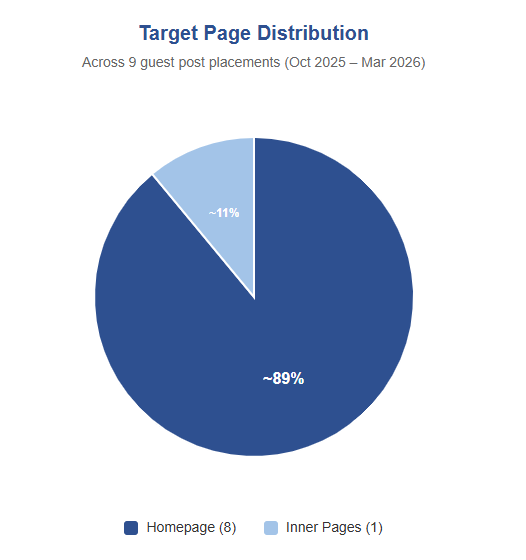
Nine out of ten guest post links pointed to the homepage. Inner page targeting was introduced only in the most recent building cycle, after four months of sustained homepage-focused authority building.
This ratio will shift going forward – the team recommended moving toward a roughly even homepage-to-inner-page split now that the site has demonstrated consistent growth. But for the period covered by this case study, the priority was stacking domain-level authority first.
Social signals from the March cycle were directed to a priority inner page identified by the client, adding an early off-page signal to that URL ahead of more sustained inner page targeting in future months.
Analysis & Takeaways
Five months and roughly $2,700 in total link spend produced a site that went from invisible to generating 2,100+ organic visits per month.
For a restricted niche with premium link pricing and limited link type options, that’s a strong return – especially considering the campaign is still in its early stages.
What stands out about this particular campaign is how much of the work was about restraint rather than aggression.
The client came in wanting exact-match anchors and links spread across five inner pages. The team’s job was partly to slow that down – keep the anchors conservative, keep the targeting focused, let the foundation set before building on it.
The results suggest that discipline paid off. The site’s growth accelerated fastest in the months after the higher-authority placements were layered onto an already-clean branded profile, not when links were being spread thin across multiple targets.
The spam backlink cleanup running in parallel with the campaign created an unusual reporting dynamic.
A reader comparing October 2025 to March 2026 would see 147 fewer referring domains and zero DR movement – and might conclude nothing happened. The traffic and keyword charts tell the opposite story.
This is a useful reminder that backlink profile metrics and actual SEO performance can diverge significantly, especially when a site enters a campaign with an artificially inflated baseline.
The client’s engagement level was also a factor worth noting. Budget increases, updated keyword priority files, strategic questions, willingness to take advice on anchor restraint – this is the kind of collaboration that allows a managed campaign to adapt in real time rather than running on autopilot.
Conclusion
This was a campaign that started behind – a spam-filled backlink profile, a restricted niche with limited and expensive link options, and a four-month delay before building began. Five months and nine guest posts later, the site is generating consistent organic traffic in its target market and ranking for keywords it had no visibility on at the start.
The backlink profile is now smaller but substantially more legitimate than it was in October 2025. That’s a trade worth making. The referring domain count will likely continue to decline as Ahrefs cleans out remaining spam, but the links that are there now are real – contextual placements on sites with actual metrics and traffic, pointed at the right pages with clean anchors.
Inner page targeting has just begun, and the client has shown a pattern of increasing budget as results materialize. Both of those create room for the next phase of the campaign to build on what’s already working.