Key Takeaways
- AI share of voice is the percentage of AI answers that mention, cite, or recommend your brand versus your rivals.
- To measure it, run hundreds of buyer-style prompts through ChatGPT, Gemini, and Google AI Overviews, then count mentions and citations.
- AI answers vary from run to run, so trust trends across many prompts, not single answers.
- AI engines lean on digital consensus: brands that many trusted sites talk about get named more.
- Earning relevant mentions and links, which is what SirLinksALot does, helps build that consensus.
Remember when “ranking on page one” was the whole game?
Those days are fading. More and more, we all ask ChatGPT, Gemini, or Google’s AI Overviews a question and read one neat summary instead of scrolling through ten blue links.
The numbers back this up. In a Pew Research Center study of U.S. adults, Google users clicked a regular result in 8% of visits when an AI summary appeared, versus 15% when it didn’t. Links inside the summary itself got clicked in just 1% of those visits.
So the old way of measuring share of voice, counting your top-10 rankings against your rivals’, only tells part of the story. The better question now: when someone asks an AI for the best option in your industry, does it name you?
That’s AI share of voice. It’s the percentage of times a generative AI engine cites, recommends, or mentions your brand when answering a prompt, compared with your competitors.
How Is AI Share of Voice Actually Measured?
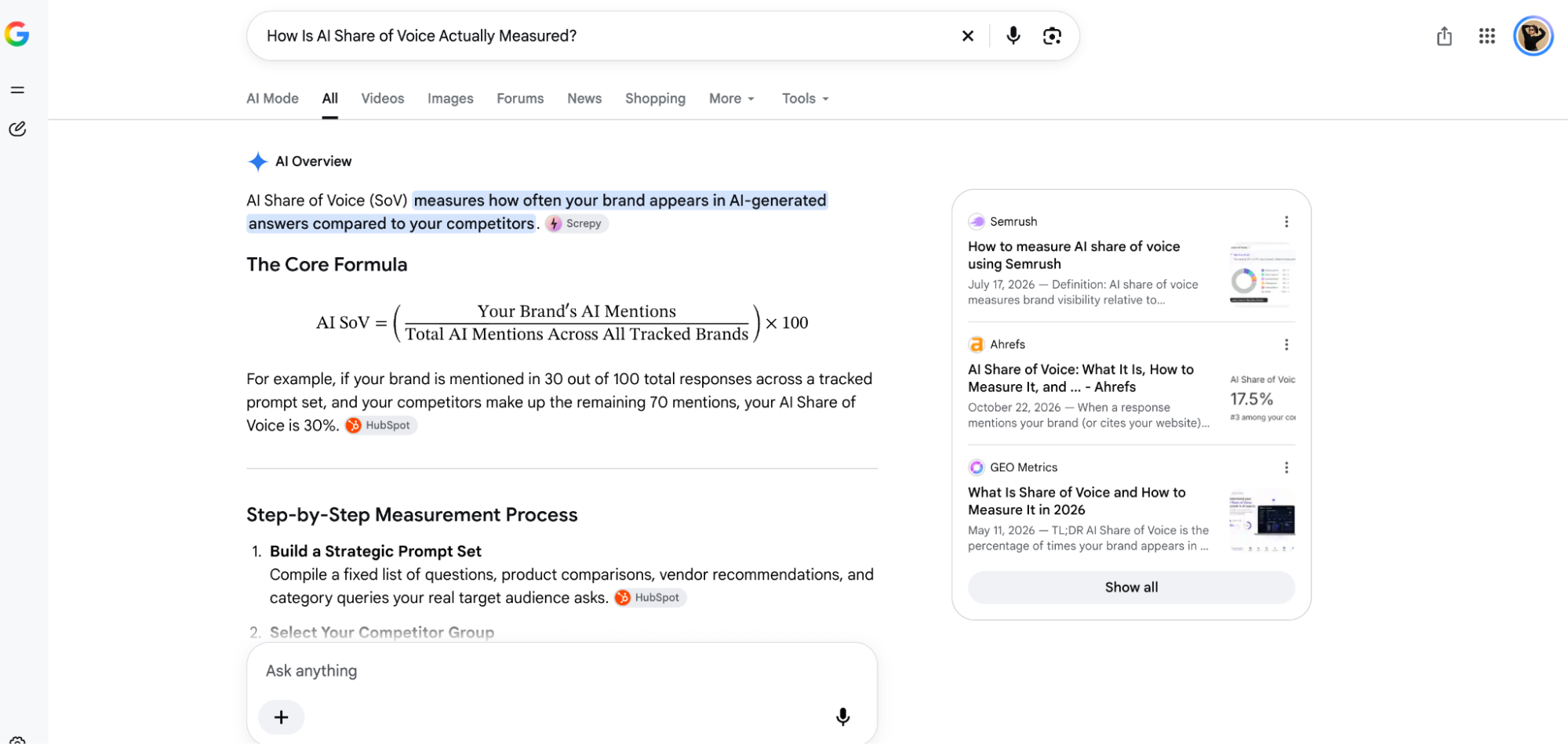
The math is friendlier than it sounds. Here’s the process:
- Pick your prompts. Write down the questions your buyers really ask, like “best accounting software for freelancers.” Focus on questions that don’t name your brand, since branded ones flatter you. Many teams run hundreds of prompts through ChatGPT, Gemini, Perplexity, and Google AI Overviews.
- Track three things for every answer:
- Citation tracking: Is your website linked in the AI’s source list?
- Brand mentions: Does the AI name your brand in the answer itself?
- Competitor benchmarking: How often are your rivals named or cited for the same prompts?
An AI can mention you without linking to you, or link to your page while recommending someone else. That’s why you track both.
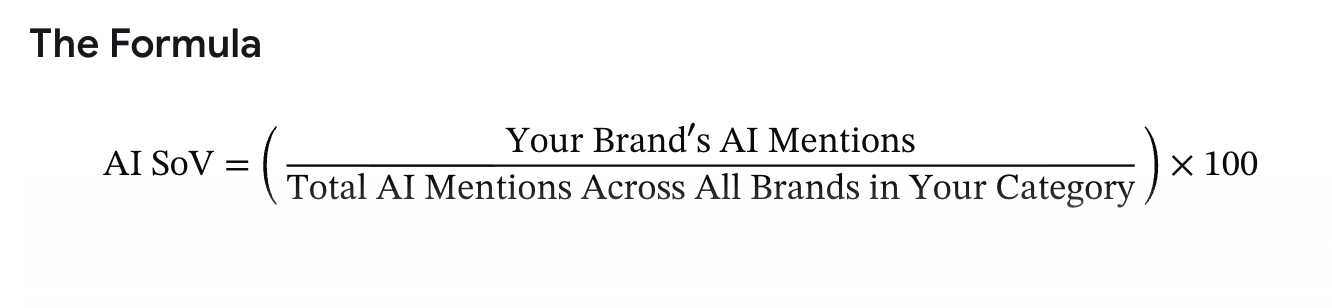
- Do the division. Divide your mentions by the total mentions of you plus your rivals:
AI share of voice = your mentions ÷ (your mentions + all rivals’ mentions) × 100
Say your tracked answers name you 20 times, Rival A 50 times, and Rival B 30 times. That’s 100 mentions in total, so your share is 20%.
- Repeat, then watch the trend. SparkToro’s study ran the same brand questions 60 to 100 times each on ChatGPT, Claude, and Google’s AI. Nearly every answer was different, yet the same top names kept showing up. So one answer proves nothing, but hundreds tell a story.
You don’t have to count by hand. Tools like Semrush’s AI Visibility Toolkit, Ahrefs’ Brand Radar, and Profound do it for you.
Check each AI engine on its own, too, because a brand can shine on one and barely register on another. And note which prompts, platforms, and rivals you tracked, since tools do the math a little differently.
Why AI Picks Certain Brands: It’s All About Consensus
Knowing your number is step one. Understanding why it’s low (or high) is where things get interesting.
AI engines don’t have favorites. They rely on digital consensus: what lots of trusted sources say about a brand. It happens in two ways:
- Training data. Large language models learn from huge amounts of web text. If a brand is named as a top pick again and again, the model picks up that pattern.
- Retrieval-Augmented Generation (RAG). When tools like ChatGPT search or Perplexity answer you, they fetch fresh web pages first, then write from what they find.
Either way, the AI is basically counting votes. If fifty respected websites call the same software the best in its category, the AI treats that agreement like a fact.
You can see it in real life. When SparkToro tested headphone recommendations, Bose, Sony, Sennheiser, and Apple appeared in 55% to 77% of answers, even though 142 people each worded the question their own way.
The bigger data points the same way. Ahrefs studied 75,000 brands and found that web mentions lined up with Google AI Overview visibility far better than backlink counts did (0.664 versus 0.218 on a correlation scale). Brands in the top quarter for web mentions averaged 169 AI Overview mentions, over ten times the next group down.
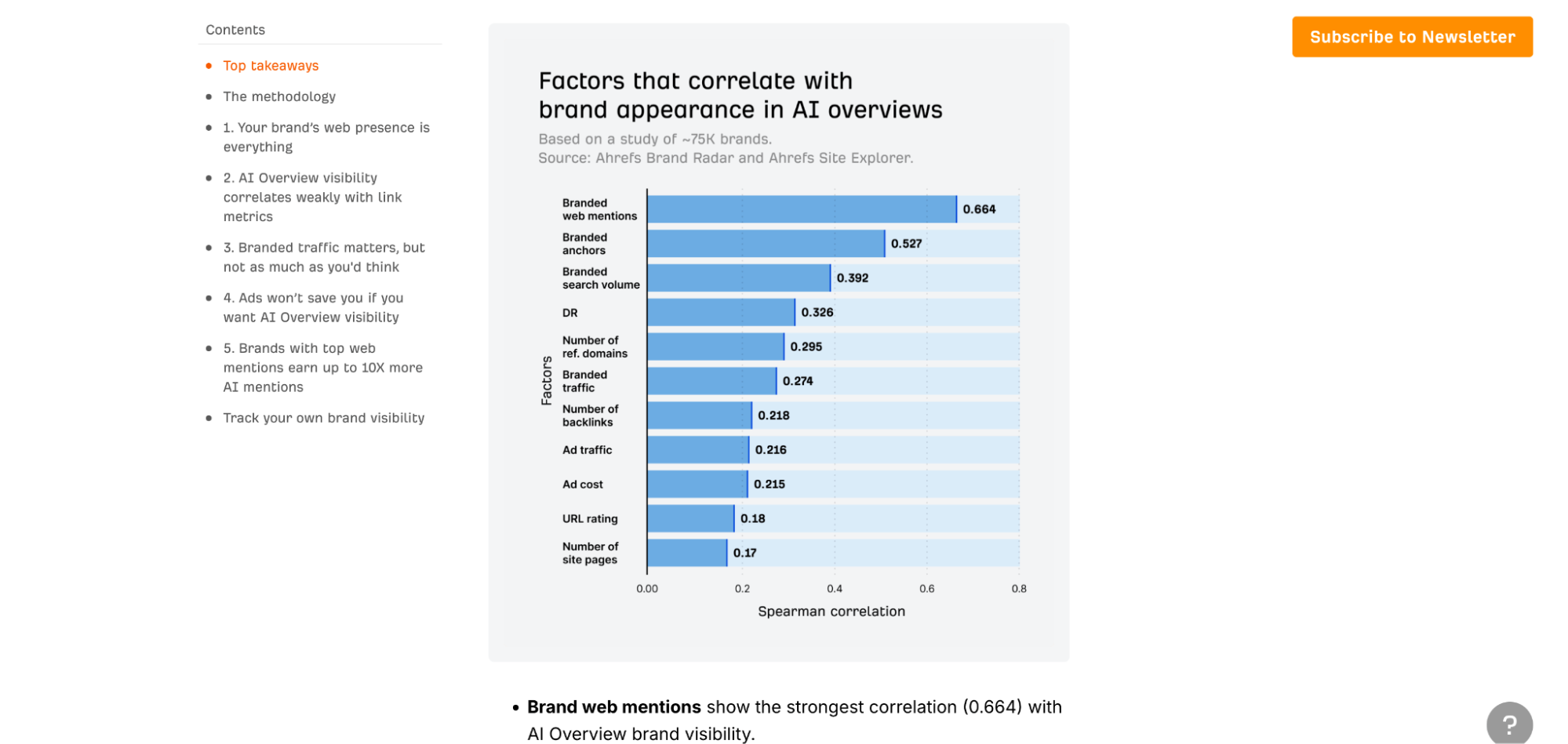
The runner-up signal? Other sites linking to you with your brand name as the link text.
Ahrefs stresses that correlation isn’t proof, but the message is clear: if few trusted sites talk about you, the AI has little to repeat.
Where AI Looks for Proof (and Where You Should Show Up)
AI doesn’t trust every website equally, and each engine has its own habits.
- Google AI summaries: Pew found Wikipedia, YouTube, and Reddit were the most-linked sources.
- ChatGPT, AI Mode, and Perplexity: A Semrush study of 230,000 prompts put Reddit and LinkedIn in the top five most-cited domains on all three.
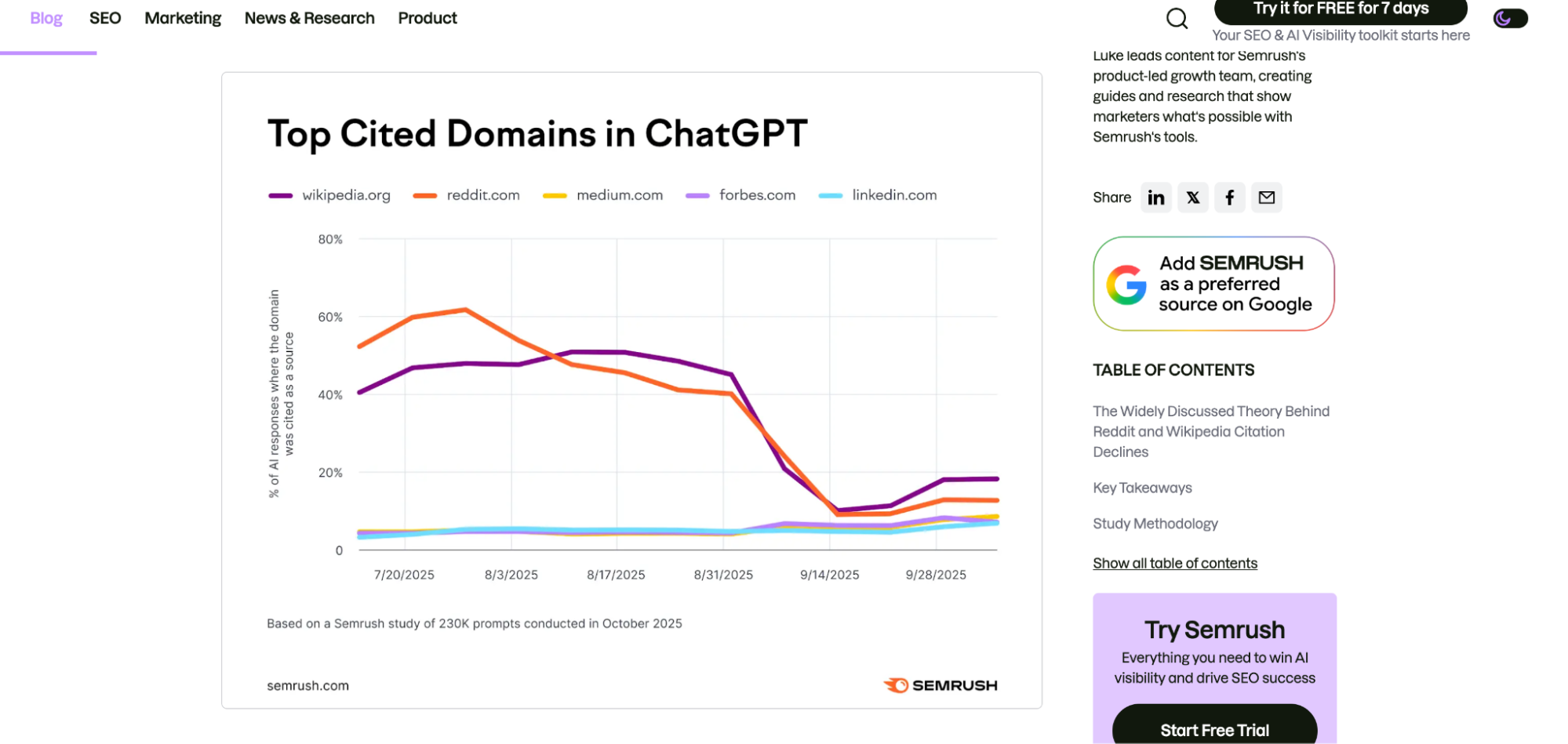
These habits also change fast. In that same data, ChatGPT’s citations of Reddit fell from nearly 60% of responses in early August 2025 to around 10% by mid-September.
So don’t bet on a single platform. Semrush advises finding which domains AI trusts in your niche, then building relationships with them. Spread your mentions across places like these:
- Industry sites and blogs: Guest posts and expert quotes put your name on pages AI tools can draw from.
- Existing articles: Niche edits add your brand and a link to pages that are already trusted and indexed.
- Reviews and communities: Honest reviews and helpful forum answers add more votes.
Quality beats quantity here. One mention on a trusted, on-topic site usually beats ten on random ones.
How to Grow Your AI Share of Voice With SirLinksALot
Here’s the catch: knowing your number won’t help unless you have a plan to raise it.
You can’t make an AI like you, but you can change what the web says about you.
Semrush, a company that sells AI tracking tools, grew its own AI share of voice from 15% to 25% across 726 prompts. It couldn’t credit one tactic, but said getting mentioned beyond its own website consistently looked like a major lever.
That’s where off-page SEO comes in. Link building is one of the most direct ways to build the consensus AI models rely on, and it’s exactly what SirLinksALot is built for.
SirLinksALot builds premium backlinks through:
- High-authority guest posts: fresh, relevant articles that put your brand on sites your audience already trusts.
- Niche edits: your brand and link added to established articles that already have authority.
Every placement is a trusted voice vouching for you. Stack enough of them across relevant sites, and the web starts telling one clear story: you’re the authority. AI engines pick up that story, which helps them recognize your brand, cite your website, and grow your share of voice.
No one can promise a specific AI answer. But trusted, relevant placements put the odds in your favor.
Your game plan: measure today, spot the prompts where rivals appear and you don’t, build trusted mentions on those topics, then re-measure monthly.
Conclusion
AI share of voice is your slice of the answer when someone asks an AI for the best in your field. You measure it by testing lots of buyer prompts, counting mentions and citations, and comparing yourself with rivals.
But the number is just a scoreboard. To move it, the web has to agree you’re the go-to name. That’s where SirLinksALot comes in: premium backlinks, guest posts, and niche edits on trusted sites help you build the consensus AI engines learn from.
Measure today, build smart, and measure again.
FAQs
What is a good AI share of voice?
There’s no universal score. It depends on how many rivals you track and which prompts you test, so compare yourself with your competitors and your own past results instead.
How often should I measure it?
Often enough to spot a trend. AI answers shift from run to run, so Semrush’s team tracks daily and reads each number as a range. For most brands, weekly checks and a monthly review work well.
Is AI share of voice the same as SEO share of voice?
No. SEO share of voice tracks your keyword rankings. AI share of voice tracks how often AI answers name or cite you. They’re related, so watch both.
Do backlinks help you show up in AI answers?
They can, but relevance matters most. Ahrefs found brand mentions across the web tracked visibility in Google’s AI Overviews more closely than raw backlink counts, and brand-name link text came second. So aim for relevant placements that name your brand, like the guest posts and niche edits SirLinksALot builds.