What began in May 2024 as a backlink campaign for an established local florist became, over the following 24 months, a multi-phase authority-building effort that adapted to the client’s business expansion.
This case study walks through the full arc – from a mature but partially compromised backlink profile, through seasonal targeting and a strategic geographic pivot, to 4x growth in monthly organic traffic.
The Managed Link Building (MLB) engagement has run continuously since the initial application, with no service pauses across 24 consecutive months. Budgets shifted in both directions across that period.
Our approach evolved to match how the client’s business itself changed – from a regional florist to a nationwide brand.
Starting Point & Initial Audit
The client came to us in May 2024 with an established e-commerce site that had been online for nearly a decade.
The site wasn’t starting from scratch – but in a niche this competitive, its existing authority wasn’t yet enough to compete at the top of the SERPs.
Here’s where things stood at audit:
| Metric | May 2024 |
| Indexed URLs | 1,410 |
| Domain Rating | 19 |
| Referring Domains | 180 |
| Top 3 Rankings | 577 |
| Organic Keywords | 14,000 |
| Organic Traffic (monthly) | 37,500 |
The site’s DR was lower than what we’d expect for a profile carrying 180 referring domains, and our audit explained why.
Roughly 46% of its backlinks were coming from automated image-scraper sites – links that pad backlink totals but add little real authority. They also distorted the anchor text profile toward unnatural page-title variations.
The contextual links the site did have, however, were natural-looking. We identified roughly nine higher-quality links from real sites with reasonable metrics and traffic.
The homepage was well-supported, no inner pages were over-linked, and there was no penalty history. Rankings and traffic had been trending upward since late 2023.
In our experience, sites in this position don’t need a recovery and don’t need a foundation – they need real authority pushed through quality contextual placements to overcome the noise in the existing profile. That framed our strategy.
Strategy
As a Managed Link Building client, the plan evolved month-to-month based on how the site responded, the client’s business priorities, and how the calendar shaped commercial demand on their end.
The flower delivery space is competitive, with large national delivery networks and gift-marketplace brands occupying most high-intent SERP positions.
In our experience working across multiple florist and flower delivery campaigns, what works for a commercial site in this kind of niche is a steady mix of mid-to-high DR guest posts and niche edits, conservative anchor distribution weighted toward branded and URL variations, and gradual layering of more descriptive anchors as the profile matures.
We also knew the year’s commercial cycle would need to be reflected in the link plan. Florist e-commerce is heavily seasonal, with Mother’s Day, Valentine’s Day, and other gifting occasions accounting for a disproportionate share of annual revenue.
The strategy needed to be ready to shift toward occasion-specific collection pages ahead of their peak demand windows, and back toward broader targeting between them.
What we didn’t anticipate at the outset – and what shaped the second half of the campaign – was that the client themselves would scale the business from a regional operation to a nationwide florist within the campaign’s first 18 months.
When that happened, we shifted the authority targeting accordingly. The full campaign falls naturally into four phases.
Campaign Phases
The headline activity in each phase is captured below.
Volume per month varied with budget, but the underlying methodology – real contextual links from sites with traffic, conservative anchor pacing, and consistent quality – stayed constant throughout.
Across all phases, the primary authority push came from DR 51+ contextual placements, with mid-authority links supplementing where appropriate.
Phase 1 – Foundation Reinforcement (May – December 2024)
We focused on offsetting the scraper-driven distortion in the existing profile with real contextual placements.
The homepage absorbed most of the authority during this period, with occasional links to early occasion-based collection pages.
| Period | Link Types | Focus |
| May 2024 | Niche edits, guest posts, pillow links | Homepage + occasion pages |
| Jun – Aug 2024 | Niche edits, guest posts, social signals | Homepage + occasion pages |
| Sep – Dec 2024 | Niche edits, guest posts, social signals | Homepage + occasion pages |
Phase 2 – Pre-Season Acceleration (January – April 2025)
The client raised the monthly budget substantially to push harder ahead of spring gifting demand.
We roughly doubled monthly link volume and expanded the range of inner pages receiving authority, with collection pages for birthday, sympathy, anniversary, and new-baby flowers all entering the rotation.
| Period | Link Types | Focus |
| Jan – Feb 2025 | Niche edits, guest posts, social signals | Homepage + multiple occasion pages |
| Mar – Apr 2025 | Niche edits, guest posts | Homepage + occasion pages, ramp toward Mother’s Day |
Mother’s Day Allocation – A Mid-Campaign Pacing Decision
One moment in this phase is worth pulling out, because it reflects what the “managed” part of Managed Link Building actually means in practice.
In April 2025, ahead of Mother’s Day, the client asked us to allocate 100% of the budgets for two consecutive months to the Mother’s Day collection page.
Their reasoning was sound from a business standpoint – Mother’s Day week represents roughly 15% of their annual gross sales, and they wanted authority concentrated where revenue would peak.
In our experience, targeted authority building for a seasonal peak works best when it starts well in advance, ideally three to four months out. In this case, the request came late enough that aggressive last-minute concentration would have been the only way to fully act on it, which is exactly why we proposed a different approach.
We pushed back. Sending an entire month’s worth of contextual links to a single seasonal URL would create an unnaturally concentrated link velocity pattern – the kind of thing that can attract algorithmic scrutiny, and that doesn’t reflect how authority would accumulate to that page organically.
We proposed a 50/50 split between the homepage and the Mother’s Day page, which still gave the seasonal URL a meaningful authority push while keeping the overall link profile naturalistic. The client agreed, and that’s the allocation we ran across April and May 2025.
In our experience, this is the kind of decision that justifies a managed service over self-directed link orders – the willingness to give a client an answer they didn’t ask for, when the underlying SEO logic warrants it.
Phase 3 – Maintenance Pacing (May – August 2025)
The budget was moved to a lower maintenance level once the spring season had passed.
We kept the link types and quality emphasis consistent with previous phases – just at a smaller cadence.
This is a normal rhythm for seasonal e-commerce clients, in which the year naturally divides into push and steady periods.
| Period | Link Types | Focus |
| May – Aug 2025 | Niche edits, guest posts | Homepage + Mother’s Day page + select inner pages |
Phase 4 – Nationwide Pivot (September 2025 – April 2026)
The client had scaled the business from a regional florist to a nationwide operation and asked us to shift authority toward their state-level delivery pages.
They had built a hub-and-spoke internal linking structure – a national hub page linking to state pages, state pages linking to local town pages – and wanted us to feed authority in at the state level so it could flow downward through their internal structure.
Budget returned to its earlier level. We focused on ten priority states across the eastern, southern, and western US.
| Period | Link Types | Focus |
| Sep – Dec 2025 | Niche edits, guest posts, social signals | Homepage + state delivery pages + occasion pages |
| Jan – Apr 2026 | Niche edits, guest posts, social signals | State pages + homepage |
Results
Across 24 months, the campaign produced sustained improvement across every meaningful authority and visibility metric.
Performance Summary
| Metric | May 2024 | April 2026 | Change |
| Domain Rating | 19 | 34 | +15 |
| Referring Domains | 180 | 2,100+ | +1,920 |
| Top 3 Rankings | 577 | 2,900 | +2,323 (~5x) |
| Organic Traffic (monthly) | 37,500 | 145,000 | +107,500 (~4x) |
The strongest signals here are the growth in Top 3 rankings and the traffic curve.
The top 3 positions are where most commercial clicks actually happen, and seeing them multiply by roughly 5x is a more meaningful indicator than total ranking keyword counts, which can fluctuate with reporting changes (more on that below).
The nearly quadrupling of monthly organic traffic speaks for itself.
A Note on Total Keyword Counts
One Ahrefs metric needs context, because at face value it looks like a regression and isn’t:
| Metric | May 2024 | April 2026 | Context |
| Total Ranking Keywords (Ahrefs) | 14,000 | 16,300 | Peaked at ~51,400 in August 2025 before Google’s September 2025 SERP results parameter change limited third-party rank-tracking tools, including Ahrefs, to reporting positions within the top 10 results per keyword. The drop reflects a reporting methodology change, not actual ranking losses – Top-3 rankings continued to grow through the same period and beyond. |
Within tools that have adapted to the methodology change, the site’s ranking footprint is materially larger than the post-September 2025 keyword count suggests.
We’re flagging it here because it’s the kind of headline number that can mislead without explanation.
Link Types, Anchors & Target Pages
The link mix, anchor distribution, and target page split below summarize the campaign’s 24-month profile. Each reflects deliberate choices that evolved across the four phases.
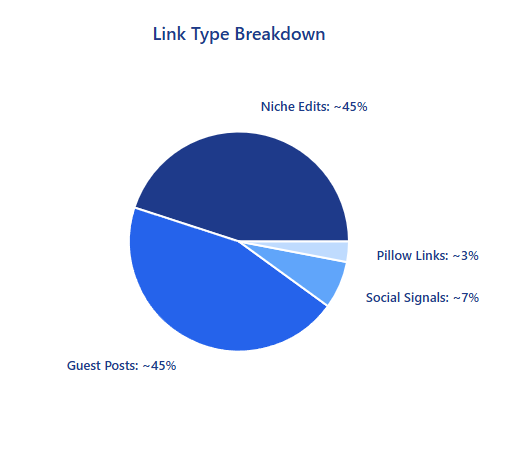
The link mix targeted a roughly 50/50 split between niche edits and guest posts – a deliberate balance we use to combine the contextual-relevance strength of niche edits with the editorial weight of guest posts.
The remaining share went to lower-cost diversification placements – pillow links in the opening month, and social signals layered in periodically across the campaign to round out the profile.
Anchor Text Analysis
The anchor strategy across 24 months reflected the site’s status as a known commercial brand and the gradual broadening into occasion-based and geographic targeting.
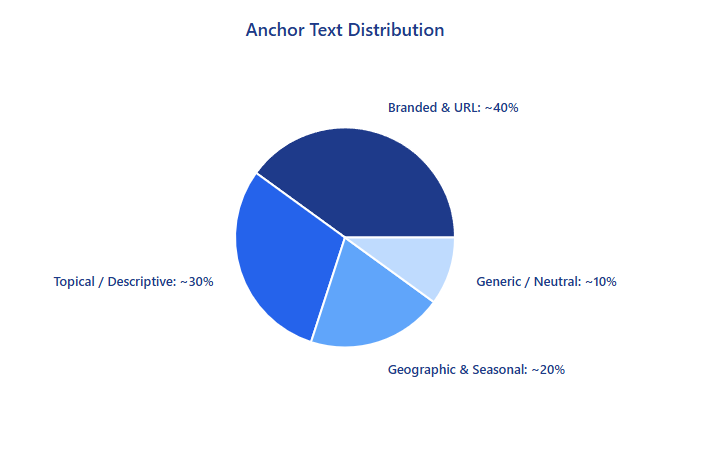
Branded and URL-style anchors carried the largest share, in line with how an established brand naturally accrues links.
Topical and descriptive anchors covered florist-services language without keyword-stuffing.
As Phase 4 brought state-page targeting into the mix, geographic anchors grew as a share of the overall profile.
Seasonal anchors mapped to the occasion-page work that ran throughout the campaign. Generic anchors stayed small, used mainly for diversification.
Target Page Distribution
Authority placement across pages followed the business priorities of each phase.
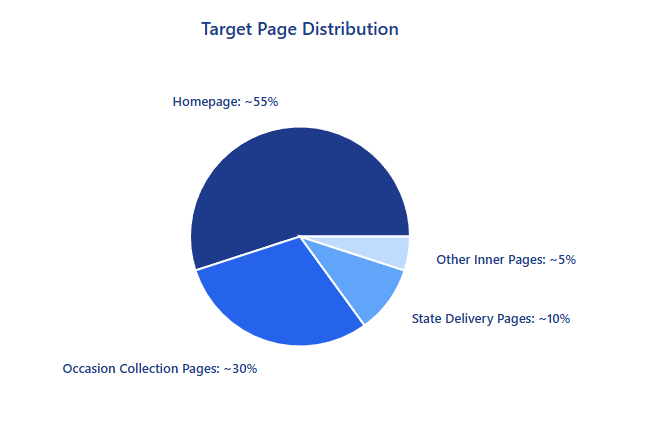
The homepage took the largest share, which is appropriate for a brand-anchored profile and which also reflects where most of the campaign’s authority needed to land.
Occasion-based collection pages – Mother’s Day, sympathy, birthday, anniversary, new baby, gift baskets – absorbed the second-largest share, supporting commercial pages that align with how customers actually search.
State delivery pages came into the mix in Phase 4 and grew steadily as the nationwide pivot played out.
What This Demonstrates
A few elements account for the results.
The site started with real fundamentals – established age, broad indexed footprint, no penalty history.
Our job was to push past the scraper-driven noise in the existing profile and build real authority on top of that foundation.
The mix of mid-to-high DR contextual links did exactly that, with DR climbing 15 points and clean referring domains multiplying by more than 10x.
Continuity mattered. Over 24 consecutive months, we had no service pauses, even as budgets fluctuated.
Authority compounds when link acquisition stays consistent, and the traffic curve through 2025 and into 2026 reflects exactly that – particularly the inflection in late 2025 as the cumulative effect of nearly two years of work began to stack.
The strategy is adapted to the business, not the other way around. Seasonal collection pages gained authority before peak-demand windows.
State pages came into focus when the client expanded nationally. Anchor distribution shifted to support the actual commercial pages without ever tipping into over-optimization.
That adaptability is what an MLB engagement is meant to enable.
The Mother’s Day decision is worth flagging as a takeaway in its own right. The strongest argument for a managed service over individual link orders is that it puts judgment, not just execution, into the relationship – and that judgment occasionally means pushing back on a client request when the SEO logic calls for it.
Conclusion
For an e-commerce site in a competitive commercial niche, the value of this campaign sits where SEO meets the buying journey.
The top 3 ranking positions multiplied roughly 5x. Monthly organic traffic grew by approximately 107,500 visits.
The majority of that traffic landed on commercial pages built to convert – same-day delivery, occasion collections, state-level service pages – rather than on informational content with weaker commercial intent.
The campaign also remains active. The client has continued the engagement without interruption since May 2024, and during this same period also engaged our service for a second site for around ten months – the kind of repeated, multi-site relationship that tends to follow when the work is doing what it’s meant to do.