Most of our campaigns start with a site that wants to climb. This one started with a client who wanted something to disappear.
When someone searches a well-known professional’s name, the first page of results becomes their reputation, whether it is fair or not.
For this client – a reputation management agency working on behalf of a healthcare executive – the problem sat at position four – a negative news article about a past legal matter, holding a prominent spot for the executive’s own name.
The agency’s brief to us was direct. Move enough credible, neutral results above that article to push it down and, ideally, off the first page entirely.
This was not a site-growth project, so there was no domain to audit and no traffic curve to chase. The work was about controlling a single search result by building authority across a portfolio of properties that already carried the executive’s name.
What follows is how we approached that, where it worked, and the one place a page didn’t respond the way we hoped.
The Brief: One Result That Had to Go
The agency came to us with a clear keyword (the executive’s name), a clear enemy (one unfavorable news result), and an open mind on tactics. Their intake notes said it plainly – whatever works is good. There was no defensive baggage to clear, just a result to outrank.
In reputation work, the target is rarely a site you own. It is usually a collection of pages that already speak well of the subject – profiles, press features, social presences – that can be strengthened until they outrank the thing you want buried. The agency had identified the most promising of these, and our job was to push authority into them.
The agency also wanted speed. They started the engagement at $500 to get moving, then asked us directly what budget would most quickly move the negative result. Our answer was less about raw spend and more about coverage. Rather than betting everything on ranking one new page that Google might resist, we recommended spreading authority across the URLs that were already responding, plus a few hub-style profiles that funnel link equity toward the others.
In our experience, that portfolio approach is more durable for reputation SERPs than trying to force a single replacement to the top. We sized the budget to the number of URLs worth pushing – roughly a few hundred dollars per property per month – and the engagement scaled up from there.
How We Approached It
We split the target properties into two groups, and we treated them differently on purpose.
The larger group was third-party properties that the executive did not host – press-release features, a personal link-hub profile, and social profiles. These pages live on strong, established domains, which means they tolerate a more assertive push.
Here we leaned on more powerful, higher-risk link types – PBN placements alongside affordable niche edits – and ran a more aggressive anchor mix, blending natural brand and URL anchors with a meaningful share of descriptive, keyword-led anchors. The host domains do the heavy lifting on trust, so the links can work harder.
The one self-hosted property in the mix – a personal site – got our standard, cautious treatment. A self-hosted domain carries its own risks if pushed too hard, so we kept the link types more conservative and the anchors weighted toward natural brand and URL references, with supporting pillow links for diversity.
Same campaign, two different risk postures, matched to what each property could safely absorb.
The split shows clearly in the link mix itself. On the third-party properties, the heavier, higher-risk link types carried roughly half the work.
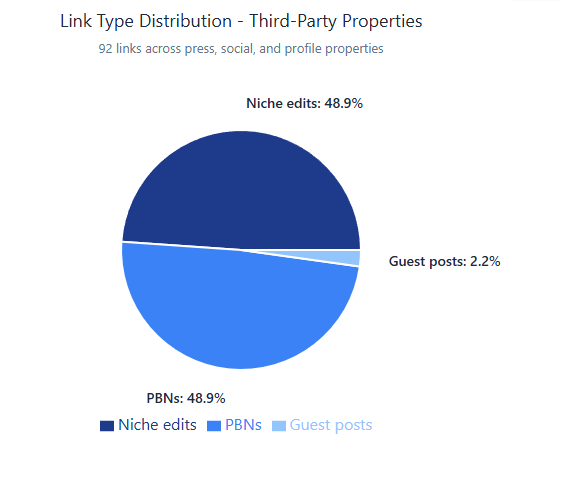
The self-hosted site tells the opposite story. It received no PBN links at all – only niche edits and a single guest post, the conservative end of what we build.
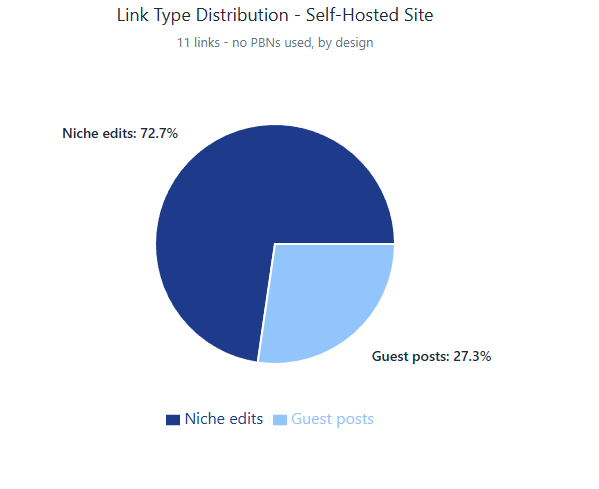
Across both groups, the logic was the same – concentrate authority on the pages most likely to respond, use hub profiles to pass equity sideways to the others, and keep building consistently rather than in a single large burst. We did not need to outrank the negative article with a single page. We needed the first page to fill up with enough strong, favorable, and neutral results that the article had nowhere to sit but lower.
It is worth saying that the first page for any well-known name is shaped by many inputs, not just ours – the subject’s own activity, press coverage, and other work all feed it. Our contribution was the authority pushed into the specific properties we were asked to strengthen, and that is where we attribute the movement below.
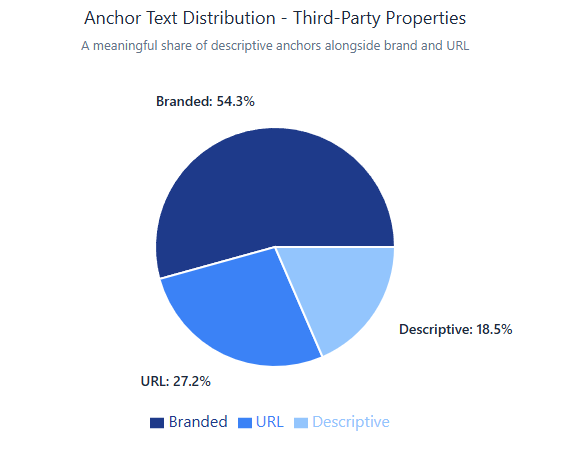
The anchor strategy followed the same split logic as the link types. On the third-party properties, where the host domains absorb the risk, we ran a more assertive anchor mix – still anchored in brand and URL references, but with a meaningful share of descriptive anchors working to reinforce relevance.
The self-hosted site was handled with markedly more restraint. Here, the anchors stayed almost entirely on brand and URL references, with none of the keyword-led anchors we were willing to use on the third-party pages – the cautious posture a domain you own calls for.
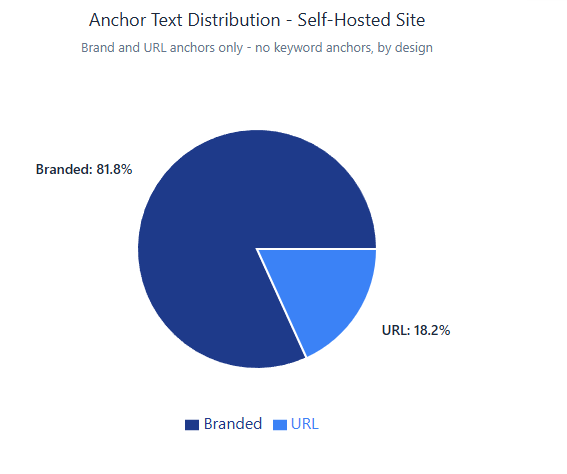
That contrast – keyword anchors used freely on properties we don’t own, kept off the one we do – is the same risk discipline that shaped the link types, applied to anchor text.
The Build, Month by Month
We ran the campaign in two distinct stretches.
The first was a concentrated push through the back half of 2025, after the budget scaled up. The client then paused over the winter to handle some internal changes on their side – new procedures and team members – before resuming at a steadier pace in early 2026, with the second stage aimed at a newer set of target URLs.
The table below tracks the build. Link authority is shown as low, mid, or high rather than as exact scores, and link types are grouped rather than counted.
| Month | Link types | Authority | Primary targets |
| Apr 2025 | Niche edits, social signals | Mid-high | Link-hub profile, first press release |
| May 2025 | Niche edits, PBNs, social signals | Low-high | Second press release, social profiles |
| Jun 2025 | PBNs, social signals | Mid-high | Social post, press release, professional profile |
| Jul 2025 | Niche edits, PBNs, social signals | Mid-high | Press release, social post, professional profile |
| Aug 2025 | Guest posts, PBNs, social signals | Mid-high | Press release, social profiles |
| Sep 2025 | Niche edits, PBNs, social signals | Low-high | Press release, social post |
| Feb 2026 | Niche edits | High | Positive news story (Stage 2) |
| Mar 2026 | Guest posts, PBNs, pillow links, social signals | Mid-high | Self-hosted site, positive news story |
| Apr 2026 | Guest posts, niche edits, PBNs, social signals | Low-high | Self-hosted site, positive news story |
The 2025 stretch did the foundational work – building up the link-hub profile, the press features, and the social properties that were already showing signs of ranking.
When the campaign resumed in 2026, we shifted toward two newer targets – a positive regional news feature and the self-hosted personal site – to widen the set of favorable results competing for space on page one.
What Moved
The honest version of this story is that the payoff lagged the work, which is normal for this kind of campaign.
Through the entire 2025 push, the negative article did not budge. It held position 4 month after month, even as the properties around it climbed. That is the part clients find hardest to sit with, and it is exactly why we keep reminding them that authority compounds on a delay – the links built in one month often do not express themselves for several more.
The break came later. By the time the campaign was wound down in mid-2026, the negative article had dropped from position 4 to around position 13, off the first page. As of late June 2026, it had fallen further, to roughly position 23.
The result the client wanted gone was no longer anywhere a casual searcher would look for it.
| Property and role | Where it ended up |
| Negative news article (the result to suppress) | Held #4 all through 2025, then fell to ~#13 by wind-down and ~#23 by late June 2026 |
| Personal link-hub profile | Held page one throughout, reaching the top of the first page mid-campaign |
| Professional network profiles | Held page one consistently |
| Press-release features | Ranked on page one early; later cycled as the subject’s broader newsroom presence grew |
Two of our targets did not behave the way we wanted, and they are worth being straight about. Not every page responds to authority in the same way, and a campaign that only reports its wins doesn’t tell you much.
| Item | What happened | Context |
| Positive regional news story | Did not rank in the target results during our window | A single story on a large, busy news domain proved unresponsive to links in the time we had; not every page will respond, which is why we favor pushing the ones that do |
| Self-hosted personal site | Climbed to #2, then moved to page two near the end | This was displacement rather than decline. As more favorable results established themselves on page one, the first page simply got more crowded; a page holding #2 gets pushed down when stronger positive results stack above and around it. For a suppression campaign, more good results competing for space is the outcome you want, even when it nudges one of your own pages down |
Neither of these changed the headline. The article the client engaged us to bury was off the first page and still falling when the work ended.
Why It Worked, and What We’d Carry Forward
This campaign worked because it did not depend on any single page winning.
By spreading authority across a portfolio of properties – some pushed hard, one handled cautiously – and by funneling equity through hub profiles, we made the first page crowded enough that the unwanted result lost its footing.
No one placement had to be perfect, and as the displacement of our own self-hosted page showed, a first page filling up with favorable results is the mechanism doing the work.
The lag is the other lesson, and it is one we’d underline for any reputation client. The negative article sat unmoved at position four for months while we built, then dropped well after the heaviest work was done, and kept dropping after we stopped. Suppression is cumulative. It rewards patience and consistency far more than intensity, and the gains can keep arriving once the links have had time to settle.
A reputation SERP is also never finished, as a ranking report might suggest. The first page keeps shifting as new results appear and old ones fade, which is why continued authority-building tends to keep a buried result down rather than letting it drift back up. In our experience, the campaigns that stay suppressed are the ones where the positive properties keep getting reinforced.
The engagement ended in June 2026 because the goal had been met – the damaging result was buried, and the client confirmed the problem was resolved on their end. That is the right reason for a campaign like this to close. When the result you were hired to move is gone from where it mattered, the work is done.