Most of the campaigns we write up here begin at zero and build upward. This one didn’t.
We were brought in to help an established telehealth healthcare provider that had already lost a lot of ground – a site with years of history and real authority behind it, but with a traffic curve that had been sliding for months before we placed a single link.
In our experience, that distinction changes the whole job.
Recovering a site that has slipped is not the same as growing a new one: the trust is already there to be rebuilt rather than earned from scratch, and there is usually a reason the decline began that off-page work alone can’t fully undo.
Going in, we treated this as a recovery project, not a growth play.
The engagement ran for about five months as a managed link building (MLB) client before the client chose to pause it. Our involvement was limited to off-page SEO, working alongside the client’s own content and technical SEO.
What follows is a candid account of what we inherited, the approach we took, what moved during the active window, and – just as honestly – what was left unfinished when the work stopped.
Starting Point & Initial Audit
Before placing anything, we ran a full off-page audit to understand what we were actually dealing with.
The short version: this was an established site with genuine history behind it, but one that had been losing visibility for a while – and the reasons for that mattered more than any single metric.
The Site We Inherited
This was not a new domain. The site had years of accumulated content and links behind it, close to 570 pages indexed, and a Domain Rating of 35 – a profile that, on paper, looked like a healthy mid-authority site.
Underneath that, though, the trend was pointed the wrong way. Organic traffic and keyword visibility had peaked around September 2024 and had been sliding steadily since.
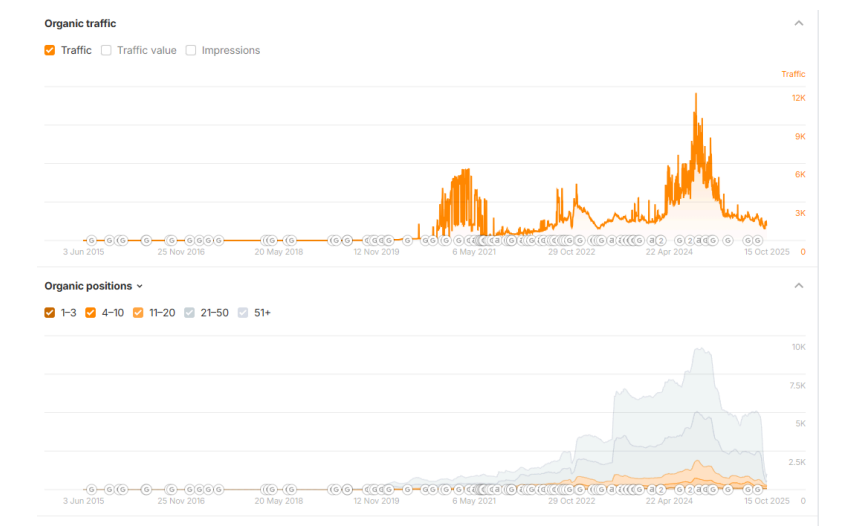
By the time we picked things up in October 2025, the site was down to roughly 810 ranking keywords and about 1,200 monthly organic visits, well off its highs.
Rather than the raw authority numbers, the direction of travel was the real story here. In our experience, a decline that has been running for the better part of a year rarely traces back to a single cause, and it almost never resolves on its own.
The timing fit a broader pattern, too. The site’s peak came right as Google’s August 2024 Core Update rolled out, and the renewed slide our audit flagged from mid-2025 lined up with the June 2025 Core Update – a stretch when Google was actively re-ranking search across the board.
The nature of the site matters here as well. As a health service, it sits in what Google treats as a YMYL – Your Money or Your Life – category, where the bar for expertise, authority, and trust is set higher, and broad updates tend to re-rank the whole vertical harder.
A legitimate, established provider isn’t penalized for that. But it does mean authority signals get scrutinized more closely, and off-page work has to move in step with the content and expertise signals Google weighs most for health sites.
It’s part of why we treated the rebuild as a patient, foundation-first job rather than something a burst of links could shortcut.
What the Backlink Profile Told Us
Digging into the links themselves, the picture got more specific.
The domain carried a large number of referring domains on paper, but only around 50 of them were the kind of higher-quality, contextual links that actually move authority – and most of those were pointing at inner pages rather than the homepage.
For a site trying to rebuild trust at the domain level, that distribution works against you. The strongest signals were being spent deep in the site instead of reinforcing the foundation.
The anchor text profile was mostly natural, which was a point in the site’s favor, but we were starting to see mild overuse of exact-match anchors creeping in.
The homepage itself had a reasonable link profile, though one inner page was carrying a disproportionate share of links relative to the site’s overall count.
One more thing stood out, and it’s worth being upfront about. Our records showed this client had come to us once before – a single one-time order back in 2023 – and then nothing sustained after that. There had never been a committed, ongoing campaign behind the site.
In our experience, that is often part of the story when an established site drifts downward: authority work gets treated as a one-off rather than something maintained, and the profile gradually falls behind the sites it competes with.
Our Read
Putting it together, we treated this as a recovery project rather than a growth campaign.
The priority was to rebuild homepage and domain-level trust, stabilize the decline, and give Google consistent, natural signals over time – before getting anywhere near aggressive inner-page targeting or more deliberate anchor work.
A site in this position needs to prove it has regained its footing first; everything more ambitious comes after that.
Strategy
As a managed link building client, the plan was never fixed. We reassess this kind of site month to month and adjust based on how it responds, which matters even more on a recovery project than on a straightforward growth build.
The starting logic was simple: before chasing rankings on any single page, we needed the domain itself to look trustworthy again.
Rebuilding Authority at the Homepage First
That meant pointing the bulk of our early links at the homepage. When a site has been sliding, concentrating authority on the foundation signals to Google that the whole domain is being reinforced, not just a page or two.
It also corrected something from the audit, where the site’s existing quality links were scattered across inner pages instead of supporting the core.
Laddering Up From Mid- to High-Authority Links
We didn’t lead with our strongest links either. Early on, we leaned on solid mid-authority placements, then layered in higher-authority links as the profile settled.
That pacing looks more natural for a site rebuilding trust than a sudden burst of high-power links, and it let us see how the site absorbed each round before pushing harder.
By the later months, once the foundation was in place, nearly every link we built was high-authority – the kind of acceleration a recovery site earns only after it has stabilized.
Keeping the Anchor Profile Conservative
Anchor usage stayed deliberately cautious.
We led with branded and URL-style references, kept generic and neutral phrasing in the mix, and introduced more descriptive, topical anchors only sparingly once the branded base was solid.
Given that the audit already showed mild exact-match overuse, restraint there was a priority rather than an afterthought.
Adding Diversity Without Overstating It
Alongside the contextual links, we added a light layer of supplemental signals early on for a bit of natural diversity – the sort of thing that helps a rebuilding profile look more organic without pretending to move authority on its own.
Pacing the Build Like a Recovery
Above all, we built consistently rather than in bursts. Link velocity was kept measured and scalable-looking, which is the right posture for a site that needs to demonstrate regained trust over time rather than force a quick jump.
The honest tension in this approach is that it asks for patience. Recovery work compounds slowly, and the payoff shows up over months of steady building – a point that becomes important later in this story.
The Build, Month by Month
With the recovery framing set, the execution was steady and deliberate. We built every month the engagement was active, starting with a foundation-first mix and laddering up the authority as the site settled.
The table below lays out what went out each month, the DR range of the placements, and where they pointed.
| Month | Link Types | DR Range | Target Focus | Notes |
| Oct 2025 | Niche edits, Guest posts, Social signals | DR 10–50 | Homepage | Opening order |
| Nov 2025 | Niche edits, Guest posts | DR 36–51+ | Homepage | First higher-authority placements layered in |
| Dec 2025 | Guest posts, Niche edits | DR 36–51+ | Homepage + inner page | Continued homepage emphasis, with a first selective inner-page target |
| Jan 2026 | Niche edits, PBN link | DR 51+ | Homepage + inner page | Shift to high-authority placements; a single PBN link added for diversity |
| Feb 2026 | Guest posts | DR 51+ | Homepage + inner page | Leaner final build before the pause |
A few things are worth pulling out of that table.
The authority curve moves in one direction. We opened with a spread that dipped as low as DR 10 for diversity and topped out in the mid-range, then tightened month over month until nearly everything we placed sat at DR 51+.
That’s the ladder working as intended – earn the footing first, then push harder.
The target focus shifts the same way. The opening month went to the homepage only, reinforcing the foundation. Once that base was down, we allowed a single inner page into the mix each month while still keeping the homepage as the priority.
One external factor is worth flagging honestly: the Google December 2025 Core Update landed right in the middle of the campaign.
It introduced real volatility into the SERPs during the exact window we were trying to establish stability, and it shows up in the traffic data we’ll get to next.
Recovery & Results
Recovery projects rarely produce a clean before-and-after chart, and this one is no exception.
The honest read is mixed: some signals moved in the right direction during the active window, others stayed stubborn, and the campaign was paused before the slower-moving needle could really turn.
Here’s the full picture.
What Actually Improved
The clearest gains showed up where a rebuilding site tends to show them first – in authority and in top-of-page rankings, rather than in raw traffic.
| Metric | At Audit (Oct 2025) | Final Report (Mar 2026) | Change |
| Top 3 Rankings | 50 | 60 | +10 |
| Domain Rating | 35 | 39 | +4 |
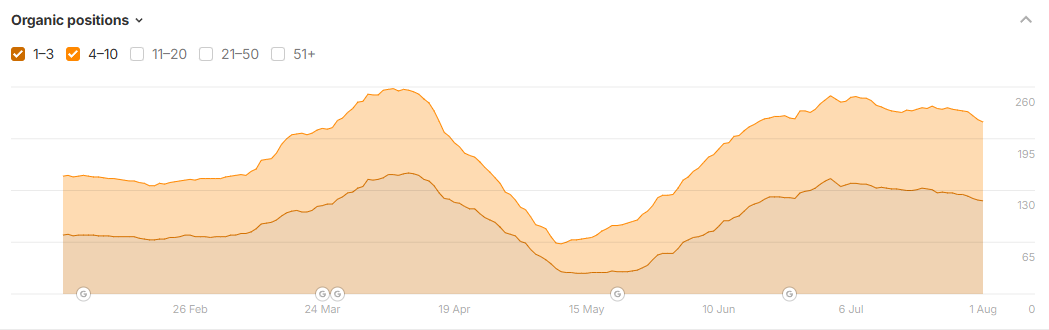
Both moved quietly but consistently. Top-3 keyword rankings actually finished higher than where the site started, having dipped mid-campaign before recovering – and Domain Rating ticked up as the homepage-focused authority accumulated.
Those aren’t blockbuster numbers. But for a site that had been sliding for over a year, halting that slide and nudging the core signals upward is exactly what the recovery phase is supposed to do.
The Traffic Story
Traffic is where the honesty matters most, so here it is straight.
Measured start to finish, traffic was down over the active window – not up. The site did not return to its former levels, and we wouldn’t claim otherwise.
At the first clean monthly report in November, on a consistent reporting view, the site sat near 774 monthly organic visits. The Google December 2025 Core Update then hit mid-campaign and pushed it down to a low near 444 in January. From there it recovered to roughly 594 by the March pause.
So the honest net figure is a decline of around 23% across the window. What changed is the trajectory: the long slide was arrested, and the final two months were the first sustained upward movement the site had seen in a long time – a recovery off the bottom rather than net growth.
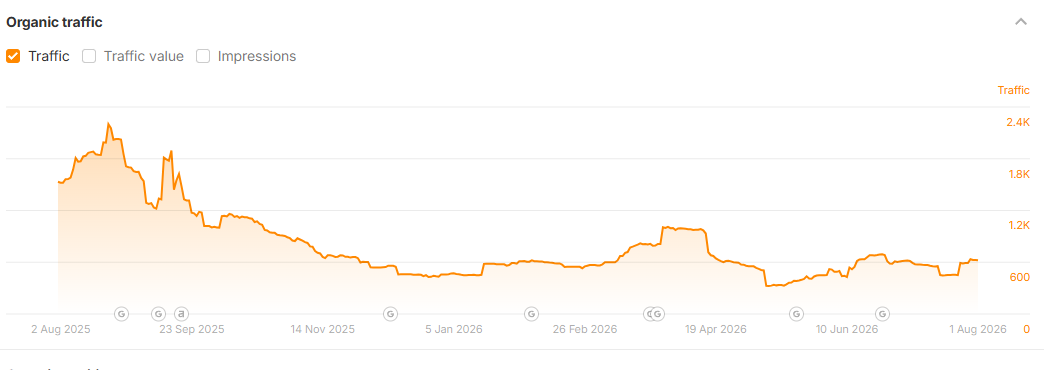
So the momentum at the end of the build was pointed the right way. It was modest, it was early, and – as we’ll get to – it never got the runway to prove whether it would hold.
The rankings data tells a similar story of stabilization, with the top-of-page positions firming up over the final two months even as the broader keyword set stayed flat.
The Metrics That Look Worse Than They Are
A couple of surface numbers moved the wrong way during the campaign, and rather than bury them, it’s worth explaining why they’re not the signals to watch.
| Metric | Direction | Context |
| Referring domains (Ahrefs) | Down (~408 → ~333) | An unreliable indicator on its own. Low-quality and spam links are constantly being added to and dropped from any established profile, so the raw count churns independently of the quality links we actually built |
| Total ranking keywords | Down vs audit (810 → ~445) | Most of this drop predated our involvement and reflects the location-reporting inconsistency Ahrefs is known for, which the monthly reports flagged throughout. The count stabilized during the campaign rather than continuing to freefall |
| Organic traffic (start to pause) | Down (~774 → ~594) | Net down about 23% across the active window – but the shape matters. The multi-year slide was halted, and the final two months turned upward: a recovery off the January low rather than continued freefall |
This speaks directly to a fair concern the client raised partway through: referring domains were growing on paper, yet traffic wasn’t following.
They were right to notice it – but referring-domain count was never the number that mattered here.
The backlinks count rises and falls with spam that often has nothing to do with the authority work.
What we were actually watching were the homepage’s trust signals, the Top-3 rankings, and whether the traffic slide had stopped – and those were the metrics that quietly moved in our favor.
After We Paused
For a complete picture – once active link building stopped in spring 2026, the late-campaign stabilization did not carry forward.
The most recent data shows organic traffic settling back to a low, flat baseline rather than continuing the modest recovery seen in the final two months of the build.
Anchor & Target Page Approach
The audit had flagged two things we wanted to be careful about – a mild drift toward exact-match anchors, and quality links landing on inner pages instead of the homepage.
Both shaped how we distributed anchors and targets throughout the build.
Keeping Anchors Branded and Conservative
The anchor profile we built leaned heavily on the safe end of the spectrum, by design:
- Branded and URL-style anchors made up the largest share at roughly 52% – the natural, low-risk references that reinforce trust without sending aggressive signals.
- Generic and neutral phrasing accounted for around 19%, the kind of non-descriptive references that keep a profile looking organic.
- Only the remaining ~29% carried topical or descriptive intent, and we introduced those sparingly and mostly later in the build, once the branded base was firmly established.
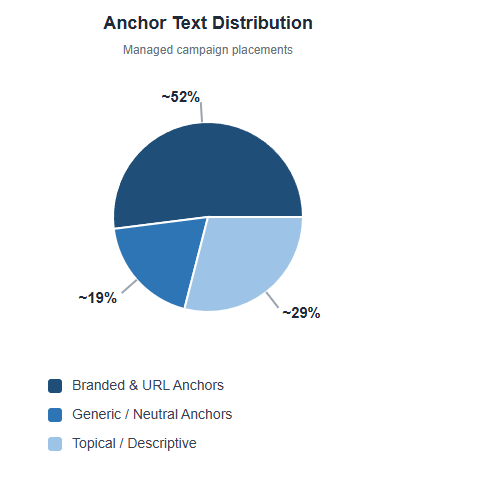
That weighting was a deliberate correction. With exact-match usage already creeping up before we arrived, the last thing a recovering site needed was more optimized anchors piling on – so we kept the descriptive layer thin and let branded references carry the load.
Concentrating Authority on the Homepage
Target-page distribution followed the same recovery logic, pointing the clear majority of links at the homepage to rebuild authority at the domain level:
- The homepage took roughly 80% of all placements.
- A small share, around 10%, went to service and location pages once the foundation was in place,
- The remaining ~10% supported blog-level pages rather than individual posts.
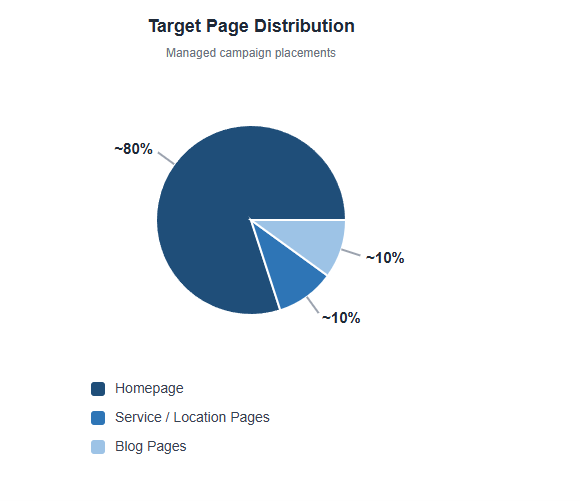
This top-heavy structure was the direct fix for what the audit surfaced.
Where the site’s existing quality links had been scattered across inner pages, we pulled the emphasis back to the core – letting authority accumulate where it would do the most to rebuild overall trust, while still allowing a measured amount to reach the pages that mattered commercially.
What This Campaign Shows
Judged on its own terms, the recovery approach did what it was built to do.
The year-long slide flattened, Domain Rating and Top-3 rankings moved up, and the final two months showed the first real traffic recovery the site had seen in a long time.
On a site that arrived in decline, that’s a foundation being rebuilt, not a quick win being manufactured.
The homepage-first strategy was the right call for the situation. Concentrating authority on the domain, keeping anchors conservative against a profile already drifting toward exact-match, and laddering from mid- to high-authority links all pointed at the same goal – proving to Google that the site had regained its footing before asking it to rank harder.
For a commercial site like this one, the signals that moved are the ones that eventually matter.
Recovering Top-3 visibility and a strengthening homepage are what put a patient-acquisition site back in front of high-intent searchers.
The gains were early and modest, but they were the leading edge of the kind of visibility that turns into inquiries and bookings.
The honest limitation is runway. Recovery work compounds slowly, and this campaign ran for about five months before it was paused – with the budget reduced partway through, at the point where the numbers were just starting to turn.
The site’s history tells a consistent story: a single one-time order back in 2023, no sustained authority work behind it, and a decline that set in during that gap.
In our experience, that’s the harder lesson in recovery SEO – and it’s sharper still for a YMYL health site, where Google’s higher trust bar means authority has to be rebuilt patiently and in step with strong content signals, not rushed.
The approach can be sound, and the early signals can point the right way, but a rebuilding site needs consistent building over time to convert stabilization into sustained growth.
Momentum that isn’t maintained tends to fade – which is what the most recent data reflects.
None of that changes what the active window demonstrated. Given the runway, the trajectory at the end of the build was the one you’d want to see continue.