Most of the campaigns we write up here move in one direction: up. This one moved the other way, and that is exactly why we wanted to document it.
The site was not a fresh build. When the client came to us at the end of 2024, it was already an established tool in the Google Drive productivity space – a domain rating around 39, roughly 320 referring domains, a link history going back to 2015, and real organic traffic arriving every month. It was ranking.
The brief was not to put the site on the map, but to push a group of commercially important keywords that kept bouncing on and off page one into steadier positions.
We ran a managed link building campaign here for about nineteen months. Across that stretch we built consistently, and by the usual measures of link quality we built well – mostly high-authority guest posts and niche edits, conservative pacing, sensible targeting. The rankings still slid.
The honest reason is worth stating plainly, because it shapes everything that follows. Almost every keyword this site cared about was a “Google Drive” keyword – and over the course of the campaign, the top of those results filled up with Google’s own properties, its help and support pages and Workspace content, alongside a handful of other giant-authority sites like Reddit and Stack Exchange.
That is a difficult position for any independent site. You are competing with Google, inside Google’s search results, for queries about a Google product, under rules Google writes. In our experience, links do a lot of things well, but they do not win that particular fight.
What follows is a straight account of how it played out and what it teaches – about the links we built, the numbers they moved and did not move, and why the outcome had far more to do with who else showed up in the SERPs than with anything in the backlink profile.
Starting Point & Audit
The first thing worth saying about this site is that there was very little to fix.
When we audited it in December 2024, it was not a struggling domain looking for a rescue – it was a healthy, established property that was already doing a lot of things right.
Our job was going to be about gaining ground, not repairing damage.
The Numbers at the Start
By the time the client engaged us, the site had a real footprint. It had been accumulating links since 2015, had roughly 214 pages indexed, and was pulling in meaningful organic traffic each month rather than scraping for its first rankings.
| Metric | At audit (December 2024) |
| Domain Rating | 39 |
| Referring domains | 321 |
| Organic keywords | 16,900 |
| Top-3 rankings | 256 |
| Organic traffic | 5,400 / month |
The backlink profile was relevant and natural for the most part, though it leaned on a fairly small base of genuinely strong links – by our count only around nine higher-quality contextual placements from sites with solid metrics and traffic of their own.

The anchor text was a mixed bag: mostly fine, with a handful of slightly overused exact-match anchors. Link distribution across the site was sensible, with a good amount pointing at the homepage and no inner page carrying an unnatural share.
One detail from the history mattered more than it first appeared.
The traffic curve was young despite the domain’s age – the site had sat quiet for years and only began climbing in mid-2023, accelerating through 2024, with visible volatility along the way. A profile like that tends to still be settling, and settling profiles can move sharply in either direction.
The Client’s Own Read
Two pieces of context came directly from the client, and both shaped how we approached the account.
- The first was a rebrand. Around eighteen months earlier the business had migrated from an older domain to its current one for trademark reasons, and the redirect had taken roughly six months to fully express itself in rankings – a reminder that this domain had already lived through one disruptive transition before we arrived.
- The second was more strategic, and we took it seriously because it came from someone who clearly knew their own numbers. The client told us plainly that their blog content, while plentiful, did not convert well, and that the homepage and the commercial landing pages under the tools section were where the value actually lived. That single insight pointed our targeting toward the pages that mattered to the business rather than the ones that simply attracted clicks.
The client also asked us to keep PBNs off the table entirely, which suited the profile – a clean, contextual-links-only approach was the right fit for a site with this much legitimate history behind it.
Strategy
Because the site arrived in good shape, our plan looked nothing like the cautious foundation-building we use on brand-new domains. There was no trust to establish from scratch and no risky profile to unwind. We could start pushing authority toward specific pages and specific keywords from month one, which is a luxury a younger site rarely affords.
The shape of the campaign came down to three decisions.
- First, where to point the links. The client’s own read – that the tools pages and homepage carried the commercial value while the blog did not – became our targeting rule rather than a footnote. We concentrated on the homepage and the tools section, treated the blog as a light, occasional target for naturalness, and largely left individual articles alone. There was little sense in pouring authority into pages the client had already told us did not convert.
- Second, what kind of links to build. We stayed with real contextual placements – guest posts and niche edits on relevant sites – and leaned toward mid and high authority throughout, with a clear tilt to the strong end of that range. For an established site chasing competitive keywords, a smaller number of genuinely authoritative links tends to do more than a larger pile of weak ones, and it keeps the profile clean. PBNs were excluded at the client’s request, which matched our own instinct here anyway.
- Third, how to handle anchors. This is where the established starting point changed our usual approach. On a new site we anchor heavily to the brand and the bare URL and expand only slowly. Here the domain already had years of history and a settled branded base, so we could be more direct – weighting toward descriptive, topical anchors that spoke to the actual keywords the client wanted to move, while keeping branded, URL and generic anchors in the mix for balance. It was a deliberately more assertive anchor profile than we would use on a younger property, and the site’s maturity gave us room for it.
Around those decisions we kept a few things deliberately loose. As a managed campaign, the mix was reassessed at the start of every month rather than fixed in advance – some months skewed toward niche edits, others toward guest posts, with occasional social signals added for a more natural overall footprint.
The client was unusually engaged throughout, regularly asking about link types and specific placement sites and generally wanting to be part of the process, which made those monthly adjustments a genuine conversation rather than a one-way report.
What we could not do anything about from the link-building side – and did not yet know would become the whole story – was who else would be competing for these rankings as the months went on.
What We Built, Month by Month
Over the roughly nineteen months we ran the account, the build itself was steady and unremarkable in the best sense – no bursts, no experiments, just a consistent flow of contextual links reassessed each month.
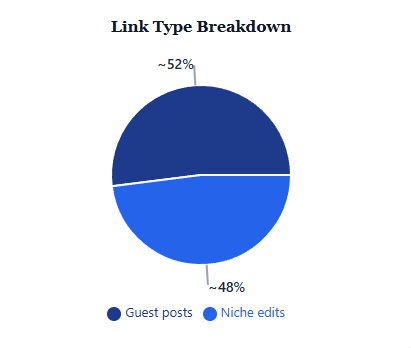
In total we placed 44 guest posts and niche edits, with around nine in ten coming from mid to high-authority sources and close to half from the strongest DR 51+ tier, supported here and there by social signals for a more natural overall footprint.
| Month | Link types | Authority | Notes |
| Dec 2024 | Niche edits | Mid | First cycle; edits into existing pages to start moving authority |
| Jan 2025 | Niche edits, guest posts, social signals | Mid | Wider mix introduced, first signals added for diversity |
| Feb 2025 | Guest posts, niche edits | High | Stepped up to the strong end of the authority range |
| Mar 2025 | Niche edits, guest posts | Mid | Balanced edit-and-guest-post cycle |
| Apr 2025 | Guest posts, niche edits | High | High-authority placements pressing the commercial pages |
| May 2025 | Guest posts, social signals | High | Two strong guest posts plus signal diversity |
| Jun 2025 | Niche edits | Mid | Niche-edit-led cycle across mid-authority sources |
| Jul 2025 | Guest posts, niche edits, social signals | Mid to high | Mixed authority with added signals |
| Aug 2025 | Niche edits, guest posts, social signals | Mid to high | Mixed cycle holding pacing |
| Sep 2025 | Guest posts | High | Two high-authority guest posts |
| Oct 2025 | Niche edits | Mid | Niche-edit cycle for steady reinforcement |
| Nov 2025 | Guest posts, niche edits, social signals | Mid to high | Mixed cycle with signals |
| Dec 2025 | Guest posts, niche edits, social signals | High | Strong guest-post pair with a supporting edit and signals |
| Jan 2026 | Niche edits, guest posts, social signals | Mid to high | Mixed authority cycle with signals |
| Feb 2026 | Guest posts | High | Two high-authority guest posts |
| Mar 2026 | Guest posts, niche edits, social signals | Mid to high | Mixed cycle with signals |
| Apr 2026 | Niche edits, guest posts, social signals | Mid to high | Mixed cycle with signals |
| May 2026 | Guest posts | High | Two high-authority guest posts |
| Jun 2026 | Guest posts, niche edits, social signals | Mid to high | Final cycle before we paused |
The point of laying it out this way is that nothing in this log went wrong. The cadence held, the authority stayed where we wanted it, and the targeting followed the plan. If a campaign’s results tracked its link inputs, this one would read as a success.
That it did not is the whole reason the next section exists – and why the explanation lives in the search results rather than in anything above.
The split between our two main link types stayed close to even across the campaign.
What Happened
For the first few months, the plan looked like it was working.
Traffic climbed through the opening stretch of the campaign to its highest point in early 2025 – a clear step up on where the site started – and the commercially important keywords were holding steadier near the top of page one. If the case study had ended in spring 2025, it would have read like every other one we publish.
It did not hold. From mid-2025 onward the trend turned, and it kept turning. Rather than separate the metrics that improved from the ones that declined – the way we normally would – we will show them honestly, because on this campaign almost everything that reflects real site performance moved the same direction.
| Metric | December 2024 | July 2026 | Change |
| Organic traffic | 5,400 / mo | 930 / mo | -83% |
| Top-3 rankings | 256 | 88 | -66% |
| Organic keywords | 16,900 | 596 | -96% |
A note on that keyword figure, because we do not want to overstate it – part of the drop reflects a reporting change in late 2025 that capped how deep the ranking tools count, so the raw keyword total fell further than the site’s real visibility did. But traffic and top-three positions are not affected by that change, and both fell hard on their own. The direction is not a reporting artifact.
Two other headline numbers moved in ways that look positive on paper but say nothing good about performance, so they belong in their own context.
| Metric | December 2024 | July 2026 | Context |
| Domain Rating | 39 | 39 | Flat across the whole campaign – our links held authority steady, but authority was never the constraint |
| Referring domains | 321 | 592 | Higher, but this reflects passive link churn far larger than anything we built, not earned authority – see below |
The traffic curve tells the story better than any table can. It shows the early climb to a peak, a long plateau through the first half of 2025, and then a stepped decline – one leg down as the March 2025 core update landed, a sharper drop from around September 2025, and a further leg down into spring 2026 before flattening near the bottom with a faint uptick at the very end.
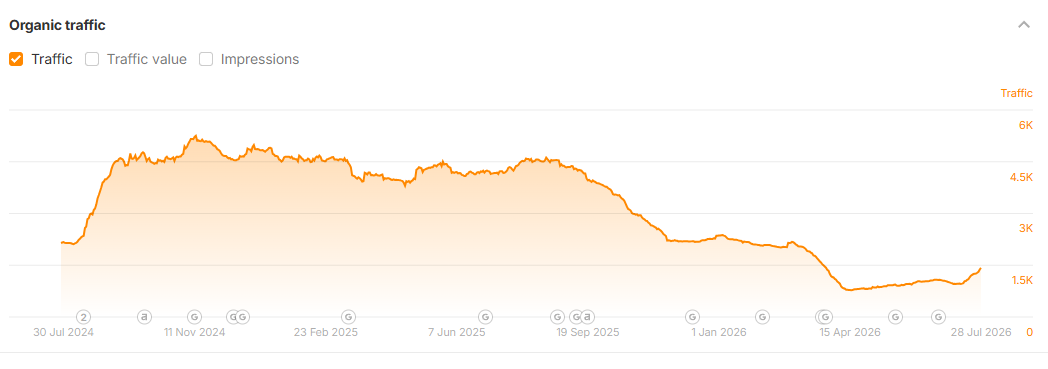
What makes the decline so clearly external, rather than something in our work, is the referring-domains line over the same period.
We built a steady handful of links each month, yet the site’s referring-domain count lurched around by the hundreds – jumping sharply in mid-2025, collapsing in spring 2026, then rebounding again – all on a scale that has nothing to do with two or three placements a month.
This is passive link accumulation and churn, the ordinary background noise of an older domain, and it moved independently of both our campaign and the traffic.
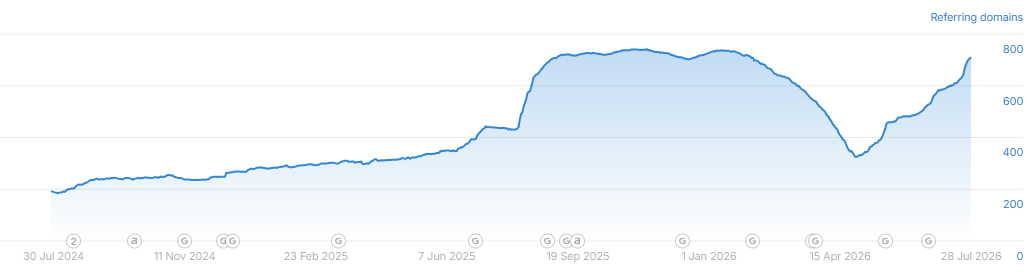
Put the two curves side by side and the point is hard to miss. By July 2026 the site had more referring domains than when we started and exactly the same Domain Rating, while its traffic had fallen by more than four-fifths.
Links were not the missing ingredient, and more of them were never going to be the answer. Something was happening in the search results themselves – and that is what the next section is about.
Anchor & Target Page Approach
Even though the campaign did not deliver the rankings we wanted, the mechanics of it are worth showing, because they were sound – and because a reader trying to learn from this study deserves to see that the decline did not come from a sloppy or aggressive link profile.
If anything, the anchor and target choices here are a reasonable template for an established site.
Where the Links Pointed
Targeting followed the client’s own commercial logic.
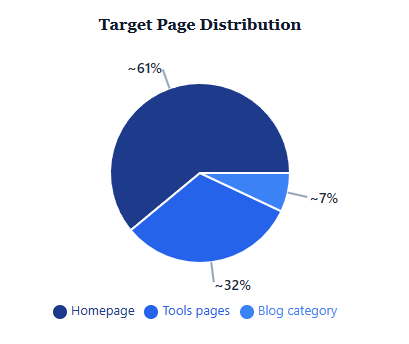
The homepage took the largest share as the domain-level anchor of the whole profile, the tools section – the pages the client identified as their real converters – took the next largest block, and the blog received only a light, occasional presence for naturalness:
- Homepage – roughly 61%
- Tools pages (hub and individual tools) – roughly 32%
- Blog category – roughly 7%
That distribution was deliberate. We were not trying to lift blog articles that the client had already told us did not convert; we were concentrating authority on the pages that mattered to the business.
As it turned out, that instinct aligned with how the SERPs moved – the commercial tools pages proved far more durable than the informational content, a point we come back to in the closing analysis.
How the Anchors Were Built
The anchor profile was more descriptive than we would ever run on a young site, and deliberately so.
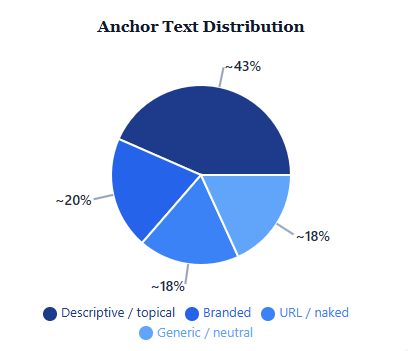
With years of branded history already behind the domain, we did not need to spend the campaign rebuilding a branded base – we could weight toward the topical, keyword-relevant anchors that actually supported the terms the client wanted to move, while keeping branded, URL and generic anchors present for balance:
- Descriptive / topical – roughly 43%
- Branded – roughly 20% URL / naked – roughly 18%
- Generic / neutral – roughly 18%
The result was an assertive but still natural-looking spread: no single category dominated, exact-match pressure stayed controlled, and the descriptive anchors did their job of reinforcing relevance rather than forcing it. In our experience this is close to how an anchor profile should look on a mature site being pushed toward competitive terms – which is exactly why it is worth stressing that the profile was not the problem here.
Why It Played Out This Way
If the links were sound, the targeting sensible and the authority stable, then the explanation has to live somewhere the link building could never reach – and it does.
It lives in who else showed up in the search results.
Nearly every keyword this site was built around was a “Google Drive” keyword – how to clean up Google Drive, how to find duplicate files, how to organize storage, and so on. That focus made complete commercial sense – it is what the tool does and who its customers are.
But it also meant the site was competing for queries about a Google product, inside Google’s own search engine, on terms where Google itself has the strongest possible claim to the top of the page.
Over the course of the campaign, that is exactly what happened.
When we looked at the results pages where the site used to rank, we increasingly found them occupied by Google’s own properties – support and help documentation, Workspace pages – alongside a handful of other giant-authority destinations like Reddit and Stack Exchange. These are not competitors an independent site outranks with a few contextual links a month. They carry the kind of domain authority, brand trust and, in Google’s case, home-field advantage that no reasonable link budget competes with.
The March 2025 core update was the first clear marker. The site’s traffic stepped down as that update rolled out, with a visible loss of featured snippets among the casualties – the small, high-value placements that had been feeding a disproportionate share of clicks. From there the pattern continued through the rest of the year, with a sharper decline from around September as the results pages kept consolidating around the largest authorities.
There was a second, quieter shift running underneath all of this, and it hit the same keywords especially hard. Informational “how do I do X in Google Drive” queries are precisely the kind that Google increasingly answers directly – through its own support pages, through featured snippets, and through AI-generated overviews sitting above the traditional results.
For a site whose blog existed to answer exactly those questions, that is an unforgiving environment. The clicks that used to reach an independent article now often never leave the results page at all.
This is where the one genuinely instructive bright spot appears.
The site’s pages did not all fall equally. The informational blog content, sitting directly in the path of Google’s own answers and support documentation, took the worst of it. The commercial tools pages – the ones the client had flagged as their real converters, and the ones we had concentrated the campaign on – held up considerably better, staying on page one even as they drifted lower. The targeting decision made at the start turned out to protect the pages that mattered most, even though it could not reverse the broader trend.
None of this is a knock on the client’s site, which remained a legitimate, well-built tool throughout.
It is simply the reality of the position. In our experience, links are powerful when the fight is winnable – when the gap between a site and the pages above it is a gap in authority that authority can close. They do far less when the pages above you are the platform itself, ranking for its own product, in a search engine it controls. That was the fight here, and it is not one more guest posts were ever going to win.
What This Campaign Teaches
We publish the wins because they are satisfying to write.
We are publishing this one because it is more useful than most of them.
The central lesson is about the limits of link building, and it is one we would rather state plainly than dress up. Links move sites when the obstacle in front of them is an authority gap – when the pages ranking above you are beatable sites that more and stronger links can help you overtake. That was not the situation here.
The pages taking this site’s rankings were Google’s own support and Workspace properties and a handful of the largest authority sites on the web, competing for queries about a Google product inside Google’s search results.
A $500 per month link budget wins that fight, and it would have been dishonest to imply that a bigger one might have. Knowing which battles links can and cannot win is, in our experience, as valuable as any tactic.
The niche mattered as much as the competitor.
A site built almost entirely around informational “Google Drive” queries was always exposed to Google answering those queries itself – through support pages, snippets and AI overviews that increasingly resolve the question before a user ever reaches an independent result. That is a structural headwind, not a link-building failure, and it is worth weighing before investing heavily in content that sits directly in a platform’s line of sight.
There is a real positive to carry out of this, though, and it is not a consolation prize.
The one strategic choice we made at the very start – concentrating authority on the commercial tools pages the client had identified as their true converters, rather than the blog – is the choice that held up. Those pages stayed on page one when the informational content did not. It is a clean illustration of a principle that applies well beyond this account: point your strongest links at the pages that carry real business value and are defensible in the SERPs, not at the pages that merely attract traffic. When conditions turn, the difference between those two decisions is what is left standing.
The work itself was never in question. Across nineteen months we built consistently, at high authority, with clean anchors and disciplined targeting, and the backlink profile ended the campaign healthy – the same Domain Rating it started with and a larger, natural-looking link base. The links did what links do. The search landscape simply moved in a direction that links could not follow, and when the client chose to pause the campaign, it was that landscape, not the linking, that had made the difference.
For a site competing with Google, on Google, for Google’s own keywords, holding any commercial ground at all is a more honest measure of success than the traffic chart alone would suggest – and it is the part of this campaign we would repeat without hesitation.