Many campaigns we document start with a website at zero. This one began with a website at the other kind of zero – a business that had once enjoyed real organic traffic, watched it disappear, and was just starting to crawl back when the owner reached out to us.
The client runs a commercial recycling and collection service in a major Australian city and applied for our Managed Link Building (MLB) service in October 2024.
Their goal was straightforward: better rankings for their target service and location keywords. Less straightforward was the path to get there. One of the first decisions on the campaign turned into the most defining one – we and the client did not initially see eye to eye on how to approach the keyword strategy.
The campaign has run continuously since October 2024 with no pauses, and the data now has enough runway to show how the strategy resolved itself.
The Site We Inherited
When we ran our initial off-page audit, the picture was not of a fresh build but of a site with a history that had not been kind to it.
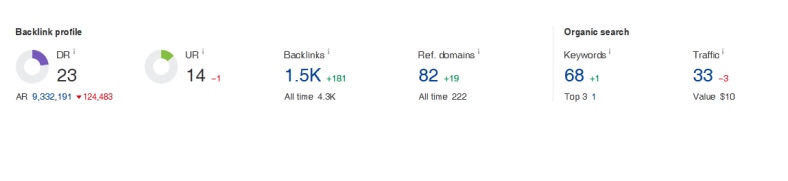
Starting-point metrics from October 2024:
| Metric | Value |
| Domain Rating (DR) | 23 |
| Referring Domains | 82 |
| Organic Keywords | 68 |
| Top 3 Rankings | 1 |
| Organic Traffic | 33 |
| Indexed Pages | 20 |
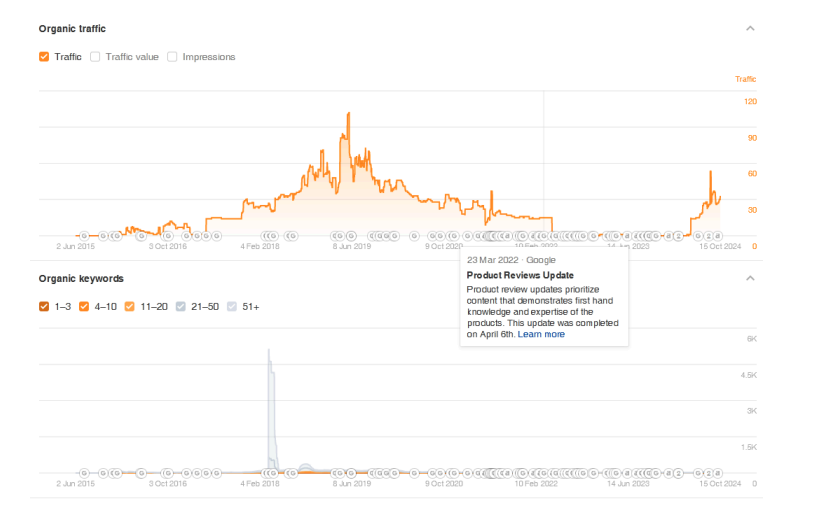
The site had age on its side – first links dated back to 2016 – but the trajectory told the harder story. Traffic peaked in April and May 2019, started declining shortly after, and dropped to zero by May 2022.
By the time the client reached out in October 2024, organic traffic had only just begun to recover from that flatline, with 33 visitors per month and one Top 3 ranking to its name.
The backlink profile itself was natural-looking, with about six legitimate, higher-quality contextual links visible in the audit. There were no obvious manipulation signals to clean up. In our experience, when a site loses traffic this dramatically, and the backlink profile is clean, the more likely explanation is that the site simply fell behind in the authority race against competitors who kept building – not that anything was actively wrong.
We classified this as a recovery project rather than a fresh build. Until the site could demonstrate sustained traffic and keyword growth, our approach would lean conservative on anchors and target pages, and only get more deliberate once Google’s trust had visibly returned.
A Different View on Strategy
Once the campaign began, the client wrote in with a clear idea about where the links should go.
Their reasoning was that competitor research showed homepage-dominated SERPs for the target keywords, so optimizing the homepage looked like the path of least resistance – especially since it was already ranking decently for some of those terms. Inner service pages existed on the site, but the client felt the data pointed away from using them.
It was a reasonable read of the SERP. Many competing recycling businesses rank with their homepages for these terms, and going where the rankings were already pointing would have been the efficient move on paper.
We pushed back.
Our preferred approach was the opposite – point targeted links at inner service and location pages, and keep the homepage on natural anchors only (brand variations, URL-style references, and generic mentions). In our experience, when Google starts ranking a recovering or growing site, inner pages tend to rank first. As authority continues to accumulate, Google then often replaces the ranking inner page with the homepage, even if the homepage was never optimized at the anchor level for those service or location terms.
The reason we pushed back with that level of confidence is that this is not a theory – it is a pattern we have seen play out repeatedly across managed campaigns over the years. We were not testing an idea on the client’s site; we were applying an approach we had already watched unfold enough times to know what to expect.
The client agreed to let us proceed.
In practical terms, that meant:
- Inner service pages received targeted anchors aimed at their respective service and location keywords.
- The homepage received natural anchors only – brand variations, URL-style anchors, and generic references – with no descriptive optimization for service or location terms.
- Pacing stayed steady, not aggressive, given the site’s recovery status and the competitive local SERP.
Month-by-Month Activity
Over the course of the campaign, the underlying build pattern stayed remarkably consistent, which is by design rather than by accident.
With a recovery project on a steady $1,000/month budget, frequent strategy shifts tend to do more harm than good – they fragment the authority signal Google is trying to read and make it harder to tell what is actually working.
Our approach was to set the core pattern early, hold it, and make only small monthly adjustments based on how the site responded. The table below reflects that consistency, with the inner-page targeting strategy visible across almost every month.
| Month | Link Types | Focus | Notes |
| Mar 2025 | Guest post, niche edits, social signals | Homepage and inner page | Foundation building with a diversity layer |
| Apr 2025 | Guest posts, niche edits, social signals | Homepage and two inner pages | Wider inner-page targeting introduced |
| May 2025 | Guest posts, niche edit, social signals | Homepage and inner page | High-authority push |
| Jun 2025 | Guest posts, niche edit | Homepage and inner page | Steady authority growth |
| Jul 2025 | Guest posts, niche edit | Homepage and inner page | Consistent mid-to-high mix |
| Aug 2025 | Guest posts, niche edits, social signals | Homepage only | Homepage-only push for diversification |
| Sep 2025 | Guest posts, niche edit, social signals | Homepage and inner page | Returned to mixed targeting |
| Oct 2025 | Niche edits | Homepage and two inner pages | Inner-page emphasis |
| Nov 2025 | Guest posts, niche edit | Homepage and two inner pages | Authority layering |
| Dec 2025 | Guest post, niche edits | Homepage and two inner pages | Lower-DR variety for naturalness |
| Jan 2026 | Guest posts, niche edits | Homepage and two inner pages | High-authority mix continued |
| Feb 2026 | Guest posts, niche edit | Homepage and two inner pages | Steady pacing |
| Mar 2026 | Niche edits | Homepage and two inner pages | Niche edit reinforcement |
| Apr 2026 | Guest posts, niche edit | Homepage and two inner pages | High-authority push |
| May 2026 | Guest post, niche edits | Homepage and two inner pages | Continued layering |
Two shifts across the campaign are worth highlighting in the month-by-month view.
The first is the gradual tapering of social signals as the campaign progressed – they were useful in the foundation-building months of early-to-mid 2025 to add naturalness and diversity, but became unnecessary once the contextual links were doing the heavy lifting on their own.
The second is the shift from a single inner-page target in early 2025 to two consistent inner-page targets starting in October 2025. This reflected a deliberate broadening of topical reach as the site’s authority grew and we became more confident in pushing relevance across multiple service-and-location combinations rather than concentrating it on one.
The August 2025 deviation – homepage-only – is addressed in the Challenges section below.
The Moment the Strategy Played Out
In our December 2025 monthly review, we flagged that the site’s main target keywords were behaving unusually. Google was flipping between ranking an inner service page and the homepage for the same terms, producing temporary volatility in the ranking data.
For us, this was not a problem – it was a confirmation. This was the exact transition point we had described to the client more than a year earlier. The inner pages had done their job: they had earned the rankings first, and as authority kept accumulating, Google was beginning to consolidate them onto the more powerful page on the site, the homepage.
The volatility settled in the following months, and the outcome held – the homepage now ranks for several of the original target service and location keywords, even though it was never optimized at the anchor level for those terms. Inner service pages continue to rank in supporting positions or have been replaced by the homepage, where the SERP rewarded it.
The number that captures this best is the Top 3 rankings, which moved from 1 at the start of the campaign to 18 today. For a commercial services business in a major Australian city where the revenue case rests on being visible to nearby buyers searching for service and location keywords, Top 3 visibility is the metric that translates directly into new business inquiries.
Challenges Worth Flagging
No campaign of this length runs in a straight line, and this one had its share of bumps.
We think it is worth naming them rather than glossing over them, both because each one had a measurable effect on the data and because the way we responded to them is part of what kept the campaign on track. Three issues stand out across the seventeen-month window.
Google’s June 2025 Core Update. In August 2025, things became shaky in the aftermath of Google’s June 2025 Core Update. Rankings and keyword counts wobbled. We made a deliberate strategic adjustment that month – pushing all authority to the homepage only – to stabilize the site through the volatility, then returned to the mixed inner-page approach once things settled.
Ahrefs reporting methodology change. In late 2025, Google changed how it serves search engine results pages, limiting the number of visible results per keyword to 10. Third-party SEO tools like Ahrefs lost the ability to consistently report rankings and traffic estimates for keywords sitting below position 10. This led to a visible drop in reported total keyword counts, even as actual visibility and traffic continued to grow. In our experience, this kind of tool-side change is more common than people realize and tends to obscure real campaign performance.
Target keyword volatility in late 2025. As described in the previous section, this was a transition moment, not a setback – but in the monthly view, it briefly looked like one. We chose to call it out in client reporting rather than gloss over it, and the months that followed confirmed the reading.
Where the Numbers Landed
The metrics that best reflect actual campaign progress are the ones tied to real organic visibility and search performance.
| Metric | October 2024 | May 2026 | Change |
| Organic Traffic | 33 | 206 | +173 |
| Top 3 Rankings | 1 | 18 | +17 |
| Referring Domains | 82 | 317 | +235 |
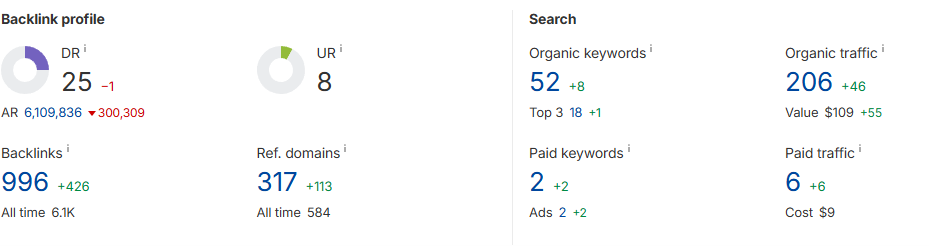
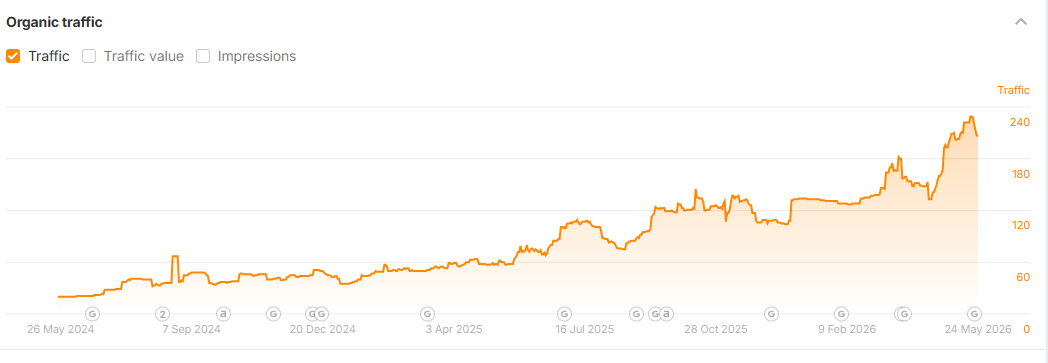
Organic traffic grew more than six times over the campaign window. Top 3 rankings – the rankings that actually drive commercial inquiries in a local service market – climbed from one to eighteen. Referring domains nearly quadrupled.
Metrics That Need Context
A few surface-level numbers moved in directions that are worth explaining rather than burying.
| Metric | October 2024 | May 2026 | Change | Context |
| Domain Rating (DR) | 23 | 25 | +2 | Essentially flat, which is not what we typically see across our campaigns of this length. DR fluctuates with Ahrefs index methodology changes and ongoing spam-domain purges, and the +2 net masks the underlying RD growth, which was substantial |
| Organic Keywords (Ahrefs) | 68 | 52 | -16 | Reflects Ahrefs’ late-2025 reporting limit to top 10 SERP positions, not a real loss of visibility – underlying traffic and Top 3 rankings both grew over the same period |
The two metrics that look soft on paper are both explainable by tool-side and index-side changes rather than campaign weakness. The metrics that cannot be explained away by methodology – Top 3 rankings and organic traffic – both moved decisively in the right direction.
Data above reflects Ahrefs metrics as of late May 2026. The ongoing month’s link-building activity is not yet included.
Anchor Text and Target Page Mix
The anchor strategy followed the divided approach we set up at the start of the campaign and stayed disciplined throughout.
Anchor Text Distribution
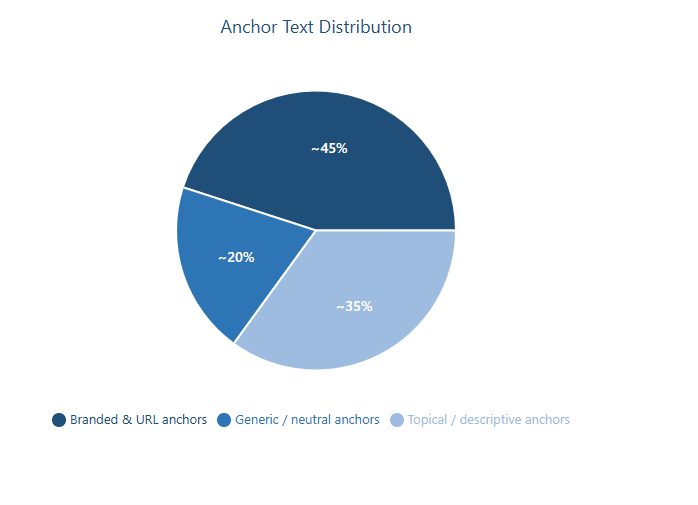
Branded and URL-style anchors carried the bulk of the homepage’s authority load and kept the profile looking natural for a real business.
A meaningful share of generic and non-descriptive anchors added further naturalness, while topical and descriptive anchors made up a substantial portion of the profile – higher than we would typically use on a homepage-focused campaign – because they were directed at the inner service pages, where descriptive anchor relevance was the entire point of the strategy.
- Branded & URL anchors: ~45%
- Generic / neutral anchors: ~20%
- Topical / descriptive anchors: ~35%
Target Page Distribution
While the campaign was built around inner-page targeting where it mattered, the homepage still received the largest share of links because it remains the page Google would ultimately reward with the most rankings – which is exactly what happened.
- Homepage: ~65%
- Inner service pages: ~25%
- Blog category page: ~10%
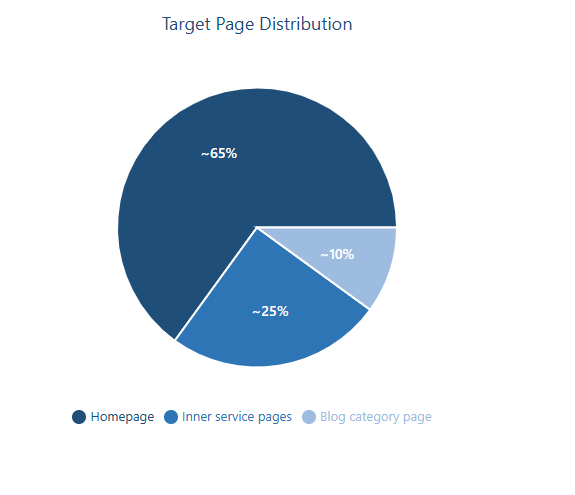
The inner-service share is what made the difference for early rankings. Without those targeted links to specific service pages, this site would have taken meaningfully longer to break into competitive local SERPs – if it had broken in at all on this budget.
Why This Approach Worked
Pulling the threads together, three things made this campaign work.
The campaign respected the site’s recovery status. We did not push aggressive anchors early, we did not over-target a single page, and we did not assume that what worked on a healthy site would work on one that had lost Google’s confidence. The pacing stayed steady at the client’s $1,000/month budget across the entire run.
The difference in strategy was resolved by data, not opinion. We were confident enough in the inner-page-first pattern to push back on the client’s homepage-only intuition, and the campaign produced exactly the pattern we predicted – inner pages ranked first, homepage took over as authority compounded. This is a pattern we keep seeing in managed campaigns, and it’s one of the main reasons we tend to push for an inner-page focus from the start.
The volatility was framed honestly. The Core Update aftermath, the Ahrefs reporting change, and the target keyword transition were all called out in monthly reports rather than minimized. None of them required a change of approach – they required patience and continued authority building, which is what the campaign provided.
Conclusion
For a commercial services business that depends on local-search visibility for new business inquiries, the numbers that matter most are not DR or total keyword counts – they are Top 3 rankings on the searches that drive real commercial intent, and organic traffic from buyers in the city. Both moved decisively over the course of this campaign: from one Top 3 keyword to eighteen, and from 33 monthly visitors to 206.
Equally important, the campaign demonstrated something we end up explaining to most new clients in some form – that inner-page targeting, even when the SERP looks homepage-dominated, tends to be the faster route to first rankings, and that the homepage will typically pick up those rankings on its own once the site has earned enough authority. This campaign is now one more data point we can point to when that conversation comes up.
This was not the client’s first managed campaign with us – the site joined a portfolio they had already trusted us to work on, which gave us a bit more runway to apply the inner-page approach we knew worked rather than start from a more cautious place.
The campaign is ongoing, and the same compounding dynamic that produced the current results is what will continue to drive growth – each month’s links keep maturing in the background while the next round goes out, and the gap to the top of the local SERP keeps narrowing.