When this site came to us in mid-2025, the numbers didn’t add up to much. It carried dozens of referring domains but a Domain Rating of zero, no real rankings, and no organic traffic – a profile that looked like activity but added up to nothing usable.
This was an e-commerce site in the medical and laboratory equipment space, selling products alongside a growing library of blog content. The owner had been spending on SEO, adding pages, and tightening on-page work, and watching almost nothing happen. In their words, the site felt stuck in the sandbox.
What follows is how we approached a site that wasn’t starting from zero on paper but effectively was in practice. We’ll cover the on-site obstacle that turned out to matter more than any single link, and how the numbers eventually moved once the foundation and the site itself were both in order.
The campaign ran continuously from June 2025 through April 2026 as an ongoing Managed Link Building engagement. Our work focused only on off-page SEO, while the client handled content and technical changes on their end.
The Starting Point
When we ran our initial audit, the headline numbers were unusual for a site that had been live since 2021. The domain had around 345 indexed pages and a backlink history going back several years, yet rankings had only begun appearing at the very start of 2025 – and even those were thin and volatile.
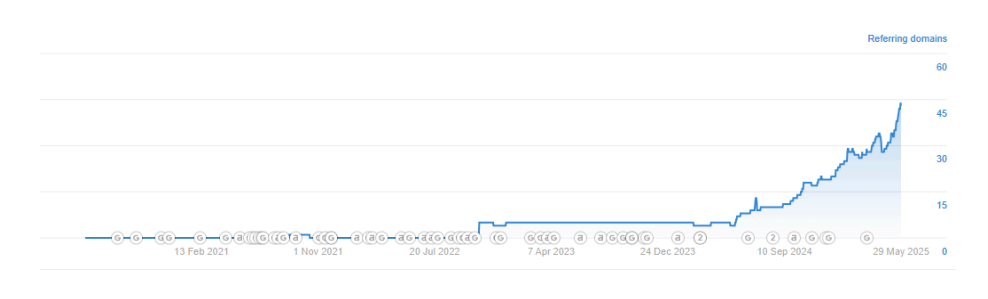
The off-page profile told us why. Domain Rating sat at 0 despite roughly 43 referring domains, and the makeup of those domains was the giveaway. Most were auto-generated links from scrapers and directories, plus a layer of low-quality links from SEO-agency-type sites – the kind a new domain tends to accumulate on its own.

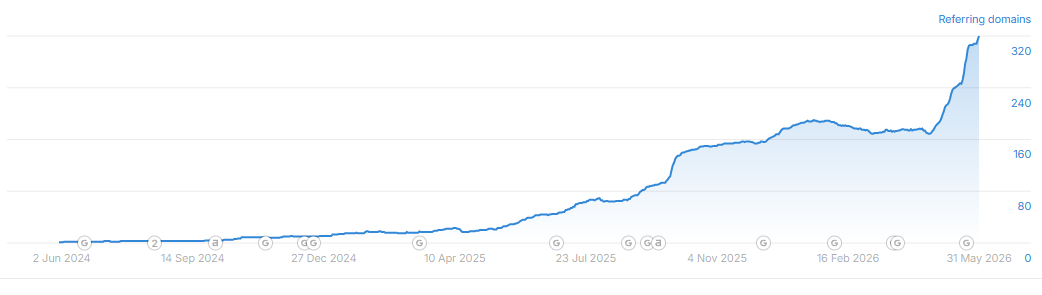
We couldn’t find any genuine contextual links from sites with real metrics and traffic behind them. The referring-domain graph reflected this: a long, flat, low base with none of the steady climb that signals real authority being earned.
The search side was just as quiet. The site carried only a handful of keywords and effectively no organic traffic, with what little ranking movement existed looking volatile rather than established.
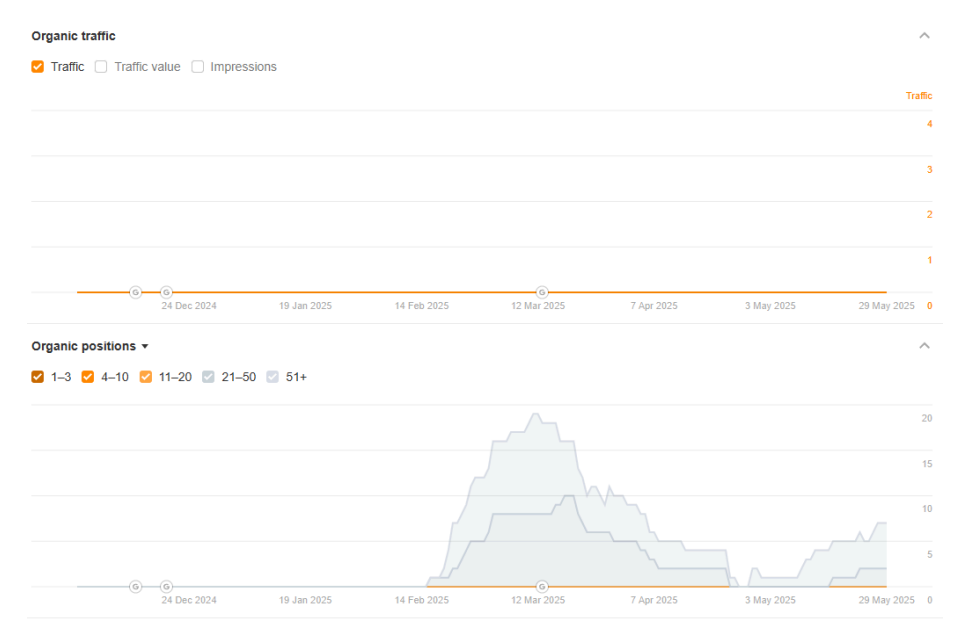
In our experience, this is a more awkward starting position than a clean slate. A brand-new domain has nothing working against it. This one had a backlink profile that looked like activity but contributed no authority, sitting underneath a new commercial site that still needed to earn trust from scratch.
On the more encouraging side, the anchor text profile read naturally, the keywords the site targeted were relevant to the business, and link distribution was reasonable rather than over-concentrated on any one page. Our read going in was that this needed to be treated as a fresh build, regardless of what the referring-domain count suggested.
That meant homepage-led foundation work and conservative, natural anchors first. Inner-page targeting and more descriptive anchors would be held back until the site had something real underneath it.
What We Set Out to Do
Because this was a managed engagement rather than a fixed package, we set a direction we could adjust month to month based on how the site responded.
The early priority was simple: build legitimate authority in the pattern a new site would naturally accumulate it, and do it consistently rather than in bursts.
The principles we used were the ones we lean on for most fresh commercial builds:
- Real contextual links as the core of the profile – guest posts and niche edits on actual sites in the niche, not volume for its own sake.
- Mid-authority placements early to build a base of links efficiently, with high- and mid-authority links layered in as the site stabilized.
- Heavy homepage targeting through the foundation phase to push authority into the domain as a whole.
- Conservative, natural anchors first – brand and URL-based references dominating early, with more descriptive anchors introduced gradually.
- Supplemental diversity where it made sense, including occasional pillow links and social signals for naturalness.
For an e-commerce site in particular, we kept inner-page and category targeting in reserve. There’s no point pushing power at product or category pages before the domain itself is trusted – and as it turned out, there was a separate reason to wait that we’ll come to next.
The Obstacles
This campaign is a useful one to write up precisely because the slow phase ran longer than most, and because the thing holding the site back wasn’t something link building could fix on its own. Three issues overlapped.
The first was the new-site reality. Even with consistent, high-quality links from June onward, the site showed almost no movement for roughly the first five months. That’s not unusual – newly placed links take time to be crawled, indexed, and credited – but here it ran longer than typical, and we were candid throughout that we hadn’t yet seen the turn.
The second, and more important one, was on the site itself. As an e-commerce store, the client needed product pages to rank and sell, but a large share of those product URLs were sitting in Search Console as crawled but not indexed.
The cause was structural. The site’s URLs were flat, meaning product pages didn’t nest beneath their category pages and instead sat at the same level off the root. The practical effect was that the authority we built reached the homepage and category pages, but didn’t flow cleanly down to the products that actually drove revenue – blog content was getting clicks while the products stayed invisible.
This sat outside the scope of link building, and we said so plainly. The site architecture and product-page indexation needed attention on the client’s side before commercial pages could benefit from the authority we were adding. To their credit, the client took this seriously, reworked product-page content and structure, and we coordinated our targeting around it.
The third was a reporting wrinkle rather than a site problem. In late September 2025, Google changed how it returns search results, limiting third-party tools’ visibility into rankings beyond the top 10.
Ahrefs and similar tools lost the ability to consistently report on positions and traffic for keywords below the tenth result. Our reported keyword counts became choppy for a stretch as a result. We mention it because it’s the kind of metric volatility that looks alarming in isolation and means very little once you understand the cause.
Month by Month
The build stayed deliberately consistent across the engagement, with the mix shifting as the site earned the right to more aggressive placements.
The table below tracks it month by month – authority is described in broad terms rather than exact figures, and link types are summarized rather than counted.
| Month | Link Types | Authority | Focus | Notes |
| Jun 2025 | Guest posts, niche edits, pillow links | Mainly mid DR | Homepage foundation | Foundation build begins; links freshly placed, no movement expected yet |
| Jul 2025 | Guest posts, niche edits, social signals | Mainly mid DR | Homepage foundation | Continued layering; still flat, in line with a new build |
| Aug 2025 | Guest posts, niche edits | Mid and high DR | Homepage authority | Domain-level authority reinforced; rankings still suppressed |
| Sep 2025 | Guest posts, niche edits, social signals | Mid and high DR | Homepage + first inner page | First rankings appear without traffic; Google’s top-ten reporting change begins affecting tool visibility |
| Oct 2025 | Guest posts, niche edits | Mid and high DR | Homepage + inner page | Higher-authority push; first AI-citation appearances |
| Nov 2025 | Guest posts, niche edits | Mid and high DR | Homepage | Steady authority layering ahead of breakout |
| Dec 2025 | Guest posts, niche edits | Mid and high DR | Homepage | First measurable keyword and traffic gains |
| Jan 2026 | Guest posts, niche edits | Mid and high DR | Homepage + blog category page | Keywords and traffic building; trend confirmed |
| Feb 2026 | Guest posts, niche edits | Mid and high DR | Homepage | Continued gains; AI citations climbing sharply |
| Mar 2026 | Guest posts, niche edits | Mainly high DR, few mid | Homepage + inner page | Strong jump in keywords, top-three positions, and traffic |
| Apr 2026 | Guest posts, niche edits, social signals | Mainly high DR, few mid | Homepage + two inner pages | Traffic roughly doubles month over month; project goals met |
When the Numbers Moved
For most of the back half of 2025, the honest answer to “Is it working yet?” was “Not visibly,” and we said so.
The turn came in December.
Rather than a single spike, growth arrived the way it tends to for sites built this way – quietly at first, then accelerating as earlier links aged and stacked with newer ones. Traffic registered for the first time in December, climbed through January and February, then jumped in March and April as the site’s commercial and informational pages began to hold positions.
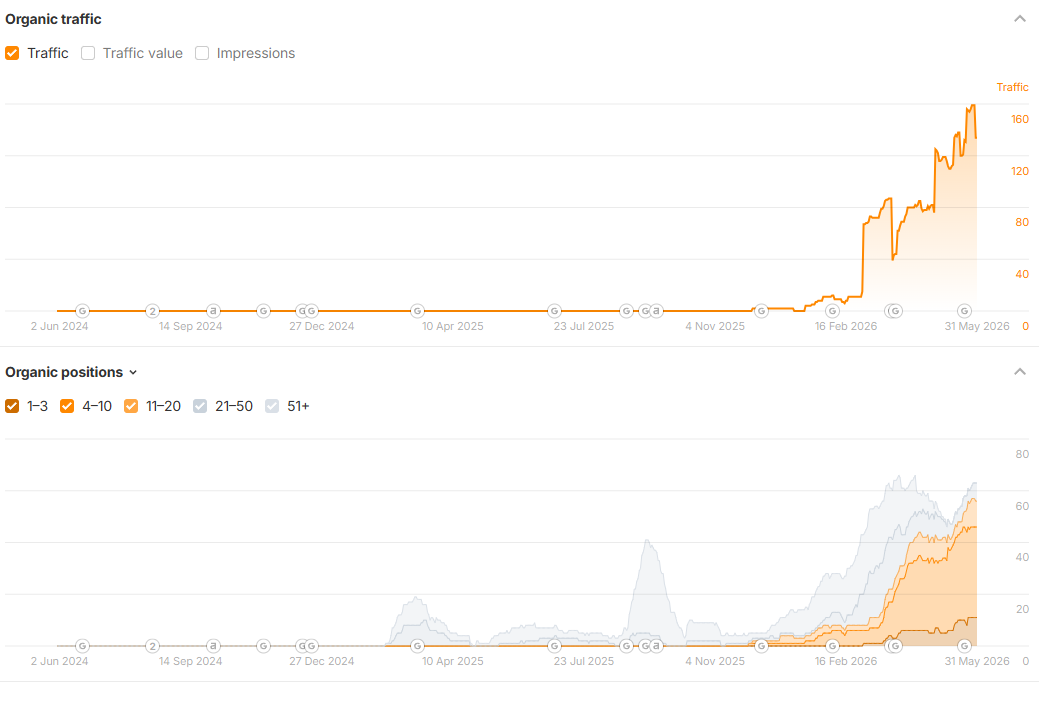
Domain Rating tracked steadily upward across the same period, moving from 0 into the teens and reaching 20 by spring. Keyword visibility recovered from the reporting-driven dip, and the site began landing top-three positions for the first time.
The referring-domain graph over the campaign shows the shape we want from real authority building: a slow start, then a steady, sustained climb as genuine contextual links were added month after month.
One signal we’d highlight for any 2026 campaign showed up clearly here. As the site’s authority grew, it also began to be cited by AI systems.
Appearances in ChatGPT and Google’s AI surfaces went from essentially nothing to a meaningful and rising count over the final months – a reflection that the domain was being read as a credible source.
The client’s view aligned with ours. In the final stretch, they reported independently that their Search Console numbers were climbing, which matched what we were seeing in the off-page data.
After We Paused
The client ended active building in April 2026, satisfied that the foundation was where they wanted it. What happened next is worth reading carefully, because the headline numbers and the real story diverge.
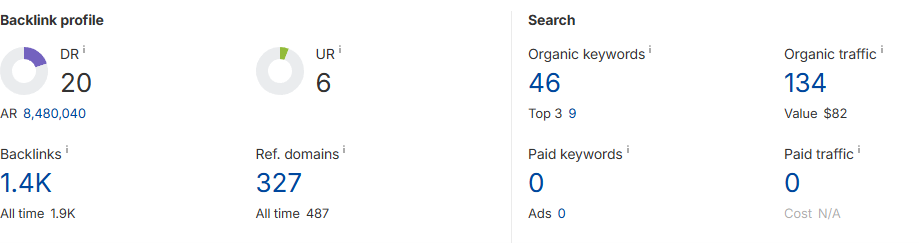
The genuinely encouraging part is that the metrics tied to earned authority continued to improve without any new links from us. By late May 2026, organic traffic had climbed further to around 134, and top-three rankings had grown from 2 to 9. That is the lagging, compounding effect we describe at the start of every new build – authority that keeps expressing itself for a while after the active work stops.
The referring-domain count is a different matter, and it’s a good illustration of why the raw number can mislead. RDs appeared to surge after the pause, but when we looked at what came in, almost all of it was the same automated scraper and directory linking the site attracted at the very beginning – of the roughly 160 domains added, only a handful were anything of substance.
In other words, that growth wasn’t us, and it wasn’t earned. It’s the passive junk a site accumulates on its own, which is exactly why we weigh contextual link quality over referring-domain count when we judge whether a campaign is actually working. The traffic and ranking gains are the signal here; the RD spike is noise.
Performance Summary
The first table covers the outcomes that reflect real progress for the business.
Starting figures are taken from our May 2025 audit, ending figures from the final April 2026 report – the close of our active campaign.
| Metric | May 2025 | April 2026 | Change |
| Organic Traffic | 0 | 86 | +86 |
| Organic Keywords | 7 | 54 | +47 |
| Top 3 Rankings | 0 | 2 | +2 |
The authority metrics below moved in the right direction, too, but each needs context to read correctly, which is why we’ve kept them separate from the headline results.
| Metric | May 2025 | April 2026 | Change | Context |
| Domain Rating | 0 | 20 | +20 | Built from an effective base of zero, the starting profile carried no real authority despite the referring-domain count |
| Referring Domains | 43 | 176 | +133 | The original ~43 were largely scraper, directory, and low-quality links; the growth here is the genuine contextual domains we added |
It’s worth noting the keyword figure almost certainly understates the site’s true ranking footprint, since the September 2025 reporting change means positions below the top ten are inconsistently captured by tools like Ahrefs.
Anchors and Targets
Our anchor and target-page choices followed the same conservative-then-broadening logic as the rest of the campaign. The distributions below reflect where the profile landed across the entire engagement, rather than in any single month.
On anchors, branded and URL-based references formed the core, which is what we want for a site establishing trust from a weak base. A neutral, non-descriptive layer sat alongside them, and descriptive, category-level anchors were introduced more heavily in the later months once inner-page targeting began.
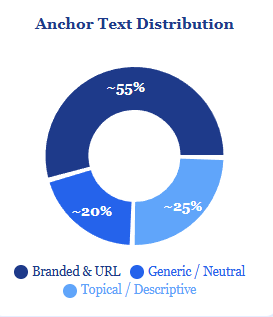
The split worked out to roughly 55% branded and URL anchors, around 20% generic or neutral references, and about 25% topical or descriptive anchors – the descriptive share weighted toward the back half of the campaign.
On targets, placement stayed deliberately top-heavy on the homepage to build domain-level authority. Category and inner pages were added selectively as the site stabilized, with some support to the blog category page.
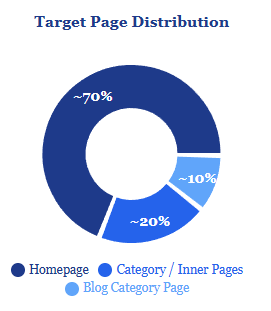
That came to around 70% to the homepage, roughly 20% to category and inner pages, and about 10% to the blog category page – a structure that let authority pool at the domain level before being directed toward the commercial pages that needed it.
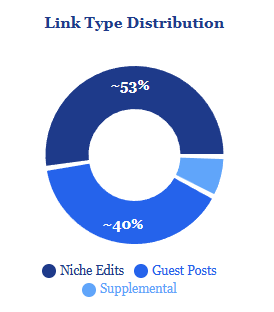
The link-type mix was almost entirely contextual – the placements that do the real work. Niche edits accounted for around 53% and guest posts around 40%, with niche edits slightly leading the build. The remaining ~7% was a light supplemental layer of pillow links and social signals for diversity and naturalness.
What We Take From This
This campaign worked because the off-page strategy and the on-site fixes eventually pulled in the same direction. It’s a useful reminder of a few things we see repeatedly.
The clearest lesson is that link building can’t outrun an indexation problem. For months, we were adding real authority to a site that physically couldn’t pass much of it to the pages that mattered because those product pages weren’t indexed, and the URL structure didn’t channel power to them. The gains became visible only once the architecture and authority work were both in place.
The second is one we flag at the start of most new builds and saw play out longer than usual here: authority compounds on a delay. The site looked flat for five months and then moved quickly, which is the normal shape, not a failure of the early months.
The third is practical – reported metrics can move for reasons that have nothing to do with the work. The September reporting change made keyword counts look worse than they were, and the post-pause referring-domain surge made the profile look stronger than it was. In both cases, the trend across the meaningful data mattered more than any single number.
Closing Thoughts
For an e-commerce store, the point of all this was never Domain Rating for its own sake. It was qualified traffic and the sales and inquiries that followed it. By the end, the site held several top-three positions, drawing real organic traffic for the first time, and building visibility across commercial- and transactional-intent searches rather than only informational ones.
That last part matters most for a business like this. Informational traffic is useful, but it’s the commercial and transactional searches – people looking for the equipment, parts, and services the site sells – that turn into orders and contact requests. Moving the site into those results is what makes the authority work pay for itself.
The product-indexation work the client carried out, combined with the authority we layered in, took the site from effectively invisible to commercially present. They ended the active engagement after reaching the goals they set for this phase, deciding that their linking foundation was where they wanted it and choosing to redirect their focus rather than keep building.
From a weak, junk-heavy starting profile, the site finished with genuine authority and a base it can hold and build on. In our experience, that base is also what continues. Measured link acquisition protects – the sites that keep investing tend to hold and extend their gains, while those that stop are the ones most exposed to drifting backward over time.