When this client came to us in January 2025, the domain was only a few weeks old as far as the web was concerned – but the business behind it was not. It was a home-services company in a Midwest metro (waste removal/hauling/cleanouts) that had recently rebranded to a new domain and was starting its off-page SEO more or less from scratch.
We were brought in to run a done-for-you Managed Link Building campaign, working strictly on the off-page side while the client handled their own content and technical SEO. The order was placed in mid-January 2025 on an $800 monthly budget, and the campaign has run continuously ever since, with no pauses.
What follows is the off-page side of that story – where the site started, what we built, the flat early stretch, and the core update we worked through, and how authority and traffic moved once the foundation had time to mature. We’ve kept the focus on the off-page inputs we control and the search metrics they influence.
Where Things Stood in January 2025
Before we built anything, we ran a full off-page audit, and the starting profile was an unusual one worth explaining up front.
The domain was new, but the business was not. The client had recently changed business names and moved to this domain, with 301 redirects from the old site and a Search Console change-of-address pointing the prior site’s equity to the new site.
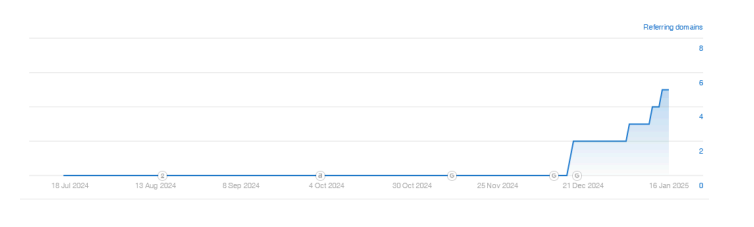
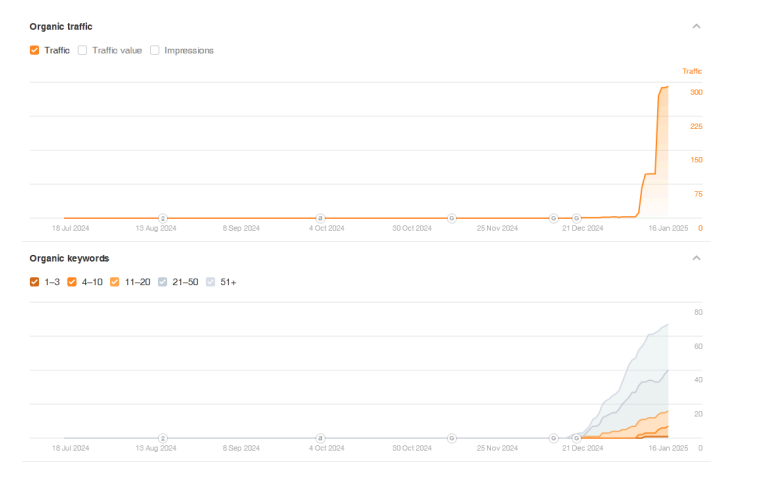
That history is why the audit looked the way it did: a Domain Rating of 0 and only about five referring domains, yet the site already carried a small base of inherited keyword rankings (~67) and some organic traffic (~291 visits) on day one.
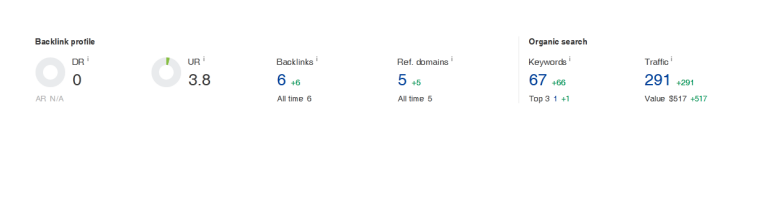
From a link perspective, though, the site was effectively starting fresh. The backlink profile was almost non-existent – a handful of low-value, directory-style links of the kind most sites pick up early – and there were very few first-page rankings to speak of.
In our experience, this is the cleaner of the two situations to walk into: there was nothing to undo or disavow, so our job was simply to build a legitimate authority foundation from the ground up rather than repair past mistakes.
We also flagged a practical reality with the client at the outset: with new sites, link building works best alongside solid on-page and technical SEO, and we recommended they keep both moving in parallel with our off-page work.
How We Approached It
Because this is a managed campaign, we don’t lock into a fixed plan – we review the site at the start of each month and adjust before building. That said, the early strategy followed a deliberate shape that we set from the audit.
For the first stretch, we leaned on mid-authority guest posts and niche edits and built more of them, rather than spending the budget on a few expensive high-authority placements. For a near-zero-DR site, in our view, that’s the more natural way to accrue trust, and it lets the profile thicken evenly before any aggressive moves.
Anchors stayed conservative early on – branded and URL-based, with generic and topical phrasing layered in gradually – and the homepage carried the bulk of the early links so authority could pool at the domain level first.
The client also runs several service lines beyond their primary one, and partway in, they asked us how to grow the others without stalling what was already working.
Our standing approach here is straightforward, and we shared it with them directly: point branded and topical anchors at the homepage, and point service-specific anchors at the matching inner pages. In our experience, the inner page tends to rank first, and as overall site authority grows, Google often shifts to ranking the homepage for those same terms.
So as the months went on, we introduced higher-authority links, more descriptive and location-style anchors, and selective inner-page targeting across the service and local pages – without disrupting the foundation underneath.
A small share of the budget went to supplemental placements for diversity rather than ranking power – some pillow links early on, and a single PBN link later in the campaign. These were never the core of the strategy; the bulk of the spend went to guest posts and niche edits, which do the most for rankings.
Throughout, we kept the pace steady rather than building in bursts. In a competitive local niche, consistent month-over-month acquisition reads more naturally and holds up better than a front-loaded spike.
The First Half: A Flat Stretch and a Core Update
We want to be straight about the early months, because they weren’t a smooth climb – and the reasons matter.
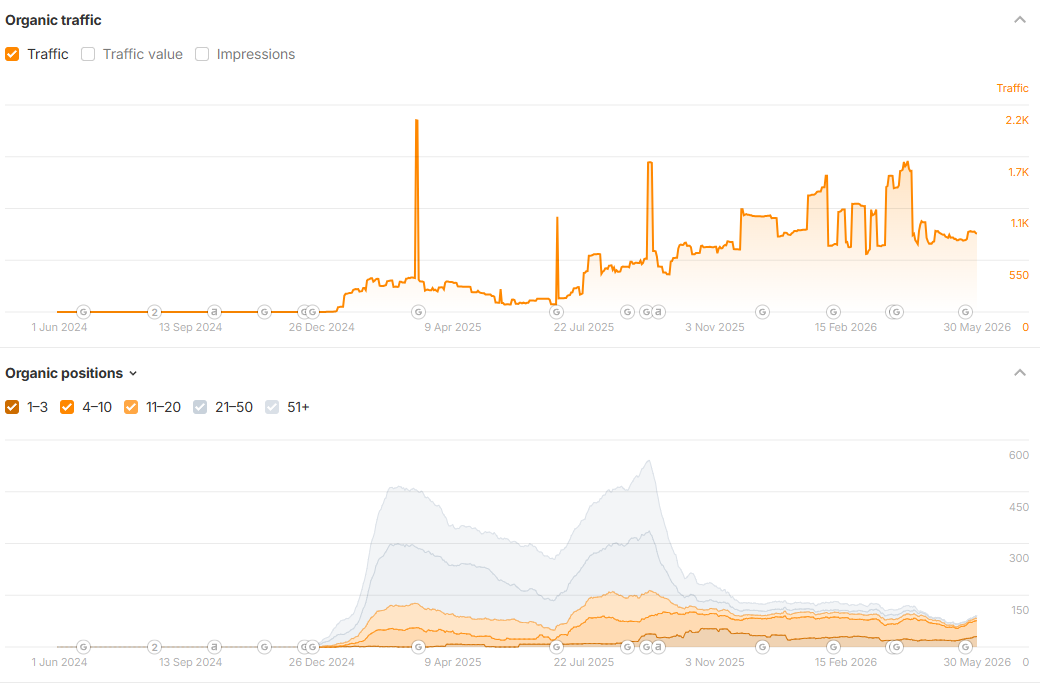
Through late winter and into spring 2025, the site’s visible numbers drifted sideways and then down. Traffic moved from ~291 at the audit to ~368 in February, then slid to ~253 in March and ~218 in April as the Google March 2025 Core Update rolled out and the SERPs churned.
By May 2025, traffic had bottomed at ~79 visits – the low point of the entire campaign. We said as much to the client at the time: the lack of movement was atypical given the volume and quality of links we’d built, and we suggested they review their own content and on-page SEO alongside our continued off-page push.
In our experience, that combination – a fresh domain plus a core update landing right as the link foundation is still young – is one of the harder early setups. It’s exactly the kind of stretch where authority is accumulating in the background without showing up in rankings yet.
So we didn’t change course in a panic. We kept building, kept the pace steady, and waited for the earlier links to take effect.
Month by Month
The table below covers the foundation phase, which emphasized volume, mid-authority placements, and homepage trust.
| Month | Link Types | Authority Mix | Focus | Notes |
| Feb 2025 | Guest posts, Niche edits | Mostly mid-authority | Homepage | Foundation building on a zero-DR site; natural anchors and pillow links for diversity |
| Mar 2025 | Niche edits, Guest posts | Mostly mid-authority | Homepage + inner page | Numbers drifting sideways; first selective inner-page link |
| Apr 2025 | Guest posts, Niche edits | Mostly mid-authority | Homepage + inner page | March 2025 Core Update volatility; conservative continuation |
| May 2025 | Guest posts, Niche edit | Mid with first high-authority | Homepage + inner page | Traffic trough; first higher-authority placements introduced |
| Jun 2025 | Guest posts, Niche edits | High with a mid for variety | Homepage + inner page | Early signs of stabilization |
| Jul 2025 | Guest posts | High-authority only | Homepage + inner page | High-authority push to add power |
| Aug 2025 | Guest posts, Niche edits | High with a mid for variety | Homepage + inner page | Keywords and traffic climbing again |
By late summer the picture changed, so the second table reflects a different emphasis – higher-authority links, broader anchors, and more inner-page targeting as the site could safely absorb it.
| Month | Link Types | Authority Mix | Focus | Notes |
| Sep 2025 | Guest posts, Niche edits | High with mids for variety | Homepage + inner pages | Authority inflection; top-3 rankings begin climbing |
| Oct 2025 | Guest posts, Niche edits | High with a mid for variety | Homepage + inner page | Google’s top-10 SERP reporting change begins distorting keyword totals |
| Nov 2025 | Guest posts | High-authority only | Homepage + inner page | High-authority push; traffic continues up |
| Dec 2025 | Guest posts, Niche edits | High with a mid for variety | Homepage + inner page | Strong authority reinforcement |
| Jan 2026 | Guest posts, Niche edit, PBN | High with mids for variety | Homepage + inner pages | Added a single PBN link for diversity |
| Feb 2026 | Guest posts, Niche edits | High with mids for variety | Homepage + inner page | Traffic peaks near ~1,000; top-3 rankings at their highest |
| Mar 2026 | Guest posts, Niche edits | High with mids for variety | Homepage + inner page | Local-keyword reporting volatility |
| Apr 2026 | Guest posts | High-authority only | Homepage + inner pages | Spring reporting softness; held to plan |
| May 2026 | Guest posts, Niche edits | High with mids for variety | Homepage + inner page | Authority and referring domains step up again |
Where the Numbers Landed
Once the foundation had matured, the metrics we’d expect to move on a healthy campaign moved – and they did so in a compounding pattern rather than a single spike.
From the summer of 2025 through, traffic recovered to ~300 in July and ~460 in August, then kept climbing through the fall and winter: ~634 in November, ~823 in December, ~866 in January 2026, and a peak near ~1,000 in February 2026.
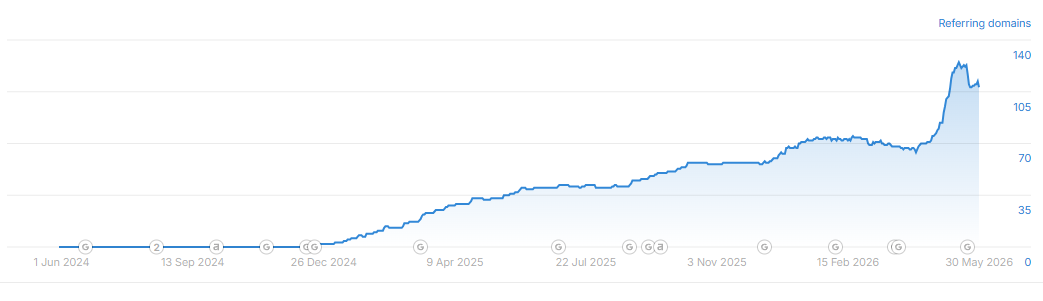
Domain Rating moved more slowly and bounced at the top end. It sat low for the first 7 months, rose into double digits by January 2026, touched 17 briefly in mid-May, and currently reads 10 – normal index movement for a site this size, and consistent with the local-SERP reporting noise above. The number of referring domains grew from about 5 at the audit to over 100.
Partway through, the client told us they were already seeing a meaningful lift in organic traffic for their primary service and wanted to extend that to their other service lines, which is a large part of why we leaned harder into inner-page targeting in the second half.
It’s worth noting the starting traffic figure already reflected the redirect from the old domain, so the campaign didn’t build that baseline from zero – but everything above it, we did.
Performance Summary
| Metric | Jan 2025 (start) | Current (May 2026) | Change |
| Domain Rating | 0 | 10 | +10 |
| Referring Domains | 5 | 108 | +103 |
| Organic Traffic | 291 | 835 | +544 (+187%) |
| Top-3 Rankings | 1 | 23 | +22 |
A couple of surface metrics moved in ways that look negative at a glance but aren’t, so we’ve separated them out with context rather than burying them.
Metrics That Need Context
| Metric | Direction | Context |
| Ahrefs keyword total | Fell from a mid-campaign peak to a fraction of it | Google capped public SERP reporting at the top 10 results per keyword in late 2025. Tools like Ahrefs lost visibility into positions 11+, so the count dropped without the underlying rankings being lost. |
| Live backlink count | Swung widely before settling | An early surge of low-value backlinks from outside our campaign was later discounted by search engines. Referring domains is the more meaningful measure of the authority we actually built. |
On the spring 2026 softness specifically: the readings came in below the winter peak, but for a local site, we read most of that as a reporting artifact rather than a real loss.
Ahrefs pulls ranking and traffic estimates from different Google data centers, and local-intent keywords bounce between those data centers, which shows up as spikes and dips that don’t reflect what’s happening on the ground.
Combined with the top-10 reporting cap above, the visible traffic line is noisier for a site like this than the underlying performance warrants. We’ve continued building to plan through it.
Anchors and Target Pages
The distributions below reflect the full campaign and show how the profile shifted from a branded foundation toward more descriptive and local phrasing as the site matured.
Anchor Text Distribution
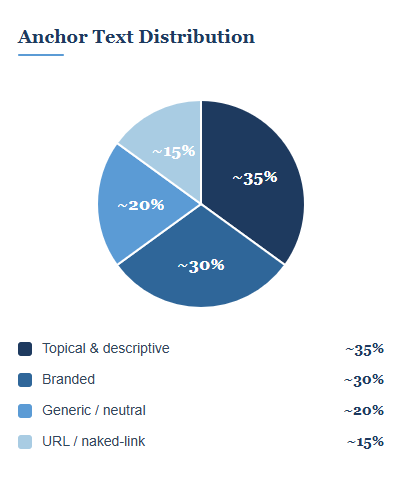
- Branded anchors: ~30%
- URL / naked-link anchors: ~15%
- Topical & descriptive anchors: ~35%
- Generic / neutral anchors: ~20%
The branded and URL anchors together anchored the profile early and kept it looking natural for a young site.
The topical and descriptive layer – including location-style phrasing tied to the service area – grew as the authority did. That shift is where the inner-page work shows up in the data.
Target Page Distribution
- Homepage: ~70%
- Service / location inner pages: ~25%
- Category / hub pages: ~5%
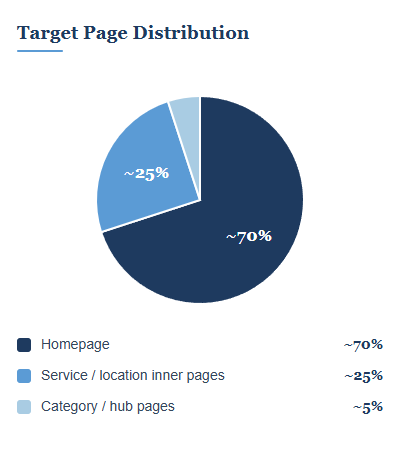
Link placement stayed deliberately top-heavy. The homepage carried the bulk of the links to build domain-level trust first.
Inner-page and category links came in selectively once that base was set, in line with the homepage-for-branded, inner-pages-for-service-keywords approach we set out from the start.
What We Take From This
This campaign worked because it matched how authority tends to build for a new local site – and because we didn’t abandon the plan during a slow first half.
A fresh domain that took an early core update on the chin spent several months looking flat, and it would have been easy to read that as failure.
In our experience, it was the opposite. The links were maturing in the background, and once they aged in, the authority and traffic gains came through and kept compounding.
Steady pacing, a homepage-first foundation, and a gradual move into higher-authority links and inner-page targeting did more here than any single aggressive push could have.
It’s also a reminder that link building does its best work alongside the client’s own content and technical SEO, not in place of it.
For a local home-services business, that growth maps directly to commercial value. The traffic and rankings we built sit on high-intent, location-based searches – the kind of queries that turn into quote requests and booked jobs.
The campaign is ongoing. As authority continues to accumulate, we’d expect the inner-page and local visibility to keep firming up, particularly as the reporting noise around local SERPs settles.