This case study covers a Managed Link Building (MLB) campaign for a new affiliate website operating in a competitive finance-related space.
The site launched in mid-2024 with minimal authority, limited historical data, and no prior penalties. The client reached out in September 2024 to engage a done-for-you link building service, with our involvement focused exclusively on off-page SEO as part of an ongoing managed campaign, running alongside the client’s own content and technical SEO efforts.
The campaign unfolded across multiple phases, including a temporary service pause and a confirmed technical issue that restricted performance for a period.
Even with these interruptions, the longer-term data clearly show how consistent authority building begins to compound once foundational obstacles are addressed.
Starting Point & Initial Audit
At the start of the managed campaign, the site was in an early stage of its lifecycle, with no meaningful authority or organic visibility.

From an off-page perspective, the site was effectively starting from zero:
- No meaningful indexed presence
- Domain Rating (DR): 0
- Fewer than 10 referring domains, primarily low-quality directory-style links commonly acquired immediately after launch
- No ranking keywords and no measurable organic traffic
Given this starting point, the backlink profile could not yet be considered developed in any meaningful way. Rather than addressing issues or correcting past mistakes (which is often challenging in itself), the priority was to build a legitimate authority foundation from the ground up.
The audit conclusion was clear: the site needed to be treated as a true fresh build. The initial focus would be on foundational link acquisition, homepage authority, and natural anchor usage before any consideration of aggressive inner-page targeting or more deliberate anchor refinement.
Strategy
As a Managed Link Building client, the strategy was continuously adjusted month-to-month based on how the site responded, rather than being locked into a static plan.
Given the site’s zero-authority starting point, the primary objective early on was to establish trust and legitimacy in a way that aligned with how new sites naturally accrue links over time.
Key strategic principles included:
- Prioritizing real contextual links (guest posts and niche edits)
- Emphasizing mid-authority links early, then layering in higher-authority placements
- Heavy homepage targeting during the foundation phase
- Conservative, natural anchor usage with gradual expansion into more descriptive anchors
- Supplemental diversity where appropriate (e.g., pillow links, social signals)
This approach allowed the authority to build evenly across the domain while minimizing risk.
Rather than forcing rankings or over-optimizing too early, links were placed to support long-term growth and future flexibility.
As signals accumulated and the site stabilized, higher-authority links and selective inner-page targets could be introduced without disrupting the overall profile.
Links were built consistently over time, not in bursts, with pacing designed to look organic and scalable rather than aggressive – an especially important consideration in a competitive niche.
Challenges
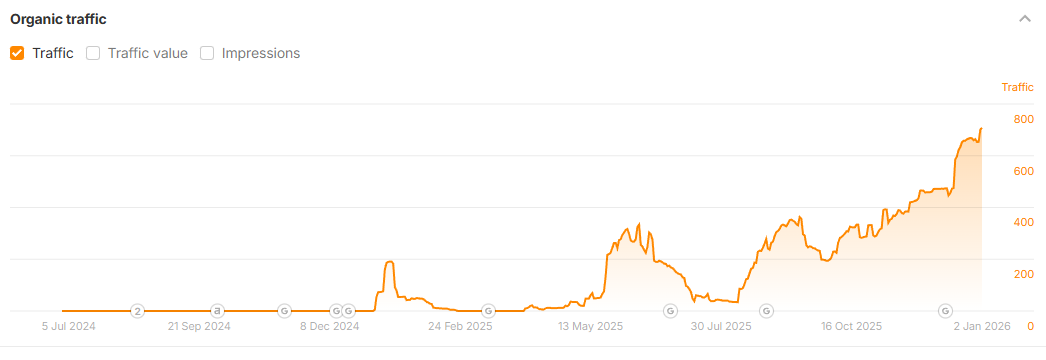
Several months into the Managed Link Building campaign, performance declined sharply despite continued authority acquisition. This drop was inconsistent with the volume and quality of links being built and pointed to an external constraint rather than an off-page issue.
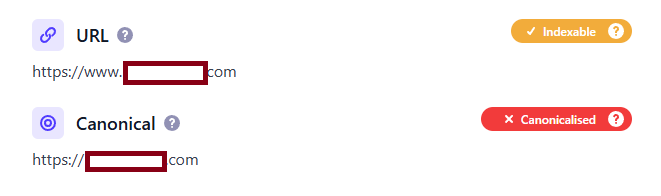
Upon further review, a technical problem was identified – the site’s canonical tags did not match the preferred URL structure. As a result, search engines were consolidating signals incorrectly, preventing the site from fully benefiting from the added authority. This issue fell outside the scope of link building, and correcting it was necessary before sustained gains could resume.
After the canonical issue was addressed, performance signals were still inconsistent. The client, therefore, shifted focus toward additional technical refinements and content improvements, and as part of that process, made the decision to temporarily pause the MLB service.
This context is important, as authority from previously built links continues to mature in the background, but visible growth is often delayed when active link acquisition is paused.
Month-by-Month Breakdown
| Month | Link Types | DR Range | Focus | Notes |
| Nov 2024 | Niche edits, guest post, pillow links | DR 10–36 | Homepage foundation | Initial authority building for a zero-DR site; emphasis on natural anchors and diversity |
| Dec 2024 | Niche edits, guest posts | DR 20–36 | Homepage + light inner pages | Continued foundation building with slightly higher-authority placements |
| Jan 2025 | Guest post, niche edit | DR 51+ | Homepage | First exposure to higher-authority links to accelerate trust signals |
| Feb 2025 | Guest posts, niche edit | DR 36 | Homepage | Reinforcing domain-level authority with consistent pacing |
| Mar 2025 | Guest posts, niche edits, social signals | DR 20–35 | Homepage | Performance drop observed; technical issues identified |
| Apr 2025 | Guest posts, niche edits | DR 20–36 | Homepage | Conservative continuation while technical issues persisted |
| May 2025 | Guest posts, niche edit, social signals | DR 36 | Homepage | Early recovery signs after technical fixes |
| Jun 2025 | Guest posts | DR 51+ | Homepage + inner page | Higher-authority push as momentum slowed |
| Oct 2025 | Guest post, niche edits | DR 36–51+ | Homepage + inner page | Service resumed after the break |
| Nov 2025 | Guest posts, niche edit | DR 20–51+ | Homepage + inner pages | Consistent authority layering |
| Dec 2025 | Niche edits | DR 10–51+ | Homepage + inner page | Strong authority reinforcement |
Recovery & Results
Once the canonical issue was resolved and the MLB campaign resumed, performance began to stabilize and then trend upward as accumulated authority was finally able to express itself.
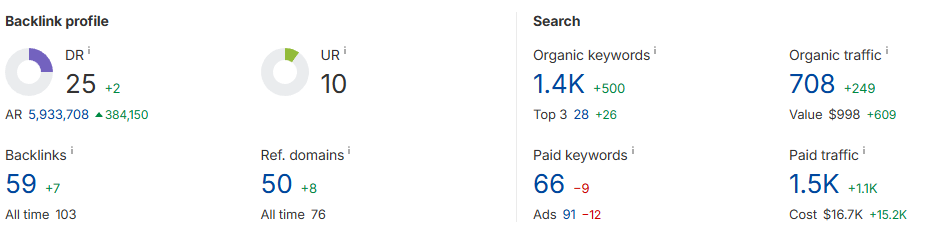
Rather than an immediate spike, growth followed a more durable pattern, with gains compounding as earlier links aged and newer placements were layered in.
Key improvements observed over time:
- Domain Rating: increased from 0 to 25
- Referring Domains: grew from ~10 to ~50 legitimate referring domains
- Organic Keywords: expanded from 0 to ~1,400 ranking keywords
- Organic Traffic: increased from 0 to ~708 organic visits
The most meaningful gains occurred after sufficient time had passed for earlier links to mature and stack with newer acquisitions – an expected pattern for MLB campaigns that start from zero authority and encounter early technical constraints.
Performance Summary
| Metric | September 2024 | December 2025 | Change |
| Domain Rating (DR) | 0 | 25 | +25 |
| Referring Domains | 10 | 50 | +40 |
| Organic Keywords | 0 | 1,400 | +1,400 |
| Organic Traffic | 0 | 708 | +708 |
Anchor & Target Page Approach
Anchor Text Analysis
The anchor strategy was deliberately conservative, with a strong emphasis on branded and URL-based anchors. Variations of the brand name and direct URL formats formed the core of the profile, helping establish trust and legitimacy for a site that started at zero authority.
A secondary layer consisted of generic and brand-plus-descriptor anchors, referencing reviews, comparisons, expertise, or the site’s blog.
These reinforced topical relevance while remaining non-aggressive. Only a small portion of anchors reflected category-level or descriptive intent, introduced sparingly once the branded foundation was firmly in place.
Branded & URL Anchors ████████████████████ ~60%
Generic / Neutral Anchors ███████ ~25%
Topical / Descriptive ████ ~15%
Target Page Distribution
Link placement was intentionally top-heavy, with the majority of links pointing to the homepage. Once the foundation was established, selective links were added to high-level category pages and the blog category page (not individual articles).
Homepage ████████████████████ ~70%
Category / Hub Pages ██████ ~20%
Blog Category Page ███ ~10%
This structure allowed authority to accumulate safely at the domain level while laying the groundwork for future inner-page performance.
Why This Worked
This campaign succeeded because it aligned closely with how authority naturally develops for new sites.
By prioritizing homepage trust, conservative anchors, and consistent pacing, the site avoided early over-optimization while still building meaningful off-page signals.
The ability to adapt strategy month-to-month – rather than forcing outcomes – also ensured that link building complemented technical and content improvements rather than competing with them.
Takeaways
- Link building works best when paired with sound technical SEO
- The link building is cumulative, even through pauses
- Consistency outweighs intensity in competitive niches
- Continued authority acquisition helps prevent long-term plateaus
Conclusion
This case study demonstrates how a structured, conservative Managed Link Building approach can drive measurable growth even when external challenges temporarily suppress performance.
Starting from zero authority, the site built a durable foundation that allowed results to compound once technical barriers were resolved.
While short-term interruptions slowed visible progress, the long-term data reinforces a core principle of SEO: authority built correctly continues to work in the background and delivers its strongest returns over time.