This case study covers a Managed Link Building (MLB) campaign for an online marketplace operating in a competitive gaming niche.
The site had been live since early 2023 and had accumulated some organic visibility on its own, but its backlink profile was underdeveloped relative to the competition. The client enrolled in the MLB program in July 2025 at a starting budget of $1,400/month, with the goal of increasing organic visibility for high-intent transactional keywords and strengthening domain authority to support long-term growth.
Our involvement was focused exclusively on off-page SEO as part of an ongoing managed campaign, running alongside the client’s own content, on-page, and technical SEO efforts.
The campaign has been running continuously since enrollment, with strategy adjustments made month-to-month based on how the site responded. While the overall trajectory has been strongly positive, the data also reflects periods of apparent decline tied to external reporting changes rather than actual performance loss – something worth unpacking in detail.
Starting Point & Initial Audit
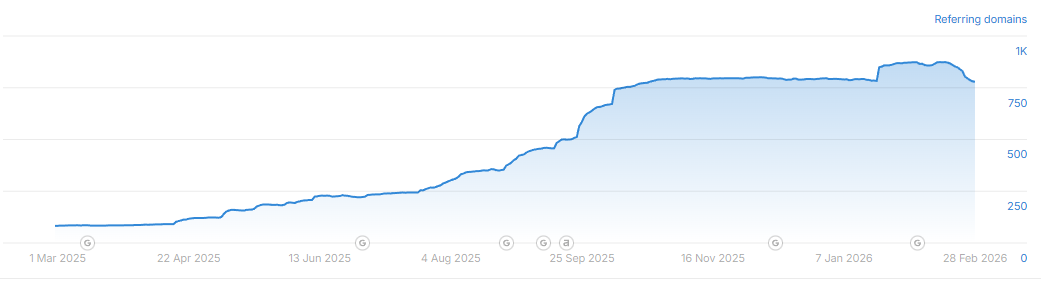
At the time of the initial audit in early July 2025, the site was not starting from zero. It had roughly 248 indexed pages, a Domain Rating (DR) of 22, and approximately 349 referring domains accumulated over about two and a half years.
However, a closer look at the backlink profile told a different story. The vast majority of those referring domains were low-quality – automated image scraper sites, spammy SEO agency links, and other sources with no real authority or relevance. Only one higher-quality contextual link was identified from a site with decent metrics and traffic.
The site’s anchor text profile was natural-looking on the surface, but included a fair number of page-title and URL anchors originating from spam sources. Several images on the site had attracted large volumes of links from scraper bots, inflating the raw referring domain count without contributing meaningful authority.
From an organic search perspective, the site had roughly 10,600 ranking keywords and an estimated 16,400 monthly organic visits at the time of the audit.
It had experienced some impact from the August 2024 Google Core Update, followed by a partial recovery after the December 2024 updates. At the point of enrollment, the site was going through another period of volatility.
The audit conclusion: despite the existing referring domain count, the site’s quality link profile was thin enough that it needed to be treated almost as a fresh build from a link building perspective. The initial focus would be on homepage authority, foundation building, and natural anchor usage before any consideration of aggressive inner-page targeting.

Strategy
As a Managed Link Building client, the strategy was continuously adjusted month-to-month based on how the site responded, rather than being locked into a static plan.
Given the gap between the site’s raw referring domain count and the actual quality of those links, the primary objective early on was to establish a foundation of legitimate, contextually relevant authority – the kind of links that would actually move the needle.
Key strategic principles included:
- Prioritizing real contextual links (guest posts and niche edits) from relevant or general-interest sites
- Starting with mid-authority placements for volume and diversity, then progressively layering in higher-authority links as the foundation solidified
- Heavy homepage targeting during the foundation phase, with selective inner-page links introduced gradually
- Conservative, natural anchor usage early on – branded, URL, and generic anchors – with more targeted descriptive anchors phased in over time
- Supplemental diversity through social signals and occasional lower-DR placements for profile naturalness
The client was also proactive on their end.
Early in the campaign, our team flagged that the site’s blog page was returning a 404 error, preventing it from being used as a link target. The client created the page within days, which opened up an additional target for authority funneling.
Later, in November 2025, the client submitted updated keyword and URL priorities reflecting new pages they had added to the site, which informed the broader inner-page targeting seen in the second half of the campaign.
Links were built consistently each month, not in bursts, with pacing designed to look organic rather than aggressive – an especially important consideration given the site’s existing spam link problem and the competitive nature of the niche.
Month-by-Month Breakdown
| Month | Link Types | DR Range | Focus | Notes |
| Jul 2025 | Guest posts, niche edits, social signals | DR 20–50 | Homepage foundation | Initial authority building; emphasis on natural and branded anchors with high volume for diversification |
| Aug 2025 | Guest posts, niche edits, social signals | DR 21–51+ | Homepage + first inner pages | Introduced first higher-authority placements; began light inner-page targeting |
| Sep 2025 | Guest posts, niche edits, social signals | DR 20–51+ | Homepage + inner pages | Mixed authority range; more targeted anchors introduced alongside natural ones |
| Oct 2025 | Guest posts, niche edits, social signals | DR 20–51+ | Homepage + inner pages | Heavy on high-authority niche edits; apparent traffic/keyword decline explained by reporting changes |
| Nov 2025 | Guest posts, niche edit | DR 10–51+ | Homepage + inner pages (incl. blog, localized pages) | All guest posts at DR 51+; expanded target URL set following client’s updated priorities |
| Dec 2025 | Guest post, niche edits | DR 36–51+ | Homepage + inner pages | Strong authority reinforcement; continued inner-page diversification |
| Jan 2026 | Guest posts, niche edit, social signals | DR 51+ | Homepage + inner pages | Exclusively high-authority placements to push maximum power |
Over the seven months of the campaign through the most recent report, approximately 49 contextual links were built (21 guest posts and 28 niche edits), supplemented by 5 social signal packages built to homepage and 4 different inner pages.
The mix shifted progressively from mid-authority volume in the early months toward predominantly DR 51+ placements in the later months as the foundation matured.
A Note on Keyword & Traffic Reporting
Before diving into results, it’s important to flag a significant external factor that affects how the numbers read.
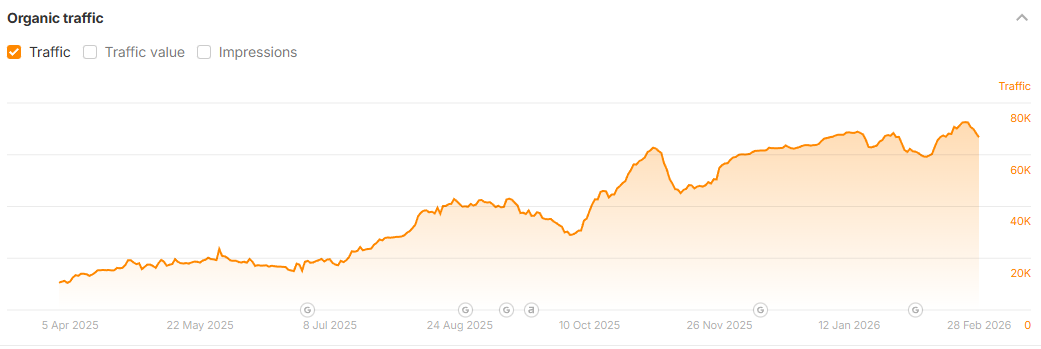
Around October 2025, Google changed a parameter that limited search engine results reporting to the top 10 results per keyword. This directly affected third-party tools like Ahrefs, which lost the ability to consistently track rankings beyond position 10. The practical result was that the site’s reported keyword count dropped sharply – from roughly 13,700 in September to 5,100 in October – even though actual ranking positions were improving across the board.
Traffic estimates from Ahrefs also dipped temporarily in October before correcting upward in subsequent months. Throughout this period, Top 3 keyword counts and real traffic trends confirmed that the site’s actual performance was not declining. The reported keyword totals in the second half of the campaign should be read with this context in mind.
Challenges & Context
Beyond the reporting anomaly, a few other factors shaped the backdrop for this campaign.
Pre-existing spam link profile. The site had accumulated a significant volume of links from automated image scraper sites and spammy SEO agency directories prior to the campaign. While Google is generally expected to ignore these, there’s ongoing debate about whether large volumes of spam links can act as a drag on performance. We flagged this in the initial audit and recommended monitoring the situation, with the option to disavow if the problem worsened.
Prior algorithm volatility. The site had been affected by the August 2024 Google Core Update, experienced a partial recovery after the December 2024 updates, and was in a period of volatility at the time of enrollment. This meant the campaign was building on a foundation that was still stabilizing from an algorithmic perspective.
Late-campaign traffic fluctuation. The most recent report (February 2026) shows a dip from ~68,100 to ~61,400 estimated organic visits. This was attributed primarily to ranking fluctuations on a few high-search-volume keywords in non-English search results – a normal pattern for a site with globally distributed traffic that doesn’t indicate a broader decline.
Results
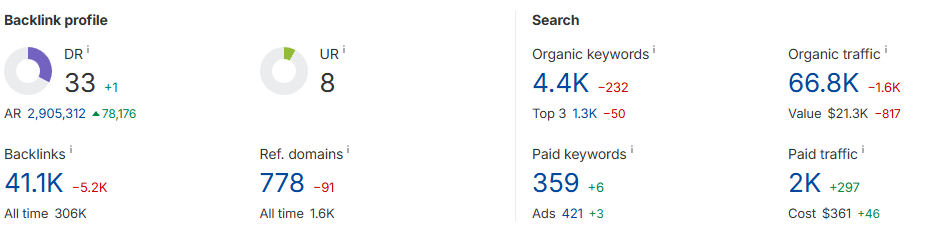
Over seven months as a managed link building client, the site showed consistent, compounding growth across its primary SEO metrics.
Performance Summary
| Metric | July 2025 (Start) | Current | Change |
| Domain Rating (DR) | 22 | 33 | +11 |
| Referring Domains | 349 | 778 | +429 |
| Organic Traffic (est.) | ~16,400/mo | ~66,800/mo | +307% |
| Peak Traffic | — | ~68,100/mo (Jan 2026) | — |
A note on referring domains: The total RD count grew by roughly 429 over this period, but the MLB campaign directly contributed approximately 49 of those through targeted contextual placements. The remainder came from organic link acquisition, image scraper activity, and other non-campaign sources. The total has also fluctuated as Ahrefs periodically deindexes spam domains, which can cause the raw count to drop between snapshots. However, the campaign links represent a disproportionate share of the quality referring domains – the placements that actually influence rankings and authority.
A note on keyword counts: Reported keyword totals dropped from ~10,600 to ~4,400 over the campaign period, but as outlined above, this is almost entirely attributable to the Ahrefs reporting change rather than actual ranking losses. The site’s Top 3 keyword count and traffic trajectory both confirm that real ranking performance improved significantly.
A note on recent volatility: The January 2026 report showed a brief dip to ~61,400 monthly visits, down from a peak of ~68,100, driven by movement on a handful of high-volume keywords in non-English search results. The most recent data shows traffic has recovered to ~66,800, confirming this was a temporary fluctuation rather than a broader downward trend.
AI Citation Growth
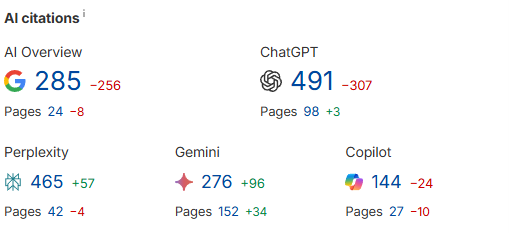
An additional signal worth noting: the site’s visibility in AI-powered search experiences grew substantially over the campaign period.
| Platform | July 2025 | Current |
| Google AI Overviews | 22 citations | 285 citations |
| ChatGPT | 0 citations | 491 citations |
| Perplexity | 1 citation | 465 citations |
| Gemini | — | 276 citations |
| Copilot | — | 144 citations |
While AI citation growth is influenced by many factors beyond link building, increased domain authority and expanded topical coverage likely contribute to a site’s likelihood of being referenced by these systems.
Anchor & Target Page Approach
How links are anchored and where they point matters as much as the links themselves.
Both were managed carefully throughout the campaign to balance authority building with risk mitigation.
Anchor Text Distribution
The anchor strategy evolved over the course of the campaign. Early months leaned heavily on branded and URL-based anchors to establish a clean, natural-looking profile on top of the site’s existing spam-heavy link history. As the foundation solidified, more topically descriptive and keyword-relevant anchors were phased in – particularly as inner-page targeting expanded in the second half of the campaign.
At a high level, the distribution across all campaign links breaks down roughly as follows:
Branded & URL Anchors ██████████████ ~35% Generic / Neutral Anchors ████████ ~20% Topical / Descriptive █████████████████ ~45%
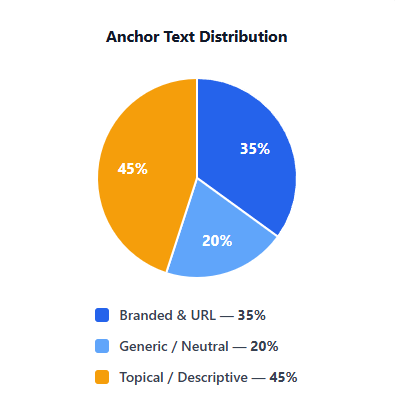
The topical/descriptive share is higher than in a typical zero-authority build because the site already had an existing branded presence and some organic visibility, which meant it could absorb more targeted anchors without appearing over-optimized.
Even so, branded and neutral anchors together still accounted for more than half of all placements, keeping the overall profile well-insulated.
Target Page Distribution
Link placement was intentionally homepage-heavy, especially in the early months when all links were directed to the root domain.
As the campaign matured and the client expanded their target URL priorities in November 2025, selective links were added to high-priority inner pages – including product category pages, the blog landing page, individual blog posts, a utility tool page, and localized versions of key pages.
Homepage ██████████████████████ ~70% Inner / Category Pages ████████████ ~30%
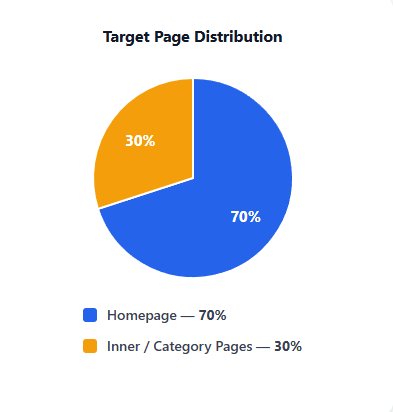
The first month was exclusively homepage-focused. From month two onward, inner-page targeting was introduced gradually and diversified as the site’s authority base grew strong enough to support it.
Why This Worked
This campaign succeeded because the strategy was calibrated to the site’s actual situation – not its surface-level metrics.
On paper, 349 referring domains suggested a site with a reasonable link profile. In practice, the quality was almost entirely absent. Rather than treating it as a site that just needed “more links,” the approach acknowledged that the foundation of legitimate authority needed to be built from scratch, even though the domain itself wasn’t new.
The progressive ramp – from mid-authority volume to high-authority precision – allowed the site to absorb new links naturally while building the kind of trust signals that compound over time. Homepage-first targeting ensured that authority was distributed across the domain before inner pages were pushed, reducing the risk of over-optimization on any single page.
The client’s responsiveness also played a role. Fixing the blog 404 when flagged, updating keyword priorities as the site evolved, and maintaining their own content and on-page SEO efforts meant that the campaign’s off-page work was being met with a site that was ready to capitalize on it.
Takeaways
- A high referring domain count doesn’t guarantee a healthy link profile – quality matters far more than quantity, and a site with hundreds of spam links may still need foundation building.
- Link building compounds over time. The strongest traffic gains appeared 4–6 months into the campaign, as earlier placements aged and newer ones layered on top.
- External reporting changes can create misleading signals. Understanding the difference between real performance and tool-level artifacts prevents unnecessary panic or strategy shifts.
- Consistency outweighs intensity. Steady monthly building at a sustainable budget produced durable growth without triggering algorithmic flags.
- Continued authority acquisition helps prevent long-term plateaus, especially in competitive niches where competitors are also building.
Conclusion
Over seven months as a Managed Link Building client, this gaming marketplace went from a DR of 22 with a thin quality link profile to a DR of 33, with organic traffic quadrupling from ~16,400 to ~66,800 monthly visits (peaking at ~68,100 in January 2026). These gains came alongside a significant increase in AI search visibility, growing from near-zero to hundreds of citations across five major AI platforms.
The growth wasn’t perfectly linear – reporting artifacts, algorithm volatility, and normal competitive fluctuations created noise along the way. But the underlying trend is clear: consistent, strategically managed authority building produced compounding returns that accelerated as the campaign matured.
The site is now in a strong position to push further, with a legitimate authority foundation that supports both traditional search rankings and emerging AI-driven discovery. Continued link acquisition at this stage helps maintain momentum and reduces the risk of plateaus as competition intensifies.