Most of the sites we take on are either brand new or carrying obvious damage. This one was neither. By the time the owner came to us in April 2025, the store had been live since 2021, was pulling a few thousand organic visits a month, and already ranked for a healthy spread of keywords. On paper, it looked like a site that had done the hard part.
Its backlink profile told a different story. Nearly everything pointing at the domain was autogenerated directory spam, scraper junk, and links from low-grade SEO networks – the kind of profile a site collects passively when no one is actively building for it. In the whole profile, we found roughly one genuine contextual link from a site with real metrics and traffic. So while the domain had age and a functioning store behind it, its off-page foundation was, for practical purposes, hollow.
What follows is the record of what we did about that over the next twelve months – a managed link building campaign for a US-based e-commerce brand in the phone and fashion accessories space, run on a $500 monthly budget, with our work focused entirely on off-page SEO while the client ran their own content and on-page efforts.
The Starting Point
When we audit a prospective client, the first question we ask is whether the existing link profile is an asset or a liability. Here, it was a liability dressed up as an asset.
On the surface, the numbers were respectable for a small store.
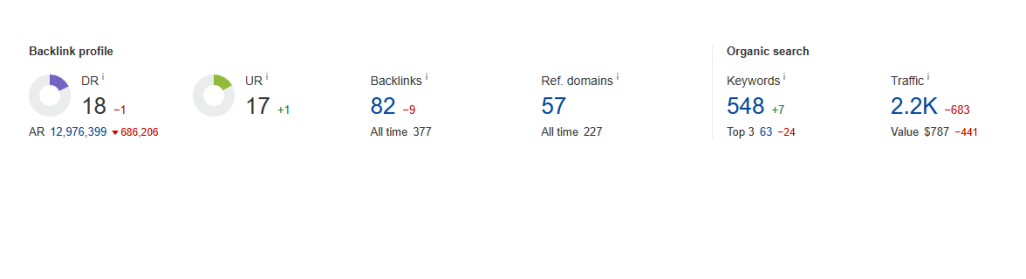
The domain carried a Domain Rating of 18, showed 57 live referring domains, and already ranked for 548 keywords – 63 of them in the top three – while pulling around 2,200 organic visits a month across 214 indexed pages.
Here is how the profile looked the month we came on board –
| Metric | At campaign start (April 2025) |
| Domain Rating | 18 |
| Referring domains | 57 |
| Backlinks | 82 |
| Organic keywords | 548 (63 in the top 3) |
| Organic traffic | 2,200 / month |
| Indexed pages | 214 |
Underneath those figures, the off-page picture was thin.
The domain had logged 227 referring domains over its lifetime but held only 57 live, and most of those were autogenerated directory lists, low-grade SEO service sites, and image scrapers – the passive sediment a site collects when nobody is building for it on purpose.
Across the entire profile, we could point to roughly one genuine contextual link from a site with real traffic and metrics.
Two things did work in the client’s favor.
The anchor spread read as natural rather than over-optimized, and equity was sensibly distributed, with the homepage holding most of it and no inner page artificially overloaded. We were not inheriting a manipulation pattern we would have to unwind first – we were building on a base that simply had very little real authority in it.
So despite the domain’s age, we treated the off-page work as if the authority foundation had to be built properly from the ground up. The near-term priority was straightforward – concentrate trust on the homepage, lead with safe and natural anchors, and start layering in real contextual links from sites that actually carry weight – the foundation this profile had never been given.
Our Strategy
A managed campaign is not a fixed package, and we did not treat this one as such. Each month began with a fresh look at how the site had moved, and the build for that cycle was set accordingly. The thread that held it all together, though, was a deliberate sequencing of authority – the right kind of link, in the right order.
In the early cycles, we leaned on low- and mid-authority placements rather than reaching straight for the strongest links available.
That is a budget decision as much as a safety one. On a $500 monthly spend, lower-cost contextual links let us build more of them, and for a profile this thin, breadth of genuine referring domains mattered more in the first few months than a handful of high-power placements. In our experience, a sparse profile benefits more from steady, believable accumulation than from a sudden injection of authority that bears no resemblance to the site’s history.
Once that base was in place, we layered in higher-authority links. From roughly the third month onward, most cycles paired a high-authority placement with a mid-authority one, so the profile kept gaining strength without ever lurching.
By the back half of the campaign, high-authority links were a routine part of the mix rather than an occasional event.
Almost the entire budget went into the two link types that move rankings – guest posts and niche edits, placed on real sites in or adjacent to the client’s space. The remainder funded supplemental diversity – a pillow-link pack early on to pad out the foundation and social signals across several later cycles for added naturalness.
On anchors, we stayed conservative by design. Branded references and the plain URL carried the early cycles, with descriptive, keyword-leaning anchors introduced only gradually as the homepage earned the trust to support them.
Targeting followed the same logic – the homepage took the large majority of links to concentrate domain-level authority first, and only once that footing was solid did we begin pointing select links at category and product pages.
The Build, Month by Month
Every cycle started with a quick read of the site’s movement, then a build shaped to fit it.
The constant was the direction of travel on authority – low and mid placements while the foundation was thin, then a steady shift toward high-authority links as the homepage earned the trust to hold them.
The table below tracks that progression across the twelve cycles.
| Month | Link types | Authority | Primary target | Notes |
| Apr 2025 | Guest posts, Niche edits, Pillow links | Low to mid | Homepage | Laying the foundation; natural anchors, maximum breadth |
| May 2025 | Guest posts, Niche edits | Low to mid | Homepage | Widening the base of real referring domains |
| Jun 2025 | Guest posts, Niche edits, Social signals | Mid and high | Homepage, inner | First high-authority placements layered in |
| Jul 2025 | Niche edits | Mid and high | Homepage, inner | Reinforcing domain-level strength |
| Aug 2025 | Guest posts | High | Homepage, inner | Concentrated high-authority push |
| Sep 2025 | Guest posts, Niche edits, Social signals | Mid and high | Homepage, inner | Holding pace through SERP volatility |
| Oct 2025 | Guest posts, Niche edits, Social signals | Mid and high | Homepage, inner | Steady layering as reporting shifted |
| Nov 2025 | Guest posts, Niche edits, Social signals | Low to high | Homepage, inner | Mixed authority for a natural spread |
| Dec 2025 | Guest posts | High | Homepage, inner | High-authority reinforcement |
| Jan 2026 | Niche edits | Low to mid | Homepage, inner | Mid-tier breadth to rebalance the profile |
| Feb 2026 | Guest posts, Niche edits, Social signals | Mid and high | Homepage | Power consolidated on the homepage |
| Mar 2026 | Guest posts, Niche edits, PBN | Mid and high | Homepage, inner | Final cycle before building paused |
When read top to bottom, the pattern is the strategy made visible.
The first two cycles are deliberately unglamorous – lower-authority links in volume, all pointed at the homepage, doing nothing more than giving the domain a believable base of genuine referring domains it had never had.
From June onward, the weight shifts, with high-authority placements becoming a regular feature and inner pages entering the mix once the homepage could spare the equity.
Across the run, the two workhorse link types – guest posts and niche edits – carried almost the entire spend, with pillow links and social signals added in select cycles purely for diversity.
The campaign ran without a single missed month from April 2025 through the final build in March 2026, at which point active building paused. What that uninterrupted year produced is the subject of the next section.
Reading the Results
A year of consistent building did what it was supposed to do. The metrics that reflect real commercial progress all moved in the right direction, and several of them moved hard.
Here is the campaign-period picture, start to finish –
| Metric | April 2025 | April 2026 | Change |
| Organic traffic | 2,200 / month | 7,200 / month | +227% |
| Top-3 rankings | 63 | 183 | +190% |
| Domain Rating | 18 | 28 | +10 |
| Referring domains (live) | 57 | 79 | +22 |
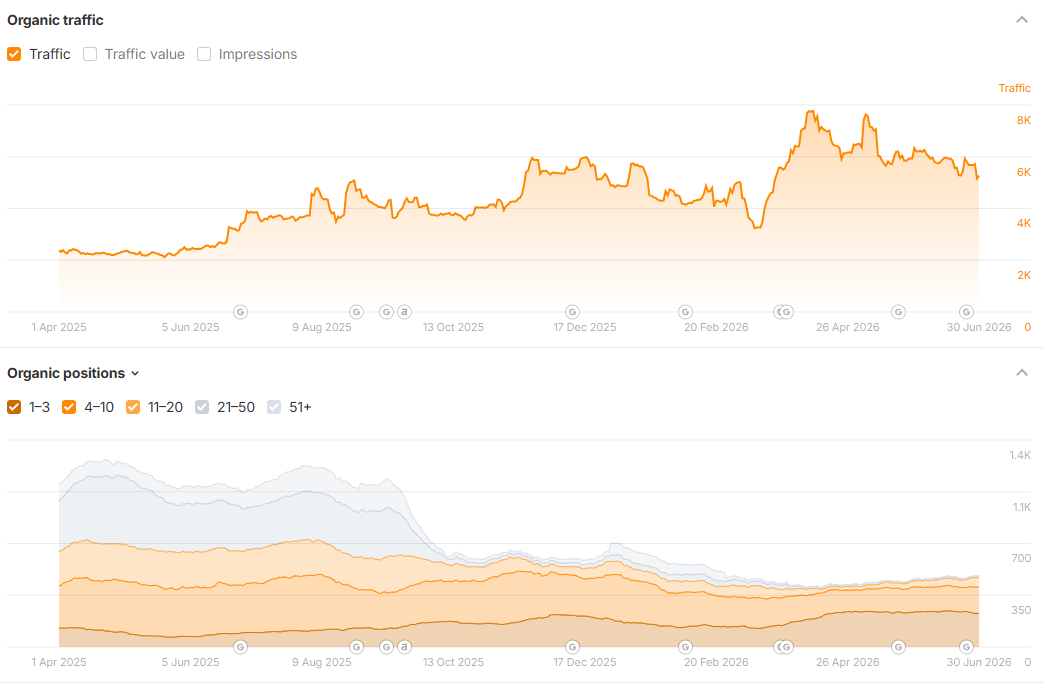
Traffic more than tripled over the twelve months. Top-three rankings nearly tripled alongside it – the metric that matters most for a store, since those positions are where the clicks and the revenue actually live.
Domain Rating climbed from 18 to 28, peaking at 30 early in the year. That is a real shift in earned authority for a profile that started with almost nothing genuine.
The referring domain count deserves a word, because the live figure understates the work. The site gained 22 net live referring domains, but that number nets out heavy churn – Ahrefs steadily dropped the autogenerated and scraper links from the old profile while we added quality ones in their place.
So the profile did not just grow – it was substantially rebuilt. Counting every link ever recorded, lifetime referring domains rose from 227 to 321 over the campaign.
A note on the keyword count
One headline metric appears to be moving in the wrong direction, and it is worth being clear about why.
Reported organic keywords fell from 548 to 326 across the campaign. That is not a loss of rankings – it is a change in what the tools can see.
In October 2025, Google began limiting search results data to the top 10 positions per keyword. Tools like Ahrefs lost the ability to consistently report rankings below that line, so any keyword sitting on page two or beyond simply stopped showing up in the count.
The proof is in the same dataset. Over the exact stretch when reported keywords “declined,” top-three rankings went up from 63 to 183, and traffic kept climbing.
The visible keyword universe shrank; the site’s actual position in it strengthened.
| Surface metric | April 2025 | April 2026 | Why it moved |
| Reported organic keywords | 548 | 326 | Google’s Oct 2025 top-10 reporting cap removed page-2-and-beyond keywords from tool visibility; not a ranking loss – top-3 rankings rose over the same period |
Volatility along the way
The climb was not a straight line, and we would not present it as one. A few stretches of turbulence are worth naming.
The Google August 2025 spam update coincided with a dip, though the larger driver looked like Google shuffling which of the client’s similar category and collection pages to rank for a given term – classic cannibalization on a store with overlapping product lines, the kind of churn that tends to settle as a domain gains authority.
Later cycles saw the same pattern flare and fade more than once. None of it broke the underlying trend; each dip recovered as building continued.
Anchor and Target Approach
How links are anchored and where they point say as much about a campaign as how many were built. For a profile this thin, both choices were made cautiously and on purpose.
Anchors
The anchor strategy stayed conservative from start to finish. Branded mentions and the plain URL formed the backbone of the profile – the safest possible signals, and the ones a real brand naturally attracts first.
A second layer used generic, non-descriptive references – neutral phrases that point at the site without forcing a keyword. These keep a profile looking organic rather than engineered.
Only a measured share of anchors carried topical or descriptive intent. We introduced these gradually, and only once the branded foundation was firmly established, so the keyword-leaning anchors arrived as a natural progression rather than an early grab for rankings.
The split across the campaign came out like this –
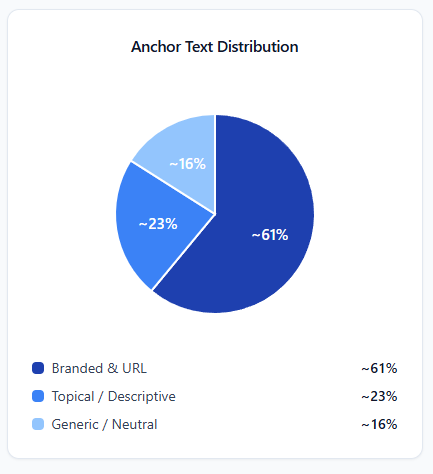
That weighting – roughly six in ten anchors branded or URL-based – is exactly what you want for a site rebuilding trust from a weak starting point. It keeps the profile defensible while still giving the commercially important pages something descriptive to rank on.
Target Pages
Link targeting followed the authority logic laid out earlier – concentrate equity at the domain level first, then distribute it.
The homepage accounted for the vast majority of links throughout the campaign. Early on, this was the entire point – build homepage trust before asking any inner page to compete.
As the foundation firmed up, we began pointing select links at category and collection pages, with a smaller share going to individual product pages and the blog. This is where commercial intent lives, so those links were spent deliberately rather than scattered.
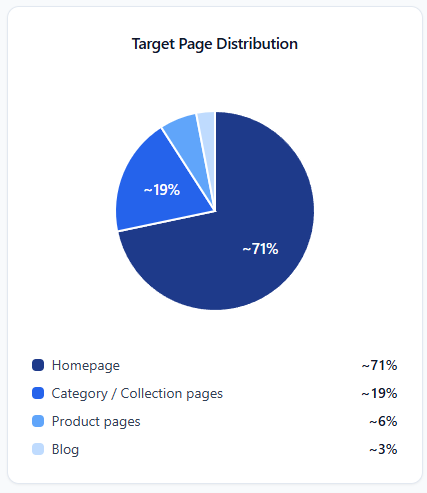
Here is how placement broke down across the twelve cycles –
The shape of that distribution is the strategy in miniature – a homepage-heavy base, with just enough inner-page targeting to start moving the pages that actually convert.
AI Visibility
Something showed up partway through this campaign that would not have appeared in a case study a year earlier – the site started getting cited by AI assistants.
When we began, the domain had no measurable presence in AI-generated answers. There was nothing to report because there was nothing there.
By late 2025, that had changed. As the site’s authority grew, it began surfacing in responses across ChatGPT, Perplexity, Gemini, and Google’s AI Overviews – the same assistants more and more shoppers now use to find products and compare brands.
We want to be careful with the numbers here, because the ground moved under them. The tools that track this are new and still changing how they measure it – Ahrefs reworked its AI index mid-campaign, adding assistants and recalculating counts – so citation totals are not cleanly comparable month to month.
What is reliable is the direction. The site went from zero AI visibility to being referenced across several major assistants during the campaign, and it still surfaces in AI responses as of mid-2026. However, as you can see, the number of AI mentions is decreasing since the end of the link-building campaign.
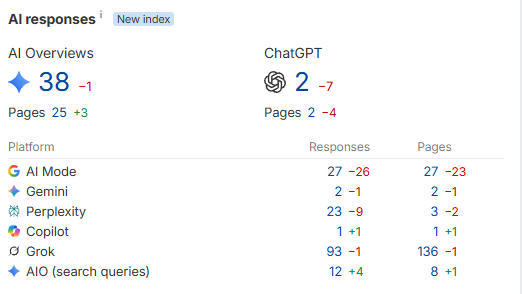
We did not run a separate playbook to make this happen. It came as a byproduct of the same work driving the traditional rankings – real contextual links from credible sites, building genuine authority.
That is worth underlining. The signals that earn trust in classic search – quality links, a clean profile, topical relevance – are largely the same ones that get a brand surfaced in AI answers. A campaign built properly for one increasingly pays off in the other.
After Building Paused
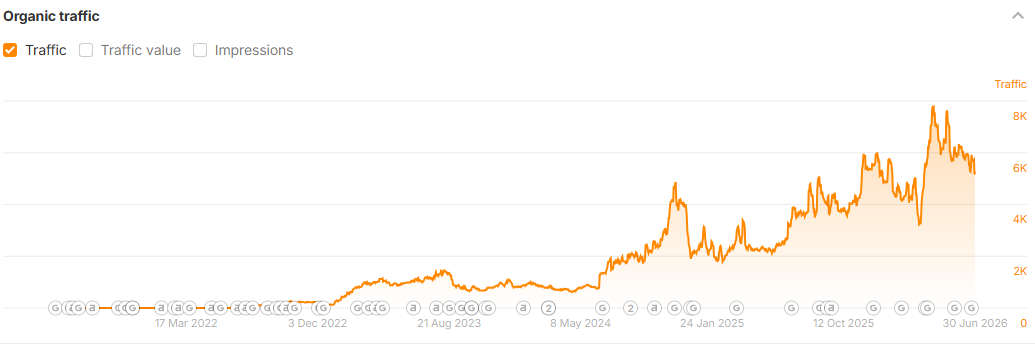
The final links went in during the March 2026 cycle, delivered in mid-April, and active building stopped there. That gives us something most case studies cannot show – what happens to a site once the active link building behind its growth switches off.
The data through June 30, 2026, tells two stories, and they pull in opposite directions.
The first is that the quality work kept paying for a stretch. Traffic actually reached its peak – close to 8,000 visits a month – in the weeks right after the last links landed, and top-three rankings nudged up further, from 183 to 194. The authority we had already earned was still working its way through.
The second story is the cautionary one, and it lives in the referring-domain count.
Live referring domains jumped from 79 at the campaign’s close to 310 by the end of June. That is not our work surfacing. We built a few links in the final cycle and only a few dozen quality contextual links across the entire year – a swing of 230-plus referring domains in roughly ten weeks is something else entirely.
With our link building switched off, the profile started doing what it did before we ever arrived – passively collecting low-grade links. The autogenerated lists and scraper sites that had defined this domain at the audit began piling back on, now that nothing was actively shaping the profile.
Domain Rating did tick up to 33 over the same window, but that figure should be read against this backdrop – a flood of new referring domains lifts DR regardless of their quality, so it is not clean evidence of earned authority on its own.
Meanwhile, the metric that actually pays the bills went the other way. Organic traffic eased from its spring peak back to roughly 5,300 by the end of June, and monthly traffic value softened in step, from about $2,600 at the campaign’s close toward $1,700.
Put the two stories together, and the lesson is hard to miss.
The gains from managed building keep compounding for a short time after it ends. But the moment active link building stops, two things happen at once – the profile begins drifting back toward the passive junk it started with, and the traffic curve loses its momentum and slides off the peak.
This is the clearest evidence we have for something we tell every client. Link building is cumulative, but it is not self-sustaining. Continued link building is not about endlessly chasing more – it is what holds a site at the level its earlier work bought, and keeps the profile from sliding back to where it began.
What Made the Difference
Strip this campaign down, and it is not complicated. A neglected profile, a modest budget, and twelve months of building the right links in the right order. The results came from discipline, not from any single clever move.
A few things mattered more than the rest.
Sequencing did real work. Leading with low- and mid-authority links to build a believable base, then layering in stronger placements once the homepage could carry them, let the profile grow in a way that looked earned rather than bought. A site rebuilding from a weak start cannot skip that order without looking unnatural.
Consistency mattered more than intensity. Twelve uninterrupted cycles, never spectacular in any single month, compounded into traffic that more than tripled. The site’s wobbles – a spam update, page cannibalization, a reporting change that masked progress – all settled as authority accumulated underneath them.
And the budget point is worth sitting with, because it reframes what this kind of work costs. At $500 a month, this store went from roughly 2,200 organic visits to 7,200 at the campaign’s peak, with monthly traffic value climbing from under $800 to around $2,600.
For an e-commerce brand, that last figure is the one that lands. Those gains were concentrated in the top three positions and on commercial pages – the rankings that put products in front of buyers, not just visitors in front of pages. Tripling that visibility on an entry-level budget is the kind of return that makes managed link building defensible to anyone holding the purse strings.
The story’s close carries its own lesson.
When building stopped, the gains held for a short while before slipping as the profile drifted back toward the passive junk it started with. In our experience, that is the rule rather than the exception – authority built properly keeps working for a time, but it is the continued building that holds a site at the level its earlier work paid for.
This site was given a real foundation, which it had never had before. Holding that ground is simply a matter of not stopping.